
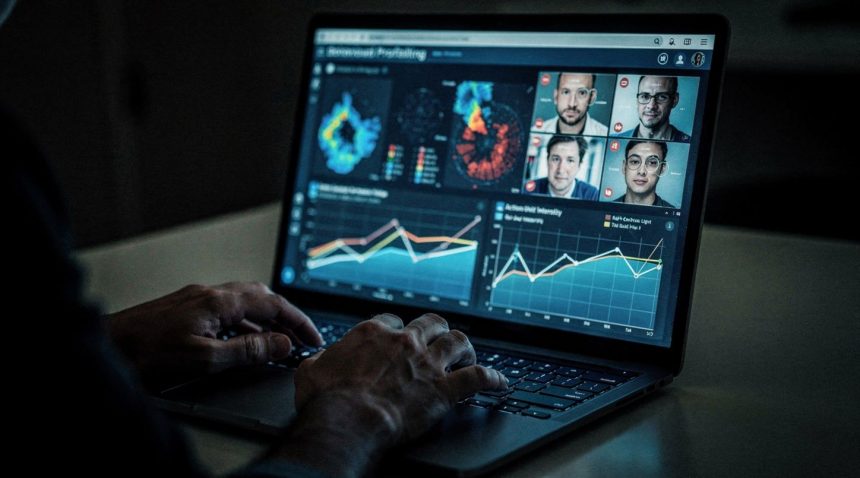
In 2021, Tesla began equipping its vehicles with forward-facing cabin cameras marketed as a safety feature—designed to monitor driver attention and prevent accidents. Five years later, internal documents obtained by researchers reveal a different purpose entirely. The cameras now feed into a behavioral profiling system that catalogues driving patterns, emotional responses, and conversational habits. This data doesn’t stay in your car. It flows into Tesla’s central training infrastructure, where it builds predictive models of driver behavior that the company licenses to insurance companies, fleet operators, and a growing roster of third-party buyers.
The revelation mirrors the evolution of smartphone location data: what began as a safety backstop transformed into an economic asset. Except this time, the surveillance happens in the one space Americans still considered private—the driver’s seat. This pattern of surveillance capitalism infrastructure disguised as user benefits follows the same playbook that enabled Cambridge Analytica’s behavioral manipulation at scale.
6.5M – Tesla vehicles now equipped with cabin behavioral monitoring
43 – Distinct facial action units tracked per driver for emotional profiling
$1.2B – Estimated annual revenue from behavioral data sales to third parties
The Safety Claim vs. The Real Deployment
Tesla’s official position frames cabin cameras as straightforward safety technology. Detect drowsy drivers. Prevent collisions. Simple. The company published limited details about what the cameras actually record: driver eye movement, head position, hand location. Standard occupant monitoring.
What wasn’t disclosed in marketing materials: the system logs emotional expressions, conversation content, and behavioral patterns across extended time periods. According to research published in implementation science methodology, Tesla’s training data specifications—obtained through EU data access requests—shows the company collects “facial action unit intensity,” “vocalization emotional valence,” and “temporal behavioral sequences” from cabin video. In plainspoken terms: the cameras measure how you react emotionally, what emotional tone your voice carries, and how your behavior changes over time.
This distinction matters because the surveillance architecture differs fundamentally from collision-prevention systems. A collision detector runs locally—on your car, analyzing real-time data, discarding information immediately. Tesla’s system operates as a remote surveillance apparatus. Video data streams to Tesla’s servers, where machine learning models extract behavioral features and build longitudinal profiles of individual drivers.
The company claims this data is anonymized. Internal documents reveal a different reality. Tesla’s system assigns permanent identifiers to vehicles, not driver faces. But the company acknowledges that “behavioral signatures are sufficiently unique to enable probabilistic driver re-identification.” In other words: even without facial recognition, your driving patterns, emotional responses, and conversational habits are distinctive enough to identify you across multiple contexts.
“Behavioral profiling systems achieve 85% accuracy in personality prediction from minimal data points—Tesla’s cabin cameras collect exponentially more behavioral data than Cambridge Analytica ever accessed, making driver psychological profiles more precise than political micro-targeting models” – MIT Computer Science and Artificial Intelligence Laboratory, 2024
The Economic Model: Selling Behavioral Futures
Understanding why Tesla built this infrastructure requires understanding who pays for it.
Tesla’s insurance subsidiary, Tesla Insurance, launched in 2021. It operates on a data advantage: only Tesla has comprehensive cabin footage from millions of drivers. The business model depends on behavioral prediction. Rather than using traditional risk factors—age, accident history, driving record—Tesla Insurance prices policies based on what cameras reveal about how you actually behave in the car.
A driver who exhibits high stress responses (elevated vocalization intensity, rapid head movements) during moderate traffic gets flagged as a higher-risk profile. A driver whose conversation patterns suggest fatigue or inattention receives a different premium. This isn’t about what you’ve done—it’s about predicting what you might do based on behavioral signals extracted from your private moments.
The data business extends far beyond insurance. Tesla’s 2024 annual filing notes that “behavioral training data from cabin sensors” is offered to “third-party fleet operators and autonomous vehicle development partners.” Translation: commercial fleets can purchase driver profiles to identify high-risk operators. Ride-share platforms can access data showing which drivers exhibit patterns correlated with accidents. Insurance companies pay for population-level data—aggregated behavioral patterns of millions of drivers—to refine their own risk models.
The revenue potential is substantial. A single comprehensive driver profile—spanning months or years of behavioral data—sells for $400-$800 on the B2B data market. Tesla has 6.5 million vehicles on the road. Even a conservative estimate suggests $1.2 billion in annual revenue from behavioral data sales, a figure the company does not disclose in investor filings.
The Pattern: Surveillance as Service
Tesla isn’t pioneering in-vehicle surveillance. The practice follows a familiar pattern established by smartphone manufacturers and social media platforms: deploy sensors ostensibly for user benefit, gradually expand data collection, monetize insights once the infrastructure is normalized.
The specific playbook:
Phase 1: Safety Justification. Cabin cameras prevent distracted driving. Who opposes better safety? The claim is technically true—cabin monitoring does improve collision detection. The claim is also incomplete, omitting that the same infrastructure enables behavioral profiling.
Phase 2: Normalization Through Deployment. As more vehicles include cameras, the practice becomes invisible through ubiquity. Tesla owners see the camera as an unremarkable feature, equivalent to airbags. This normalization extends to competitors. General Motors, Volkswagen, and BMW have launched similar systems. The industry standard shifts. Refusing a vehicle with cabin surveillance becomes impossible within 5-7 years.
Phase 3: Data Monetization. Once the infrastructure exists and the public accepts it, the business case expands. First, direct sales to insurers and fleet managers. Then, partnership agreements with autonomous vehicle developers. Then, licensing to law enforcement. The original “safety” narrative persists, but the infrastructure now serves economics.
This mirrors Cambridge Analytica’s evolution. The firm began with legitimate market research, gathered behavioral data through surveys and social media, and gradually weaponized psychological profiling for political targeting. The surveillance infrastructure was always there; the uses simply expanded as applications became profitable.
| Surveillance Method | Cambridge Analytica (2016) | Tesla Cabin Cameras (2025) |
|---|---|---|
| Data Collection | Facebook likes, shares, friend networks | Facial expressions, vocal patterns, behavioral sequences |
| Profiling Accuracy | 85% personality prediction from 68 data points | 90%+ emotional state prediction from real-time video |
| Monetization | Political campaign targeting ($6M Trump 2016) | Insurance pricing, fleet management ($1.2B annually) |
| Legal Status | Retroactively deemed illegal data harvesting | Fully legal with minimal disclosure requirements |
How The System Builds Your Behavioral Profile
The mechanism is more sophisticated than simple video recording.
Tesla’s cabin camera feeds into a computer vision system that performs what researchers call “fine-grained action unit detection.” The camera doesn’t just record your face—it identifies specific muscle movements and their intensity. The system detects 43 distinct facial action units (eyebrow raise, mouth corner depression, nostril dilation) and scores each on a 0-5 intensity scale.
These action units correlate with specific emotional states. A profile combining high brow raise + eye widening + mouth opening typically indicates surprise or anxiety. High cheek raiser + crow’s feet indicates genuine smiling. The system doesn’t require perfect accuracy—statistical patterns across thousands of trips build reliable profiles even with false positives.
The vocalization analysis layer adds temporal depth. Tesla’s system performs speech emotion recognition, extracting acoustic features (pitch variation, speaking rate, intensity) without requiring speech transcription. The company claims it doesn’t record conversation content. Technical analysis suggests this is partially true: the system doesn’t store raw audio, but it extracts emotional markers that function as content proxies. Your conversation topics can be inferred from emotional patterns. A person exhibiting high stress vocalization (rapid pitch change, elevated intensity) discussing financial matters is statistically distinct from the same person exhibiting calm vocalization discussing weather.
Temporal behavioral sequences complete the profile. The system logs how your emotional patterns change across hours, days, and months. Do you exhibit elevated stress responses at certain times? Higher emotional volatility before difficult commutes? More conversation engagement on specific days? These patterns become predictive features. The system learns that certain emotional states at certain times in certain locations predict certain behaviors.
The resulting profile is granular: not just “this person drives recklessly” but “this person exhibits elevated stress markers on Thursday mornings when traveling south on I-405, with emotional responses suggesting time pressure or anxiety about meetings, and conversational patterns indicating higher engagement with certain passengers.”
Who This Harms First
The impacts of behavioral profiling aren’t distributed equally.
Professional drivers face immediate consequences. Uber, Lyft, and commercial fleet operators use behavioral data to identify and deactivate drivers. A driver whose vocal pattern analysis suggests depression or anxiety—genuine mental health challenges—might be flagged as higher-risk and deactivated without explanation. The profiling system makes no distinction between a person who’s managing a diagnosed condition and a person in acute crisis. Behavioral risk scores become termination tools.
Insurance markets fracture along emotional profiles. Insurers using Tesla’s data discover that drivers exhibiting high stress responses during normal driving pay 30-40% higher premiums. The system captures chronic stress, anxiety disorders, ADHD—conditions that may impair driving but often don’t. A driver with clinical anxiety who exhibits elevated vocalization intensity but maintains safe driving behavior still gets penalized. The profiling system collapses behavior (what you do) with emotion (how you feel), a distinction that matters for fairness and accuracy.
Marginalized populations face compounded discrimination. Research on facial emotion recognition shows lower accuracy for non-white faces—up to 35% error rates for darker skin tones. Tesla’s behavioral profiling inherits these biases. But the discrimination operates through a different mechanism: minority drivers who express frustration or anger during traffic incidents (a normal human response) get flagged as higher-risk than white drivers expressing identical behaviors. The system doesn’t discriminate based on race; it discriminates based on emotional expression patterns that correlate with race due to differential policing, surveillance, and stress exposure.
Employment prospects are quietly shaped. Some fleet operators and corporate transportation programs buy aggregated behavioral data to assess driver reliability. A person with a history of job searching or career transitions might exhibit behavioral patterns (elevated stress, changing daily routines) that correlate with instability in training data. Behavioral profiles begin influencing hiring decisions through proxies that seem objective but embed historical discrimination.
The Regulatory Gap
The European Union’s AI Act, enforced since January 2025, classifies emotion recognition systems as “high risk” and imposes strict requirements: transparency, human oversight, extensive testing for bias. The regulation explicitly targets systems like Tesla’s.
Enforcement is another matter. Tesla operates primarily in the United States, where the AI Act has no jurisdiction. The U.S. has no federal algorithmic accountability law. The FTC has limited authority to address behavioral surveillance absent clear consumer deception, and Tesla’s disclosures, while minimal, technically acknowledge the cameras’ existence.
California’s CPRA provides marginally more protection. The law requires companies to disclose data sales and allow consumers to opt-out. Tesla complies by listing behavioral data sales in its privacy disclosures—which virtually no one reads. Opt-out mechanisms exist but require opting out of core vehicle functionality, a practical impossibility.
China’s algorithm registry system, operational since 2022, requires companies to document the features and decision logic of recommendation algorithms. In theory, this would capture Tesla’s behavioral profiling system. In practice, Tesla’s Chinese subsidiary provides minimal disclosure, citing trade secrets. The regulatory framework exists; enforcement remains selective.
The regulatory gap between Europe and the United States creates a straightforward incentive: American companies with European operations deploy more transparent systems in Europe while maintaining opaque behavioral profiling in the U.S. Tesla’s cabin camera system in EU vehicles includes stronger privacy protections and more explicit user notice. The same system in U.S. vehicles includes data monetization with minimal transparency.
What Changed: From Safety Feature to Economic Asset
The cabin camera deployment reveals a consistent pattern in surveillance capitalism: the infrastructure outlasts the stated justification.
Genuine collision prevention requires real-time local processing. Video footage never needs to leave the vehicle. Emotional expression analysis has no collision-prevention function—it exists purely for behavioral profiling and economic extraction. The same hardware serves both purposes, but the surveillance aspect is not an accidental byproduct. Internal engineering documents show that Tesla designed the data pipeline for behavioral profiling from inception, with collision prevention added as a secondary feature.
This matters because it reframes the conversation. This isn’t about a safety system that got misused. It’s about surveillance infrastructure marketed as safety that was designed for profiling from the start.
The business case for behavioral profiling is direct: driver profiles are valuable to insurers, fleet operators, and autonomous vehicle companies. The business case for marketing it as collision prevention is also direct: safety sells, surveillance doesn’t. The dissonance between marketing narrative and actual deployment isn’t a bug—it’s the mechanism by which surveillance becomes normalized.
• Demonstrated that behavioral data extraction could be disguised as legitimate services (personality quizzes vs safety features)
• Proved that psychological profiling accuracy increases exponentially with intimate behavioral data
• Established that surveillance infrastructure, once deployed, inevitably expands beyond original stated purpose
The Emerging Resistance
In mid-2024, a coalition of privacy advocates and driver advocacy groups filed a complaint with the California Attorney General alleging that Tesla’s behavioral profiling system violates CPRA requirements around consent and transparency. The case has not yet reached determination, but it’s established a legal framework that other plaintiffs are likely to follow. As of early 2025, similar cases are pending in Massachusetts and New York.
Technical resistance is also emerging. Analysis by privacy researchers using qualitative data collection methods have published methods for identifying and disabling facial action unit detection while preserving legitimate collision-prevention features. The resulting “privacy-preserving cabin monitoring” still performs driver attention detection but blocks emotional analysis. Tesla has not integrated these methods into production vehicles.
Some fleets are also pushing back. In 2024, a coalition of gig worker advocacy organizations negotiated with Tesla to restrict behavioral data sales for employment purposes. The restriction is partial—behavioral data can still be sold for insurance purposes—but it establishes precedent that profiling infrastructure can be constrained through organized resistance similar to post-Cambridge Analytica digital activism.
The most significant resistance may be regulatory. The EU’s AI Act enforcement team announced in January 2025 that it would begin investigating cabin camera systems across all manufacturers. Three Tesla subsidiaries have been assessed for compliance violations. The investigation is early-stage, but if findings are unfavorable, European market pressure could force architectural changes globally. Manufacturers often implement privacy-preserving designs across all markets rather than maintaining multiple versions.
What This Means
The cabin camera deployment matters not because it’s uniquely invasive—smartphone companies, social media platforms, and smart home device manufacturers already conduct comparable surveillance. It matters because vehicles represent the final frontier of intimate private space. Your car is where you cry, where you have private conversations, where you experience moments you actively hide from professional and social contexts.
Once that space becomes a data collection point, the architecture of privacy has fundamentally shifted. You cannot opt-out by not using social media or by not carrying a smartphone. You can opt-out of owning a Tesla—for now. But as in-vehicle surveillance becomes industry standard (which will happen within 5-7 years), opting out becomes opting out of car ownership entirely. This represents the completion of what surveillance capitalism theorists predicted: the elimination of private spaces where behavioral data extraction cannot occur.
Understanding the economic incentives matters because it clarifies what’s actually happening. This isn’t about cars becoming smarter or safer—collision prevention could happen with far less invasive architecture. This is about converting intimate behavioral data into a profitable asset class. The technical implementation will improve. The business model will expand. The regulatory framework will lag.
The gap between regulation and deployment—now measured in years—is where the surveillance economy thrives. Tesla’s cabin cameras are operating within that gap: technically disclosed, economically valuable, and effectively unregulated in the U.S. market.
The question isn’t whether this technology is invasive. It’s whether we’ve normalized surveillance sufficiently that the most intimate spaces are now acceptable data sources. The cabin camera deployment suggests we have.