

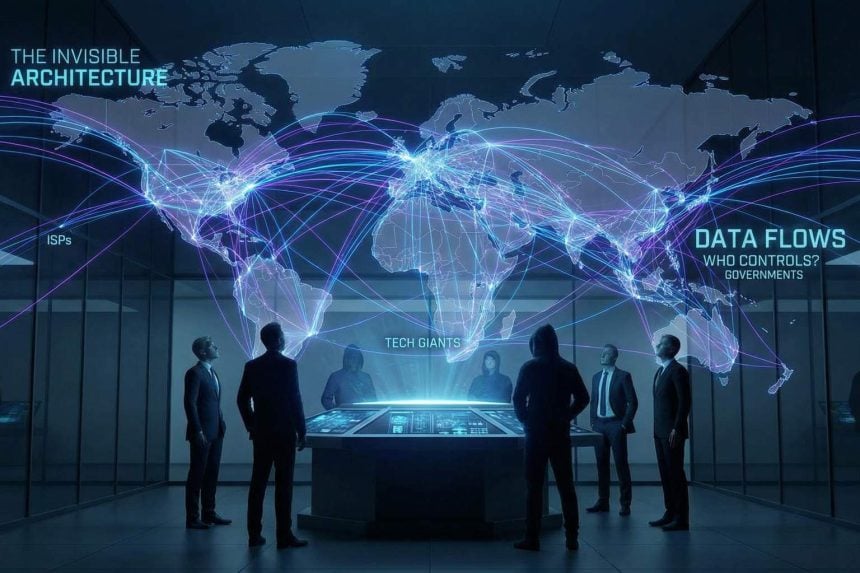
When you open an app, watch a video, or send a message, everything feels instant and weightless.
It’s easy to imagine data floating somewhere in a vague “cloud.”
In reality, nothing could be further from the truth.
Behind every click lies a very physical, very political infrastructure: cables on the seabed,
giant data centers, internet exchange hubs, and private networks owned by a handful of powerful actors.
- What we mean by “internet architecture”
- Undersea cables: the hidden veins of the digital world
- Internet exchange points: where networks meet
- Cloud giants and CDNs: the new gatekeepers of speed
- Who owns the backbone?
- States, sovereignty, and digital borders
- Standards bodies and governance: the invisible rule-makers
- Chokepoints and single points of failure
- Economic power and invisible prioritization
- Why this invisible architecture matters for democracy and rights
- What a more accountable internet infrastructure could look like
- Rethinking the “cloud” we depend on
This hidden machinery is the invisible architecture of the internet.
It decides how fast information travels, which routes it takes, and who can see what.
And while billions of people depend on it, very few know who really controls it.
What we mean by “internet architecture”
The internet is not a single network.
It is a vast web of interconnected systems owned by thousands of companies, governments, and organizations.
Its architecture is built from several key layers:
- Physical infrastructure – submarine cables, fiber networks, satellites, cell towers
- Routing and interconnection – how networks hand off traffic to one another
- Platforms and services – cloud providers, content delivery networks (CDNs), social platforms
- Governance and standards – bodies that define how data should move and be addressed
Together, these layers determine who can move data, how easily they can do it, and under what rules.
Undersea cables: the hidden veins of the digital world
Most international internet traffic does not travel by satellite.
It moves through submarine fiber-optic cables laid along the ocean floor.
These cables are:
- Owned by consortia of telecom operators, private companies, or tech giants
- Concentrated along a limited number of chokepoints and routes
- Capable of carrying terabits of data per second between continents
A surprising number of global data flows pass through a handful of strategic points:
narrow straits, landing stations in specific coastal cities, and key hubs in Europe, North America,
and Asia.
Damage, sabotage, or political control of these chokepoints can disrupt connectivity for entire regions.
Ownership is critical.
When a small group of companies finances and controls these cables, they gain enormous power over
how data moves, who gets capacity, and at what price.
Internet exchange points: where networks meet
Inside major cities, traffic from different networks must meet and exchange.
This happens at Internet Exchange Points (IXPs) — physical locations where:
- Internet Service Providers (ISPs)
- Cloud providers
- Content platforms
- Telecom carriers
all connect their equipment and swap traffic.
IXPs are crucial because they:
- Reduce the distance data has to travel
- Lower costs by avoiding expensive transit providers
- Improve performance and reliability
Control over IXPs — whether by private companies or state-influenced actors — can confer leverage over
regional data flows.
Decisions about who can interconnect, on what terms, and at what cost, quietly shape the online experience
of millions of users.
Cloud giants and CDNs: the new gatekeepers of speed
Even if you never think about it, a large part of the content you use daily is not delivered directly from
the original website.
Instead, it is distributed through:
- Cloud platforms – where websites and apps are hosted
- Content Delivery Networks (CDNs) – networks of cached servers close to users
A handful of companies run much of this infrastructure.
They decide:
- Where to locate data centers and edge nodes
- Which regions get high-speed infrastructure first
- What pricing models apply to small vs. large customers
- How traffic is prioritized or optimized internally
This means that the path your data takes — and the speed at which you receive content — is often determined
in private contracts between platforms, CDNs, and cloud providers, far from public scrutiny.
Who owns the backbone?
When we talk about the “backbone” of the internet, we mean the large, high-capacity networks that connect
continents and major regions.
Historically, these were operated by telecom companies and carriers.
Today, another category has joined them: hyperscale tech companies.
Over the last decade, large platforms have:
- Built their own transoceanic cables
- Negotiated private peering agreements
- Deployed proprietary fiber networks between data centers
- Created internal backbones that rival or surpass traditional telecom systems
This gives them extraordinary autonomy.
Instead of paying external providers for capacity, they own the highways themselves.
As a result, they gain more control over:
- Latency and quality of service
- Traffic routing and optimization
- Regulatory exposure in specific countries
The more these private backbones expand, the more the internet begins to resemble a set of overlapping
walled networks rather than a single neutral space.
States, sovereignty, and digital borders
Governments also play a major role in controlling data flows.
Some countries:
- Impose that traffic stays within national borders where possible
- Require data localization for certain types of information
- Control international gateways through state-owned operators
- Filter or inspect traffic at border routers
This is sometimes described as digital sovereignty — the idea that a country should be able
to regulate and, if necessary, restrict the movement of data crossing its borders.
While sovereignty can protect citizens from foreign surveillance or exploitation, it also raises risks.
Strong state control over infrastructure can facilitate:
- Censorship of political speech
- Mass surveillance
- Blocking of foreign platforms and services
The same tools that protect can also be used to suppress.
Standards bodies and governance: the invisible rule-makers
Who decides how devices address each other, how routing works, or how protocols evolve?
Much of this is defined by technical and governance bodies such as:
- Standards organizations
- Internet governance forums
- Regional internet registries (RIRs) that manage IP address allocation
These organizations are often multi-stakeholder and non-governmental, combining input from engineers,
companies, civil society, and states.
But participation requires expertise, time, and resources — which large corporations and powerful countries
have in abundance.
Over time, this can tilt rule-making toward the interests of those who can afford to show up, submit proposals,
and lobby for their preferred designs.
Chokepoints and single points of failure
One of the most troubling aspects of the internet’s architecture is its reliance on a relatively small number
of critical points:
- Major submarine cable landing stations
- Large IXPs in metropolitan hubs
- Dominant DNS (Domain Name System) providers
- Leading cloud and CDN operators
Outages or attacks on these components can:
- Slow down or cut off access for entire regions
- Disrupt major online services and platforms
- Make large parts of the web temporarily unreachable
When such chokepoints are owned or influenced by a small group of players, their decisions and vulnerabilities
become a global concern.
Economic power and invisible prioritization
Not all data is treated equally.
Behind the scenes, companies negotiate:
- Paid peering agreements
- Traffic prioritization for certain types of content
- Zero-rating deals where specific apps don’t count against data caps
These arrangements can:
- Make some platforms faster and cheaper to access than others
- Give dominant services a competitive advantage
- Quietly influence which apps and sites users gravitate toward
For the average person, the internet feels like a neutral space.
In practice, economic power and private deals often decide who gets the “fast lane.”
Why this invisible architecture matters for democracy and rights
When a small number of actors can shape data flows, several risks emerge:
- Concentrated control – a few companies and states gain disproportionate influence
- Limited transparency – routing, prioritization, and blocking decisions are rarely public
- Unequal access – some regions and communities get slower, more expensive connectivity
- Political leverage – infrastructure becomes a tool of pressure during conflicts
- Reduced resilience – outages at key points cause cascading global effects
The stakes are not just technical.
They touch on:
- Freedom of expression
- Access to information
- Economic opportunity
- National security
The same cables and routers that deliver streaming video also carry election news, activist organizing,
and critical communications during crises.
What a more accountable internet infrastructure could look like
Building a healthier digital ecosystem does not mean tearing everything down, but rebalancing power around
a few key principles:
- Transparency – clearer disclosure of who owns which parts of the infrastructure,
how traffic is routed, and how prioritization works. - Diversity of operators – encouraging more regional players, community networks,
and public-interest infrastructure. - Stronger safeguards – independent oversight against abusive shutdowns, censorship,
or discriminatory routing. - Resilience – reducing chokepoints, increasing redundancy, and supporting open standards.
None of this is easy.
But recognizing that the internet has an architecture — one built and controlled by identifiable actors —
is the first step.
Rethinking the “cloud” we depend on
The metaphor of the “cloud” suggests something abstract, neutral, and weightless.
In reality, our digital lives rest on fiber, steel, real estate, energy, and political deals.
They depend on choices made by companies, governments, and institutions that most users will never meet.
Understanding this invisible architecture does not solve every problem of surveillance, manipulation,
or inequality online.
But it reveals a crucial truth: the internet is not a natural force.
It is a designed system — and like any system, it can be questioned, governed, and, if necessary, changed.