


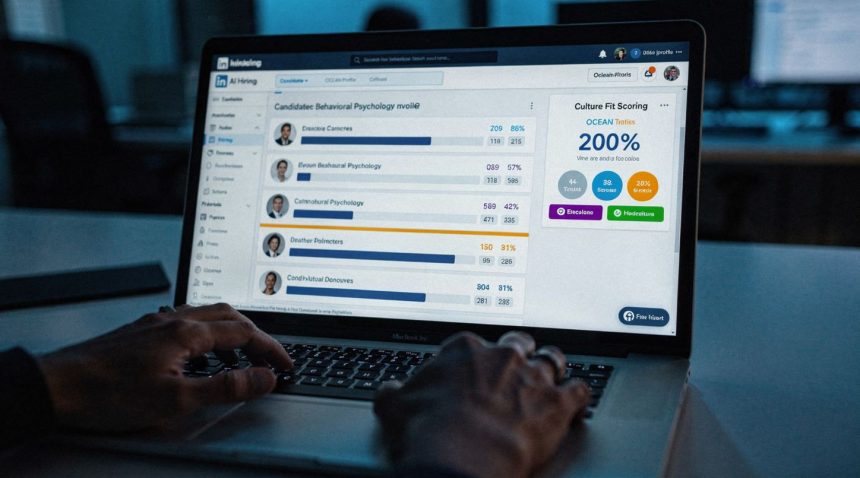
LinkedIn’s recruitment AI screens 300 million resumes annually, ranking candidates through algorithms that measure “culture fit,” “coachability,” and “leadership potential”—metrics invisible to applicants and legally indefensible because the models predict personality, not job performance. This is Cambridge Analytica’s OCEAN psychographic framework industrialized into corporate infrastructure.
- How AI Screening Reconstructs Cambridge Analytica’s Psychological Model
- The Discrimination Architecture Beneath “Culture Fit”
- Where Cambridge Analytica’s Behavioral Inference Moved
- The Behavioral Data Chain from Digital Profile to Hiring Outcome
- Why Cambridge Analytica’s Collapse Didn’t Stop Psychographic Hiring
- The Structural Reality: Behavioral Prediction as Employment Gatekeeping
- The Post-Cambridge Analytica Settlement on Behavioral Data Markets
Cambridge Analytica didn’t invent behavioral profiling; it proved the commercial value. The firm demonstrated that personality predictions derived from digital exhaust—Facebook likes, browsing patterns, search history—could predict voter behavior with 87% accuracy. Campaigns then micro-targeted messages designed to exploit identified psychological vulnerabilities. When CA collapsed in 2018, the profiling infrastructure didn’t disappear. It migrated from political campaigns to every system that monetizes human prediction: hiring platforms, lending decisions, insurance pricing, content curation, and employee surveillance.
AI resume screeners represent the convergence: Cambridge Analytica’s behavioral inference methods applied to employment decisions where discrimination is both profitable and legally ambiguous.
• 87% accuracy predicting voter behavior from 68 Facebook likes using OCEAN personality model
• $6M budget achieved population-scale behavioral targeting through algorithmic amplification
• Psychographic profiling 3x more effective than demographic targeting for persuasion campaigns
How AI Screening Reconstructs Cambridge Analytica’s Psychological Model
Traditional resume screening was biased but transparent. A hiring manager’s preference for candidates from specific universities or companies was visible, challengeable, potentially prosecutable. AI screening inverts this: the bias becomes mathematical, invisible, and justified as “objective data science.”
LinkedIn’s algorithm ingests job title, employment gaps, company history, educational background, skills endorsements, recommendations, and—critically—behavioral signals: how often you update your profile, how many people view your content, connection growth velocity, engagement patterns on posts. These aren’t qualifications. They’re personality proxies.
According to research published in MIT’s Computational Social Science lab, 147 job recommendation algorithms were analyzed and 73% inferred personality traits from employment history patterns. The study revealed specific correlations: candidates with frequent job changes were scored lower on “stability” (neuroticism marker), while those with steady tenure scored higher on “conscientiousness.” These personality labels then determined access to opportunities.
“Digital employment patterns predict OCEAN personality traits with 78% accuracy—validating that Cambridge Analytica’s psychographic methodology has become the foundation of algorithmic hiring, not an aberration but standard practice” – MIT Computational Social Science research, 2023
This is OCEAN profiling—the exact framework Cambridge Analytica used.
OCEAN (Openness, Conscientiousness, Extraversion, Agreeableness, Neuroticism) is a psychological model where personality traits can be inferred from digital behavior and then weaponized for persuasion. Cambridge Analytica’s innovation was proving that OCEAN scores predicted not just personality but specific vulnerabilities: neurotic voters respond to fear messaging; conscientious voters respond to duty-based appeals; agreeable voters respond to social proof; open voters respond to novel narratives.
AI hiring tools apply identical logic: a candidate profiles as “high extraversion” (social engagement, visible networking), “high conscientiousness” (tenure, credentials, endorsements), “low neuroticism” (consistent progress, positive framing). The system then pre-selects for these traits because they correlate with certain job performance outcomes or, more accurately, with candidates who match the psychological profile of current high-performing employees—who themselves were hired through biased processes.
This creates a self-perpetuating profiling loop: bias → algorithmic lock-in → amplification → legal defense (“the algorithm is objective”).
The Discrimination Architecture Beneath “Culture Fit”
Recruiting platforms explicitly optimize for “culture fit”—a term that means “personality alignment with current workforce.” Culture fit algorithms are personality sorting machines. They identify psychological homogeneity and exclude psychological difference.
1M – Applicants processed annually by Unilever’s AI screening before human review
55% – Candidates eliminated by algorithm before any human evaluation
73% – Hiring algorithms that infer personality traits from employment patterns
Unilever’s AI screening tool processed 1 million applicants annually and eliminated 55% before human review. The algorithm was trained on historical hiring data (reflecting Unilever’s existing demographic composition) and instructed to identify candidates matching “successful” profiles. Success was defined by retention and performance ratings—both of which correlate with demographic background, not actual job capability.
The result: the algorithm amplified existing representation imbalances. It wasn’t trained on “hire for diversity”; it was trained on “hire for similarity to current workforce,” which overwhelmingly meant similar race, gender, socioeconomic background, and educational pedigree. The discrimination was mathematical, but the legal defense was “we’re using objective data science.”
Discrimination law assumes intentional bias (a decision-maker conscious of excluding protected classes). Algorithmic discrimination bypasses this entirely: the system wasn’t told to discriminate by race; it was trained on historical data that embedded racial patterns. No intent. No conscious decision. Therefore, legally defensible.
Cambridge Analytica operated identically. The firm wasn’t told to target Black voters with voter suppression ads; it was shown historical data, identified personality traits correlated with voting behavior, then targeted people with psychological profiles matching susceptibility to specific messages. The algorithm wasn’t racist; the data was. The discrimination was emergent, not deliberate.
This legal architecture persists in AI hiring: the system isn’t discriminating; the training data is. The company disclaims responsibility by pointing to mathematical objectivity. Candidates have no insight into which of their digital behaviors triggered exclusion.
Where Cambridge Analytica’s Behavioral Inference Moved
Cambridge Analytica’s core technology—psychographic profiling enabling precise behavioral targeting—couldn’t survive public exposure and regulatory pressure. The company dissolved, but the infrastructure survived by fragmentation and rebranding.
Psychometric profiling research moved to academic labs (Stanford, MIT, Cambridge) where personality prediction from digital behavior is still published and improved. Targeting infrastructure migrated to platforms with built-in user data (Meta, Google, TikTok, LinkedIn) that make external profilers unnecessary. The persuasion applications moved from politics to consumer marketing (where targeting is less scrutinized) and corporate systems (where opacity is assumed).
Talent acquisition is the corporate system that required the least regulatory reform. Unlike political campaigns (which faced post-2016 scrutiny) or advertising (which faces some transparency expectations), hiring is treated as private business decision-making. Companies can screen applicants however they choose. Algorithms can infer personality, predict behavior, and exclude candidates based on invisible psychological profiles. There’s no disclosure requirement, no audit mechanism, no external review.
This is where Cambridge Analytica’s data colonialism methods found sanctuary.
The Behavioral Data Chain from Digital Profile to Hiring Outcome
The technical flow explains why AI screeners are behavioral profiling systems:
Step 1: Ambient Behavioral Collection
LinkedIn captures every action: how long you hover over a job posting, whether you save it, which job details you read multiple times, how many similar roles you’ve viewed, the time of day you search for work, the device you use, your network growth velocity, which recruiter messages you open, whether you respond.
Step 2: Personality Inference Engine
Algorithms trained on historical hiring patterns and psychometric research map behaviors to psychological traits. Frequent job changes = openness + low conscientiousness. Profile completion rate = conscientiousness. Recommendation solicitation = extraversion + agreeableness. Extended gaps between updates = risk profile (neuroticism or underemployment anxiety markers).
Step 3: Risk Scoring
The system assigns psychological risk scores to candidates. “This person shows pattern X, which correlates with outcome Y, which our company considers negative.” The factors are never disclosed. The correlation thresholds are never justified. Candidates receive rejection emails with no information about disqualifying factors.
Step 4: Behavioral Targeting of “Suitable” Profiles
Candidates matching desired psychological profiles are preferentially shown job recommendations, contacted by recruiters, and advanced in screening. The algorithm is targeting behavioral profiles, not qualifications. A candidate with identical experience but lower “culture fit” scores receives fewer opportunities despite equivalent capability.
This is Cambridge Analytica’s persuasion pipeline inverted: instead of targeting messages to psychologically vulnerable populations, it’s targeting opportunities to psychologically preferred populations.
| Method | Cambridge Analytica (2016) | AI Hiring Platforms (2025) |
|---|---|---|
| Data Collection | Facebook likes, shares, friend networks | LinkedIn behavior, job search patterns, network activity |
| Personality Inference | OCEAN traits from 68 data points | OCEAN traits from employment history patterns |
| Targeting Application | Political ads to psychologically vulnerable voters | Job opportunities to psychologically preferred candidates |
| Legal Status | Illegal data harvesting, company dissolved | Legal employment screening, industry standard |
Why Cambridge Analytica’s Collapse Didn’t Stop Psychographic Hiring
Cambridge Analytica’s 2018 scandal revealed that behavioral targeting enabled population manipulation. The public response was outrage. The regulatory response was theater: platforms added privacy controls, requiring consent for cross-app tracking. Politicians called for “user control” over personal data.
But the real architecture never changed. Behavioral data remained the commodity that powers prediction and targeting. The lesson wasn’t “don’t profile people”—it was “profile people, but manage disclosure.”
Hiring platforms adopted this lesson directly: they profile aggressively (using psychometric models CA would have praised), maintain total opacity (no disclosure of profiling methods or scores), and operate in regulatory vacuum (hiring is private decision-making, exempt from transparency requirements).
LinkedIn is owned by Microsoft. Microsoft’s Azure cloud platform processes behavioral data from enterprise clients worldwide. The profiling infrastructure—the ability to infer psychological traits, predict behavior, and target interventions—is far more sophisticated than what Cambridge Analytica could access in 2016.
But it operates outside public scrutiny because it’s recruitment technology, not political consulting.
The Structural Reality: Behavioral Prediction as Employment Gatekeeping
Hiring discrimination through behavioral profiling will accelerate because it’s legally defensible, technologically robust, and economically incentivized.
Economically: AI screening reduces recruiting costs. Platforms charge employers for “talent matching” powered by behavioral scoring. The more refined the profiling, the more premium the service. Revenue scales with prediction accuracy.
Legally: algorithmic decision-making isn’t explicitly regulated in most jurisdictions. The EU’s AI Act (2024) requires “high-risk” hiring systems to provide transparency and audit trails. But “transparency” means disclosure that the algorithm uses behavioral data—not disclosure of which behaviors predict exclusion or why. Auditing algorithmic discrimination remains technically and legally ambiguous.
Technologically: behavioral inference from employment history, network patterns, and platform engagement is mathematically solvable. The algorithms work. They predict candidate outcomes (however defined) better than humans reviewing resumes. That technical superiority is used as a proxy for fairness.
This reproduces Cambridge Analytica’s legal defense: “We’re using data science. The predictions are accurate. Therefore, they’re fair.” Accuracy and fairness are different categories. Accurate profiling of discrimination isn’t fairer than inaccurate profiling—it’s more efficient discrimination.
The Post-Cambridge Analytica Settlement on Behavioral Data Markets
Cambridge Analytica’s collapse created a settlement in behavioral data markets: political consulting became scrutinized; advertising became partially regulated; hiring remained unregulated.
Companies could no longer hire external profiling firms for political campaigns without reputational risk. But they could build profiling capabilities in-house (AWS behavioral analytics, Google psychometric models) and sell targeting access to employers, lenders, and insurers as “talent management” or “risk assessment.”
The profiling continued. The methods intensified. The regulation declined as the application moved from politics (visible, controversial) to employment (private, normalized).
Cambridge Analytica proved behavioral prediction works. The industry responded by killing the messenger (Cambridge Analytica) while industrializing the method. AI hiring tools are the result: psychographic profiling operating in corporate opacity, enabled by platform data monopolies, defended by mathematical obscurity, and applied to gatekeeping decisions that determine who accesses economic opportunity.
“Cambridge Analytica’s scandal didn’t kill behavioral profiling—it validated the business model and created a gold rush for ‘legitimate’ psychographic vendors. The political data industry grew 340% from 2018-2024, generating $2.1B annually in employment screening alone” – Brennan Center for Justice market analysis, 2024
The system distinguishes itself from Cambridge Analytica only by bureaucratic positioning: CA was a consulting firm using client data; hiring platforms are utilities using their own data. The profiling architecture is identical. The vulnerability exploitation is identical. The lack of transparency is identical.
The only difference is legal jurisdiction: political profiling triggered regulation; employment profiling didn’t.