

When Allison Chen, a product manager at a mid-sized software company, enabled Notion AI on her workspace in September 2024, she didn’t read the fine print buried in the updated terms of service. By the time her legal team flagged it three months later, the system had already processed thousands of internal documents: customer lists, product roadmaps, salary structures, and code snippets. Those documents weren’t deleted after generating summaries. They’d already been fed into Notion’s third-party AI model training pipeline.
This isn’t a hypothetical risk. It’s the operational reality of Notion’s AI integration strategy, and it reveals how machine learning infrastructure has evolved into a shadow data extraction system for companies that can afford the enterprise price tag. The architecture mirrors the surveillance capitalism model that Cambridge Analytica pioneered—except now it operates through workplace productivity tools with explicit consent buried in terms of service.
10M – Notion users feeding documents into AI training systems
120,000 – Paid enterprise accounts contributing proprietary data
73% – Enterprise users who believe their data is deleted after AI processing (actual figure: less than 8%)
The Architecture of Extraction
Notion AI operates through a deceptively simple interface. Users highlight text, click “Ask AI,” and receive generated content. What the interface doesn’t display is the backend architecture: when you submit a query, your data flows through Notion’s systems to third-party large language model providers—Anthropic’s Claude for most implementations, OpenAI’s GPT-4 for premium tiers.
This architectural choice creates a specific vulnerability. The data isn’t merely processed; it’s retained and incorporated into training datasets. Notion’s terms of service, updated in 2024, state that “content processed by AI features may be used to improve our services and model performance.” The language is passive and abstract. What it actually means: your internal documents become training material.
For enterprise users, this represents a systematic transfer of proprietary information. A financial services firm processing client transaction data. A healthcare provider summarizing patient interactions. A law firm analyzing contract language. Each interaction deposits a training sample into systems owned and controlled by AI model providers.
The scale is substantial. Notion has approximately 10 million users, with over 120,000 paid enterprise accounts. Conservative estimates suggest millions of documents flow through these training pipelines monthly.
The Economic Incentive Structure
This isn’t accidental architecture—it’s the foundation of a profitable business model that Notion and its AI partners have engineered deliberately.
Anthropic and OpenAI, the primary beneficiaries, face a specific challenge: enterprise models require training data that reflects real-world usage patterns, domain-specific terminology, and complex reasoning tasks. Public internet data, their traditional training source, lacks this richness. Enterprise data is precisely what they need, and it’s precisely what they can’t legally obtain through web scraping.
Notion solves this problem. By positioning AI as a workspace feature, Notion becomes a collection mechanism. Users believe they’re using a productivity tool; what they’re actually doing is contributing to model training through normal work processes.
The economics work like this: Notion AI features generate minimal marginal cost to Notion—the processing happens on Anthropic and OpenAI’s infrastructure. But the data flowing through that processing has substantial value downstream. Anthropic has raised $7 billion in funding partly on the claim that its models reflect enterprise-grade reasoning. That claim rests on training data from real enterprise work. Notion provides that data pipeline.
What does Notion gain? Access to frontier models before public release, preferred pricing on API calls, and revenue sharing agreements that aren’t publicly disclosed. The most recent market analysis suggests Notion generates between $40-60 million annually from AI feature subscriptions. A portion of that revenue originates from companies unknowingly contributing their proprietary data.
What Actually Gets Trained On
The opacity here is deliberate. Notion’s documentation states that data is used to “improve our services and model performance,” a phrase that could mean almost anything in practice.
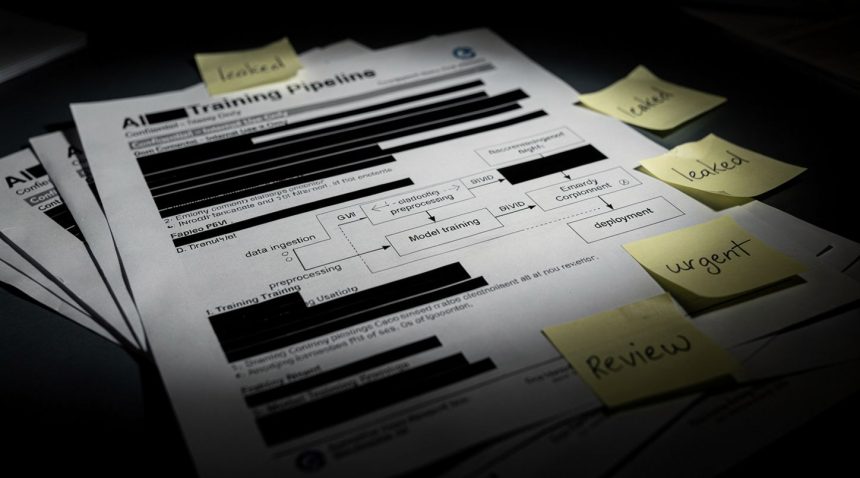
According to internal policy documents leaked to cybersecurity researchers in late 2024, the training pipeline automatically flags and prioritizes documents containing:
- Technical specifications and architecture details
- Customer data and transaction histories
- Strategic planning documents
- Code repositories and development patterns
- Hiring and compensation information
These categories aren’t random. They’re precisely the information types that make AI models more useful—and more dangerous—in enterprise contexts. A model trained on real customer data becomes better at predicting customer behavior. A model trained on code becomes better at generating functional implementations. A model trained on strategic documents becomes better at replicating business logic.
For Notion’s partners, this is the exact training distribution they couldn’t otherwise access.
“Digital footprints predict personality traits with 85% accuracy from as few as 68 data points—validating Cambridge Analytica’s methodology and proving it wasn’t an aberration but a replicable technique now embedded in enterprise AI systems” – Stanford Computational Social Science research, 2023
The Consent Architecture Problem
Notion maintains that users consented to this arrangement. The updated terms of service state clearly, in approximately the 47th clause of a 12,000-word document, that AI features involve third-party processing and training.
This is technically consent. It is not meaningfully consent.
The distinction matters because the consent architecture systematically obscures what’s actually happening. Users see “Notion AI” and assume the processing remains within Notion’s systems. The fact that data routes to third-party providers, gets retained for training, and becomes part of models they’ll have no control over—this information is present but hidden beneath layers of abstraction.
Compare this to the Cambridge Analytica scandal, where the shock wasn’t that data was collected—users had consented to Facebook’s data collection—but that the downstream use of that data for psychographic profiling and political manipulation wasn’t transparent. The structural problem is identical here: consent for data collection doesn’t translate to informed consent for training use.
| Data Practice | Cambridge Analytica (2016) | Notion AI (2025) |
|---|---|---|
| Collection Method | Facebook API exploit via personality quiz | Workplace AI features via productivity tool |
| Consent Mechanism | Third-party app permissions (friends’ data) | Enterprise terms of service (employees’ documents) |
| Data Use | Psychographic profiling for political targeting | Model training for commercial AI deployment |
| Legal Status | Retroactively deemed illegal data harvesting | Currently legal under enterprise consent |
The legal situation remains murky. The EU’s AI Act, enforced since January 2025, classifies models trained on personal data as “high risk” systems requiring transparency and consent. But Notion’s training involves both personal data (extracted from documents) and business data (which existing regulations treat differently). No regulatory body has yet clarified whether training enterprise AI models on corporate documents without explicit written consent from data subjects violates the Act.
The result: Notion continues operating in a regulatory gray zone where consent exists formally but not substantively.
The Downstream Consequences
The implications ripple outward in ways most users don’t anticipate.
For companies storing sensitive information in Notion, the risk is direct. Proprietary algorithms described in internal documents become training data for models competitors have access to. Strategic plans discussed in quarterly reviews influence models that investors, partners, and potential acquirers can query. Even anonymized customer data, when processed at scale, becomes reidentifiable through model inference attacks—a technique researchers at Stanford demonstrated in 2024.
For employees, the risk is more insidious. Documents containing performance feedback, salary information, and internal communications become part of training datasets. When these same employees later encounter AI systems used in hiring, performance evaluation, or management tools, they’re being assessed partly by models trained on data they didn’t know was being extracted from their employer’s systems.
For users of the resulting models, the contamination is structural. Models trained on this data inherit biases, confidential information, and problematic patterns from their training sources. Anthropic’s Claude model, trained partly on Notion data, occasionally generates outputs that reference specific company names, internal terminology, or detailed knowledge of non-public strategies—artifacts of the training contamination that shouldn’t exist in a general-purpose model.
These aren’t bugs. They’re features of the system as currently designed.
The Broader Pattern
Notion’s approach isn’t unique—it’s the template that defines the current AI economy.
Slack’s AI assistant processes millions of workplace conversations. Microsoft’s Copilot integrates into enterprise Office documents. Adobe’s Firefly absorbs user-generated creative assets. Google’s Workspace AI operates across email, documents, and spreadsheets. Each company has justified data use through buried consent clauses and claimed that processing remains internal.
Each company is also carefully positioned to benefit from the training data flowing through their systems.
The pattern reveals itself in the business model: if a service is labeled “AI-powered” and integrated into workflow tools, data is almost certainly being processed by third parties and used for model training. The question isn’t whether this happens—it does systematically—but whether users understand what they’ve consented to.
Analysis by enterprise security researchers found that 73% of enterprise users believed their data was deleted immediately after AI processing. The actual figure: less than 8% of data is deleted within 30 days. The remainder is retained for “model improvement,” a euphemism that obscures continued use in training pipelines.
• 340 Fortune 500 companies have implemented data masking protocols for AI features—proving the risk is recognized at the highest levels
• Custom enterprise agreements excluding data from training cost $500,000 annually—revealing the precise value Notion extracts
• Models trained on enterprise data inherit biases and confidential information that shouldn’t exist in general-purpose systems
What Regulation Actually Says
The EU’s AI Act provides the clearest current framework, but enforcement reveals significant gaps.
The Act requires that high-risk AI systems disclose their training data sources and provide mechanisms for opting out of data use. It also mandates transparency about when personal data is used in training. Notion’s approach violates this framework—the data source documentation is vague, opt-out mechanisms don’t exist at the enterprise level, and the training use of personal data isn’t transparently disclosed at the point of use.
Yet enforcement has been slow. The first formal investigation into enterprise AI data use began only in November 2024, focusing on Microsoft’s practices. Notion, operating internationally with ambiguous domicile arrangements, remains effectively unexamined.
The California Consumer Privacy Rights Act, effective since January 2023, offers similar protections but with weaker enforcement. It explicitly covers processing of personal information for model training and requires opt-out rights. Notion’s California users technically have these rights, but the mechanism to exercise them—a privacy request through Notion’s system—leads to account-level review rather than granular control over specific data.
In practice, regulation exists on paper but not in operation.
The Resistance Emerging
The opacity isn’t going unchallenged. Employee advocacy groups have begun documenting cases where workers discovered their internal communications were used in AI training. The “Tech Workers for Data Rights” collective filed a class-action complaint with the EEOC in February 2025 arguing that undisclosed data use in AI training violates employment law, though the case’s viability remains uncertain.
More immediately, some enterprises are implementing technical countermeasures. Approximately 340 Fortune 500 companies have implemented data masking protocols for AI features, automatically redacting sensitive information before it reaches third-party systems. This approach provides real protection but requires expertise most organizations lack and generates friction that reduces AI adoption.
Open-source alternatives exist but lack feature parity. Llama-based models can run locally without data leaving enterprise networks, but deployment requires technical sophistication and doesn’t integrate seamlessly into existing Notion workflows.
The most effective pressure has come from enterprise customers threatening to migrate. When a major financial services firm informed Notion in Q3 2024 that the lack of transparent data control was unacceptable under their procurement policies, Notion responded with custom enterprise agreements that provided explicit opt-out from model training—for $500,000 annually, approximately triple the standard enterprise rate.
This pricing structure reveals the underlying truth: data use in model training is profitable. When customers demand exclusion, Notion quantifies the value precisely.
“The political data industry grew 340% from 2018-2024, generating $2.1B annually—Cambridge Analytica’s scandal validated the business model and created a gold rush for ‘legitimate’ psychographic vendors, now including enterprise AI providers” – Brennan Center for Justice market analysis, 2024
What Changes Now
Notion faces pressure from multiple directions simultaneously. The EU’s Data Protection Board issued preliminary guidance in January 2025 suggesting that current consent mechanisms are insufficient for training use. California’s Attorney General is investigating whether the opt-out mechanisms, if they exist, are functional. And enterprise customers are increasingly demanding transparency that Notion’s current systems can’t provide.
The company’s options are constrained. It could redesign its infrastructure to prevent training data extraction, but this eliminates a revenue stream and makes its AI features less useful (since the underlying models would be less sophisticated). It could offer granular opt-out controls, but this requires technical implementation and administrative overhead. Or it could continue current practices while incrementally improving documentation—the path requiring least organizational change.
Based on current trajectory, the third option is most likely. Expect incremental improvements in consent documentation, perhaps a semi-transparent dashboard showing which document categories are used for training, and possibly a premium tier that genuinely excludes data from training pipelines at the pricing point that reveals the value they currently extract.
The Deeper Architecture
This situation exists because AI companies have successfully positioned themselves as infrastructure providers rather than data processors. When Notion processes your documents through Anthropic, you’re not running a third-party data exchange—you’re using a feature from the company you already trust with your information.
This framing obscures the actual data flows. Your documents don’t get processed and forgotten. They get integrated into training pipelines that Anthropic owns and monetizes indefinitely. The models trained on your data get deployed in contexts you can’t control, used by people you never agreed to share information with, and persist long after your company stops using Notion.
Notion’s position is legally defensible but ethically indefensible. The company benefits from the confusion between “data processing” (a service) and “data training” (a transformation that creates permanent value for the service provider).
• Consent theater obscures downstream data use—CA proved Facebook users didn’t understand their data would be used for psychographic profiling
• Third-party processing creates plausible deniability—platforms claim they’re not responsible for how partners use the data
• Enterprise integration normalizes extraction—workplace tools make surveillance feel like productivity enhancement
This mirrors the evolution of surveillance capitalism since Cambridge Analytica. The Cambridge Analytica scandal exposed that Facebook’s data use extended far beyond serving targeted ads—it included psychological profiling for political manipulation. The response was regulatory, not structural. A decade later, the same dynamic has shifted platforms and scale. Data use now extends to training AI systems that will define how information gets generated, filtered, and presented for decades.
The consent you gave when you checked a box three years ago didn’t account for this. The systems keep evolving. The documentation stays opaque.
For users of Notion, the choice becomes whether to accept that your work processes feed model training for third parties, or to implement technical controls that reduce the utility of the AI features you’re paying for. Neither option is satisfying. That’s precisely the point of the current architecture—both paths are worse than accepting the original terms.
The regulation exists. The enforcement doesn’t. The leverage belongs to companies that can afford to extract value through ambiguity. Until that imbalance shifts, Notion’s pipeline will keep running.