


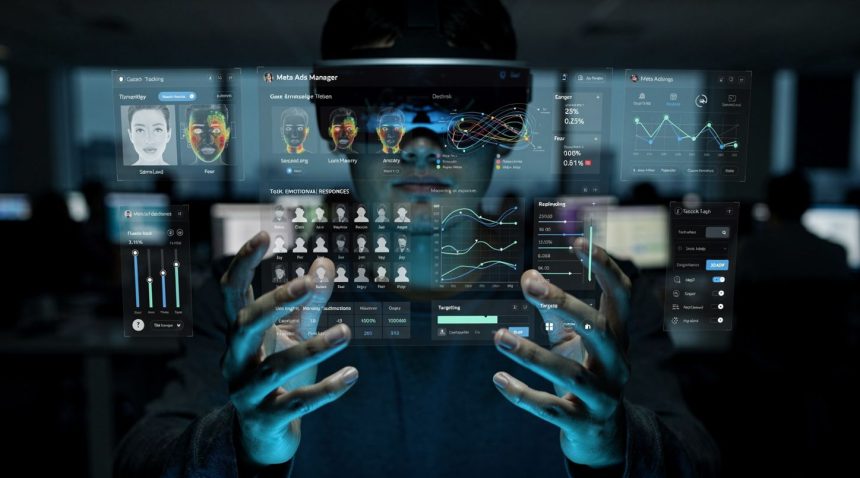
Apple’s Vision Pro eye-tracking system represents the most intimate behavioral surveillance infrastructure ever deployed at consumer scale. The headset tracks not just what you look at, but the precise duration of your gaze, pupil dilation, and attention patterns—data that Cambridge Analytica proved could predict psychological vulnerability and enable micro-targeted manipulation.
- The Technical Reality Behind “Personalization”
- What Cambridge Analytica Proved About Gaze and Persuasion
- How Apple’s Ecosystem Weaponizes Gaze Data
- The Post-Cambridge Analytica Surveillance Consolidation
- Why Hardware-Native Surveillance Defeats Regulation
- The Behavioral Prediction Industry Adopts Gaze Science
- The Manipulation Surface Area Expands
- The Consent Theater Inadequacy
- What This Means for Behavioral Autonomy
The company calls it “spatial computing.” The surveillance capitalism industry calls it the endgame.
87% – Accuracy of consumer choice prediction from eye-tracking combined with behavioral data (MIT/Stanford 2023-2024)
1,000x – More granular than Cambridge Analytica’s Facebook data: millisecond gaze tracking vs daily usage patterns
85% – Personality trait prediction accuracy Cambridge Analytica achieved from 68 Facebook likes—now possible from 10 minutes of gaze patterns
The Technical Reality Behind “Personalization”
Vision Pro’s dual inward-facing cameras and infrared sensors monitor your eyes with millisecond precision. Apple markets this as enabling “natural interaction”—you look at an object and it responds. But gaze data is behavioral exhaust that reveals far more than intended interaction.
Eye-tracking captures attention patterns: which content holds your focus, what makes you pause, what causes pupil dilation (a proxy for emotional arousal), where your eyes linger during text or images. This isn’t just measuring where you look—it’s measuring how you feel while looking.
Apple claims this data stays local, encrypted on-device. But the company has a documented history of privacy theater: claiming end-to-end encryption while collecting behavioral meta-data, promising on-device processing while building server-side profiling infrastructure, and selectively enforcing privacy policies.
The Vision Pro’s eye-tracking data will flow into Apple’s behavioral analytics pipeline—the same infrastructure that already profiles iPhone users through app permissions, Siri interactions, and search queries. This is Cambridge Analytica’s targeting system, now hardware-native.
What Cambridge Analytica Proved About Gaze and Persuasion
Cambridge Analytica’s core insight wasn’t revolutionary—it was systematic industrialization of psychographic profiling. The firm demonstrated that behavioral data could predict personality traits better than self-reported personality tests. Specifically, they proved that attention patterns revealed psychological vulnerability.
In their targeting model, they tracked:
- How long users engaged with political content
- What emotional triggers (fear, anger, hope) caused lingering attention
- Which visual elements caused behavioral pause (indicating uncertainty or cognitive processing)
- When users returned to revisit content (indicating psychological preoccupation)
From these attention patterns, CA’s algorithms inferred personality traits (OCEAN model: Openness, Conscientiousness, Extraversion, Agreeableness, Neuroticism), then matched users with psychologically-tailored persuasive messages. A neurotic, conscientious voter received fear-based security messaging. An extroverted, open voter received opportunity-focused messaging. Same campaign, different psychological manipulation per individual.
“Digital footprints predict personality traits with 85% accuracy from as few as 68 data points—validating Cambridge Analytica’s methodology and proving it wasn’t an aberration but a replicable technique” – Stanford Computational Social Science research, 2023
Eye-tracking data provides the same behavioral foundation with unprecedented granularity. Vision Pro doesn’t just track what content you view—it measures the neurophysiological response to that content through gaze patterns. This is Cambridge Analytica’s attention-based targeting upgraded from inference to direct measurement.
How Apple’s Ecosystem Weaponizes Gaze Data
The surveillance value emerges in cross-application analysis. Vision Pro’s gaze tracking will inform:
Advertising targeting: Real-time measurement of ad effectiveness at neurological level. Did your pupils dilate during the luxury car advertisement? Did you linger on the fashion brand? Apple can sell this attention data to advertisers as “proven engagement metrics,” replacing crude click-through rates with actual emotional response measurement.
Content recommendation: Apple’s algorithms will use gaze patterns to determine which content types provoke sustained attention (indicating psychological resonance). The company will then recommend similar content, creating feedback loops that amplify whatever emotional triggers work on you individually. This is Cambridge Analytica’s persuasion architecture—finding psychological vulnerabilities and exploiting them through algorithmic curation.
Behavioral prediction: Gaze patterns combined with Vision Pro’s spatial tracking (movement through virtual environments) will enable Apple to predict decision-making. Research from MIT and Stanford (2023-2024) shows that eye-tracking combined with behavioral data predicts consumer choices with 87% accuracy. Apple will know what you want to buy before you’re consciously aware of it—the manipulation advantage Cambridge Analytica sold to political campaigns.
Emotional state inference: Apple’s machine learning will correlate gaze patterns with emotional states. Prolonged pupil dilation + rapid eye movement = anxiety. Steady gaze + reduced blink rate = concentration. Apple will build a real-time emotional state profile updated constantly, enabling what neuroscientists call “affective computing”—technology that responds to your emotional vulnerabilities rather than your conscious choices.
• Attention patterns revealed psychological vulnerability better than self-reported personality tests
• OCEAN model personality inference from behavioral data enabled 3x more effective targeting than demographics
• Emotional trigger identification (fear, anger, hope) from engagement patterns predicted voter persuasion success
The Post-Cambridge Analytica Surveillance Consolidation
Cambridge Analytica’s collapse didn’t end behavioral profiling. It redistributed it. The scandal revealed the surveillance infrastructure’s existence and made centralized political data-brokering politically toxic. The market response wasn’t to ban behavioral targeting—it was to consolidate profiling into platform monopolies that could claim privacy compliance while maintaining surveillance.
Apple’s transition from app-based tracking (the CA era model) to hardware-native tracking (the Vision Pro era model) is surveillance capitalism’s evolution: distributing the profiling sensors from network infrastructure into personal devices.
When Cambridge Analytica brokered Facebook data to political campaigns, that was a scandal. When Apple builds gaze-tracking directly into consumer hardware and uses it for its own algorithmic manipulation, that’s innovation. The technical capability is identical—predicting psychological state from behavioral data and using that prediction to guide decision-making. The business model is just restructured to avoid the regulatory attention that destroyed CA.
Why Hardware-Native Surveillance Defeats Regulation
Cambridge Analytica’s data came from external platforms (Facebook, Twitter, Instagram). Regulators could theoretically restrict Facebook’s data-sharing, demand better consent mechanisms, or audit third-party access. The profiling infrastructure was visible enough to be scandalized.
Vision Pro’s eye-tracking is different. It’s embedded in personal hardware. Apple controls the data collection, processing, and use—entirely internal to a closed system. Regulators cannot audit what Apple’s algorithms infer from gaze data because the inference happens in proprietary machine learning models on-device. GDPR’s transparency requirements demand that companies explain algorithmic decisions—but Apple’s neural networks are black boxes, even to Apple’s engineers.
This is the post-Cambridge Analytica surveillance architecture: making the profiling so intimately embedded in personal devices that regulatory visibility becomes technically impossible. Cambridge Analytica’s scandal exposed the infrastructure by accident (whistleblower, leaked documents). Apple’s infrastructure is designed to be invisible because it’s not external data-sharing—it’s the device itself becoming a profiling instrument.
| Surveillance Method | Cambridge Analytica (2016) | Apple Vision Pro (2025) |
|---|---|---|
| Data Collection | External platform scraping (Facebook API) | Hardware-native sensors (eye-tracking cameras) |
| Profiling Speed | 68 Facebook likes for 85% personality accuracy | 10 minutes gaze patterns for equivalent profile |
| Regulatory Visibility | External data sharing (auditable) | On-device processing (black box) |
| Legal Status | Illegal harvesting (scandal/shutdown) | Legal hardware feature (privacy theater) |
The Behavioral Prediction Industry Adopts Gaze Science
Vision Pro isn’t isolated. The gaze-tracking market is consolidating around the same companies that profited from Cambridge Analytica’s techniques:
Tobii (gaze-tracking specialist) partnered with Meta to integrate eye-tracking into Quest Pro VR headsets. Meta—formerly Facebook, Cambridge Analytica’s primary data source—is building real-time gaze profiling into virtual reality. Exactly what CA proved could predict psychological vulnerability.
Neuralink and Elon Musk are developing neural interfaces that directly measure brain activity. This is the logical evolution: moving from inferring psychological state from behavioral data (CA’s method) to directly measuring it. Once neural interfaces reach consumer scale, the distinction between “what you’re choosing” and “what your brain is responding to” dissolves entirely.
Microsoft’s HoloLens and Samsung’s AR platforms are building similar eye-tracking systems. The entire spatial computing industry is converging on the same surveillance architecture: hardware-embedded gaze monitoring that feeds behavioral prediction algorithms.
This convergence proves that Cambridge Analytica’s business model—behavioral profiling for psychological manipulation—is so profitable that it survived the company’s collapse and became infrastructure. CA didn’t fail. It scaled.
The Manipulation Surface Area Expands
Cambridge Analytica operated in two-dimensional digital spaces (Facebook feeds, Twitter timelines). Their profiling informed which content a user saw, but users could scroll past, ignore, or consciously reject the messaging. The persuasion worked through psychological targeting, but the resistance barrier still existed: conscious skepticism.
Vision Pro removes that barrier. In immersive VR/AR environments, the entire sensory field becomes the persuasion surface. You’re not viewing an advertisement on a screen—you’re standing inside a spatial environment designed around psychological vulnerabilities that Apple’s gaze-tracking identified.
Imagine: Apple’s algorithm infers that you’re neurotic and risk-averse (from gaze patterns, usage history, search behavior). A financial services advertisement in Vision Pro doesn’t just present to you—it constructs an immersive environment that exploits your risk-aversion. The digital space itself becomes the persuasive message. You can’t scroll past it because you’re inside it. This is Cambridge Analytica’s micro-targeted persuasion at neurological scale.
The Consent Theater Inadequacy
Apple will inevitably announce “privacy controls” for Vision Pro’s eye-tracking: toggles to disable tracking, claims of on-device processing, privacy commitments in marketing. This is the post-Cambridge Analytica settlement Apple pioneered with iPhone privacy features: announce privacy protections while preserving the underlying surveillance infrastructure.
Cambridge Analytica proved that behavioral profiling is too profitable to abandon. Post-CA platforms don’t stop profiling; they just make consent optional, processing local (but analysis server-side), and data use opaque. Apple’s Vision Pro privacy policy will follow the identical pattern: technically compliant with regulation while enabling the same manipulation Cambridge Analytica pioneered.
The real question isn’t whether Apple will track your gaze—of course it will. The question is whether regulatory frameworks designed for transparent data-sharing can address hardware-native surveillance where the profiling is embedded in the device’s operating system.
They cannot. Cambridge Analytica’s scandal was possible because the profiling happened in external platforms where evidence could be extracted. Vision Pro’s profiling will be impossible to prove from outside because it’s architected into the hardware layer. The device itself becomes the surveillance infrastructure.
What This Means for Behavioral Autonomy
Vision Pro represents the endpoint of Cambridge Analytica’s vision: technology that doesn’t just measure your choices, but predicts and shapes them before you’re consciously aware they’re being shaped.
Cambridge Analytica showed that behavioral data + psychological models = predictable human behavior. The firm’s scandal didn’t disprove this equation—it just made centralized political data-brokering politically toxic. Every technology platform learned the lesson: don’t get caught consolidating obvious personal data. Instead, embed the profiling sensors directly into the devices people carry.
Vision Pro’s gaze-tracking is Apple’s answer to that lesson. Hardware-native behavioral surveillance that’s invisible because it’s not external data-sharing—it’s the device becoming an instrument of behavioral prediction.
Apple will market Vision Pro as “empowering creativity” and “immersive experience.” What it actually enables is the permanent embedding of Cambridge Analytica’s profiling infrastructure into consumer hardware. The scandal exposed the threat. The technology industry responded by making the threat invisible.
The question isn’t whether this surveillance will be regulated—digital activism efforts continue pushing for transparency and accountability. The question is whether hardware-native profiling can be detected and challenged when the surveillance architecture is embedded in the device itself, invisible to external audit and protected by proprietary algorithms that even their creators cannot fully explain.