
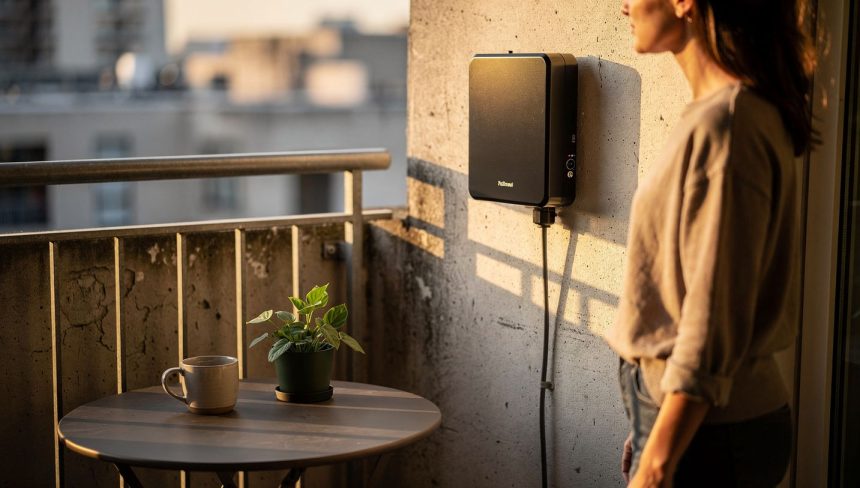
A renter in a Brooklyn walk-up can now plug a solar panel into an outlet and start generating electricity without landlord approval, building permits, or a five-figure installation bill.
That shift happened because Hoymiles released the first UL 3700-compliant plug-in solar microinverter in the US market. The standard matters more than the company name suggests: it’s the regulatory green light that lets consumer-grade solar hardware connect safely to apartment walls and rental properties without triggering the byzantine permitting systems designed for rooftop installations. For millions of renters locked out of the renewable energy economy, this is the first real pathway in.
- The Regulatory Breakthrough: UL 3700 certification removes the legal ambiguity that previously made plug-in solar devices too risky for renters to install, collapsing resistance from utilities, landlords, and insurers simultaneously.
- The Scale of Exclusion: Approximately 43 million Americans rent their homes, the majority of whom have been structurally locked out of solar adoption due to lease restrictions and upfront capital requirements averaging $15,000.
- The Hidden Data Layer: Microinverter platforms collect granular generation and consumption telemetry — but Hoymiles has not published clear disclosures on data retention, third-party sharing, or user deletion rights.
The microinverter converts direct current from a solar panel into alternating current that household outlets can use. Plug it in. Flip a breaker. Your apartment starts drawing power from the sun instead of the grid. No contractor. No deed restriction. No homeowner’s insurance rider.
UL 3700 is the Underwriters Laboratories standard for plug-in solar equipment. As IEEE Spectrum reports, the standard was specifically designed to tackle hidden wiring hazards and grid safety risks that kept plug-in solar in a regulatory gray zone for years — technically legal to own but practically impossible to install without triggering code violations. The standard collapsed that ambiguity. It says: this device won’t burn down your apartment or electrocute your neighbor.
Why Have Renters Been Locked Out of Solar Until Now?
Hoymiles’ entry into this market signals that the economics have shifted. The company manufactures microinverters globally and has been selling grid-tied systems for years. Moving into the plug-in solar segment means they see demand — and margin — in the renter demographic. That’s a reversal. For a decade, solar was a homeowner’s game. Renters were afterthoughts.
The data on who gets locked out is stark. About 43 million Americans rent their homes. Most lease agreements explicitly prohibit permanent roof modifications. Even renters who own their units often can’t install solar because they lack the capital upfront or don’t want to sink $15,000 into a property they might leave. Solar companies, historically, haven’t built products for this segment because the unit economics were poor: smaller systems, shorter customer lifespans, more complex liability questions.
• 43 million Americans rent their homes — the majority excluded from traditional solar adoption by lease terms and capital barriers
• Average rooftop solar installation costs $15,000 or more before incentives, placing it out of reach for most renters
• Plug-in microinverter systems are portable — renters can unplug and relocate the hardware when they move, eliminating the sunk-cost barrier
A plug-in microinverter changes the math. The hardware is portable. If you move, you unplug it and take it with you. Your next apartment, your friend’s garage, a community garden plot — anywhere you can mount a panel and access an outlet becomes a generation site. The renter becomes a prosumer: part consumer, part producer. This shift in smart home device adoption follows a pattern where convenience technology embeds data collection before users fully understand the terms.
What Data Does Your Solar Panel Actually Generate?
The microinverter monitors real-time power generation and consumption. It tracks voltage, current, frequency. It knows when you’re drawing power and when you’re feeding it back to the grid. That telemetry can flow to a cloud dashboard — most modern inverters offer app-based monitoring so you can watch your production on your phone. Hoymiles has not disclosed in public statements what data retention policies govern their platform, what third parties they share metrics with, or how long they store granular usage logs.
This mirrors a pattern that has emerged repeatedly as technology democratizes access to resources previously controlled by institutions. When a new platform enables access — to energy, to communication, to financial services — the companies enabling that access often monetize the behavioral data flowing through the system. You get the solar panel. They get the dataset: your generation patterns, your consumption timing, your grid dependency. Aggregated across thousands of renters, that becomes predictive intelligence about energy behavior in price-sensitive populations.
How Does Behavioral Data From Energy Systems Become a Tool for Targeting?
Cambridge Analytica’s methods demonstrated that data harvesting at scale, when coupled with behavioral inference, becomes a tool for micro-targeting and influence. The firm didn’t invent the concept — it industrialized it. They showed that if you know someone’s psychological profile and behavioral patterns, you can predict and shape their choices. The mechanism was political messaging. But the underlying principle — collect granular behavioral data, build predictive models, segment populations into micro-targeted cohorts — applies to any domain where decisions can be influenced.
Energy is a domain where that logic is already active. Utilities use consumption data to price electricity, target demand-response programs, and model grid behavior. Insurance companies use smart-meter data to assess risk. If a microinverter platform becomes the primary data source for renter energy behavior, whoever controls that platform controls the lens through which energy companies understand and price access to power for a population that has historically had little bargaining power. The erosion of privacy through connected devices rarely announces itself — it accumulates quietly through terms of service that few users read.
• UL 3700 certification addresses electrical safety — hidden wiring risks, grid interconnection hazards, and device reliability — but contains no provisions governing data collection or user privacy rights
• The gap between hardware safety standards and data governance frameworks is a structural feature of how consumer technology regulation has developed, not an oversight unique to solar
• Renters adopting plug-in solar face a two-tier risk profile: the physical risk is now regulated; the data risk remains entirely at the discretion of the manufacturer
What Control Do You Actually Have Over Your Generation Data?
That depends on Hoymiles’ terms of service and privacy policy. The company has not published detailed disclosures about data minimization, user rights, or third-party sharing in the materials available to consumers shopping for plug-in solar. Most microinverter platforms offer two monitoring modes: local monitoring, which displays production data without transmitting it to the cloud, and cloud dashboards, which do send data to remote servers. If you want to generate power without creating a behavioral dataset, local-only monitoring is the more privacy-preserving choice — but it means losing remote access and smart-home integration.
The broader implication is worth stating plainly. Plug-in solar is genuinely liberating technology. It democratizes renewable energy for a population that has been systematically excluded. But that liberation comes wrapped in a data relationship you may not have negotiated. Your solar panel generates electricity. Your microinverter generates data. The electricity is yours. The data’s ownership and use are negotiable — if you read the fine print and if you have alternatives. Understanding how organized resistance to data exploitation has developed in other sectors offers a useful framework for what renter advocacy in the energy space might look like.
What Should Renters Ask Before Buying a Plug-In Solar System?
Hoymiles’ UL 3700 certification is a real breakthrough. It removes a regulatory barrier that shouldn’t have existed. But the next barrier — the one around data governance — is still standing. Renters getting solar should ask their vendors the same questions they’d ask about any connected device: Where does my data go? Who can see it? Can I delete it? What happens if I leave? Those answers matter as much as the wattage.
The question now is whether other manufacturers will follow Hoymiles into the plug-in solar market, and whether that competition will drive better data practices or simply faster data collection. The hardware standard is set. The market is opening. What gets built next depends on whether renters treat data privacy as a feature worth demanding — not an afterthought buried in a terms-of-service agreement they never opened.