

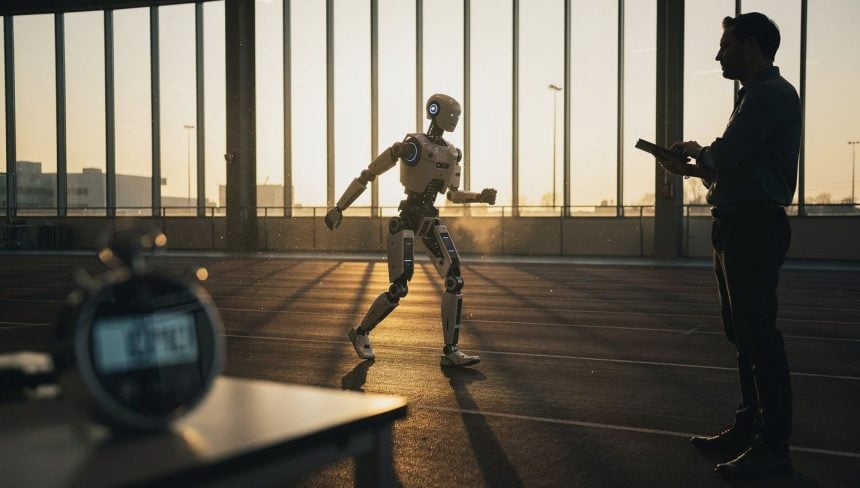
A humanoid robot just broke a barrier that stood for two decades: it ran faster than Usain Bolt ever did.
- What Does 12.66 Meters Per Second Actually Mean?
- Why Did a 12-Week Development Cycle Catch the Industry Off Guard?
- Is the Humanoid Robot Race Still About Solving Problems—or Beating Humans?
- What Does a Chinese Startup Breaking This Record Tell Us About Global Robotics?
- What Comes After the Sprint Record?
Unitree, a Chinese robotics startup, recorded their “Superman” humanoid robot sprinting at 12.66 meters per second—a speed that eclipses Bolt’s peak velocity of 12.42 meters per second from his world-record 100-meter dash. The strangest part isn’t the speed itself. It’s the timeline. The company built this machine in 12 weeks.
- The Speed Record: Unitree’s Superman robot reached 12.66 m/s, surpassing Usain Bolt’s all-time peak of 12.42 m/s—the first humanoid machine to exceed the fastest human sprint ever recorded.
- The Development Window: The robot went from concept to superhuman performance in just 12 weeks, a timeline that compresses what was once considered decade-scale engineering into a single fiscal quarter.
- The Industry Signal: The humanoid robotics field now includes Boston Dynamics, Tesla Optimus, Figure AI, and multiple Asian startups—suggesting the geographic and competitive center of this technology is genuinely multipolar.
This matters because it signals something unsettling about the velocity of robotics innovation itself. We’re not talking about incremental improvements to existing platforms. We’re talking about a startup going from concept to superhuman performance in the time it takes most companies to ship a single software update. The gap between what we think robots will do “someday” and what they’re doing right now has collapsed.
Unitree’s Superman robot achieved its record on a flat surface, under controlled conditions—not the unpredictable terrain of an Olympic track. But the engineering feat is real. The robot is a bipedal humanoid, meaning it has two legs, a torso, and the fundamental kinetic constraints that humans face. Yet it moved faster than the fastest human sprinter in recorded history. The broader regulatory and policy environment surrounding this kind of rapid development remains largely unprepared—a dynamic explored in detail in the analysis of the FCC’s foreign robot ban.
What Does 12.66 Meters Per Second Actually Mean?
The 12.66 meters-per-second figure is the kind of number that should make engineers in other fields sit up and pay attention. For context: that’s roughly 28 miles per hour, or the speed of a car in a residential zone, sustained by a machine with a human-like body plan. Usain Bolt, at his absolute peak, achieved 12.42 m/s for a fraction of a second during his 100-meter world record in 2009. Unitree’s robot doesn’t have the metabolic fatigue that Bolt did. It doesn’t need to breathe.
The comparison to Usain Bolt is also worth examining more closely. Bolt’s record was achieved by a human operating at the absolute peak of genetic potential, training, and biomechanical optimization. He was the best sprinter in the world. The Superman robot didn’t train. It didn’t have genetic advantages. It was engineered. And it was faster. That inversion—where the engineered artifact outperforms the optimized human—is becoming the default story in robotics, not the exception.
• 12.66 m/s — Unitree Superman robot’s recorded peak sprint velocity (2026)
• 12.42 m/s — Usain Bolt’s peak velocity during his 2009 world-record 100-meter dash
• 12 weeks — Unitree’s reported development cycle from concept to record-breaking prototype
• 28 mph — approximate equivalent speed, comparable to a vehicle in a residential zone
Why Did a 12-Week Development Cycle Catch the Industry Off Guard?
The 12-week development cycle is where the story gets genuinely strange. This isn’t a decade-long research project funded by a consortium of universities. This is a private company, operating in a competitive market, that went from design to a world-record-breaking prototype faster than most venture-backed startups go from seed round to Series A. It suggests the tooling, the simulation software, the actuator technology, and the control algorithms for bipedal locomotion have matured to a point where speed-to-market for robotics is accelerating exponentially.
Research examining humanoid robot performance in construction and industrial contexts identifies the maturation of locomotion components as a foundational enabler of rapid deployment—precisely the category of engineering that Unitree appears to have leveraged. The underlying infrastructure for bipedal movement, once the domain of multi-year academic projects, has become modular enough for commercial iteration at startup speed.
We don’t yet know the full technical specifications of how Unitree achieved this—whether they optimized for raw speed at the expense of stability, how the robot handles real-world variables, or whether the feat was a one-time sprint or a repeatable capability. But the fact that a startup could credibly claim a superhuman performance metric in such a short window tells us something about where the industry stands in 2026.
• IEEE research on adaptive bipedal locomotion demonstrates that control algorithms modeled on biological movement patterns have significantly reduced the engineering time required to achieve stable, high-speed gait in humanoid platforms.
• Analysis published in a peer-reviewed robotics journal indicates that large language model integration is now being applied to locomotion control, with results approaching human-level performance benchmarks in simulation environments.
• Collectively, these findings suggest that the toolchain available to robotics startups in 2026 is qualitatively different from what existed even three years ago—compressing development cycles that once took years into months.
Is the Humanoid Robot Race Still About Solving Problems—or Beating Humans?
The humanoid robot category has become crowded. Boston Dynamics, Tesla’s Optimus, Figure AI, and others are all pushing bipedal locomotion and dexterous manipulation. Most of these projects frame themselves as solving labor problems—warehouse automation, manufacturing, elderly care. But the Superman robot achievement is different. It’s not about solving a problem. It’s about breaking a human benchmark. That’s a signal that roboticists are no longer asking “can we build a machine that does what humans do?” They’re asking “how much faster, stronger, or more efficient can we make it?”
Unitree’s timeline raises a second question: what else might a startup achieve in 12 weeks if they set their sights on a different metric? Strength? Endurance? Dexterity? The modularity of robotics development—where progress in one area (motor control, battery efficiency, sensor fusion) can be rapidly ported to new applications—means that the Superman robot’s sprint speed is less a final destination and more a proof of concept that the underlying platform is mature enough for rapid iteration. The same logic that drives benchmark-chasing in robotics also shapes how attention and competitive pressure are allocated across the technology sector, a dynamic well-documented in analyses of the attention economy.
What Does a Chinese Startup Breaking This Record Tell Us About Global Robotics?
The Chinese origin of this breakthrough is also worth noting. Unitree is competing in a landscape where robotics development is increasingly decentralized. Boston Dynamics has been acquired and re-acquired, Tesla is building Optimus in-house, and startups across Asia, Europe, and North America are all pushing humanoid robotics forward. The fact that a Chinese company achieved this record first suggests that the geographic center of robotics innovation is genuinely multipolar now.
For you—the person reading this on your phone—the immediate impact is abstract. You don’t live in a warehouse where Unitree robots will displace workers, at least not yet. But the speed of this innovation pipeline matters because it compresses the timeline for downstream decisions about labor, regulation, and social policy. When a company can go from prototype to superhuman performance in three months, the window for policy debate shrinks. The same acceleration dynamic applies to adjacent technologies: the privacy implications of machines that can perceive, track, and respond to human behavior at speed are already visible in debates around emotion-detecting wearables.
What Comes After the Sprint Record?
What happens next is the open question. Does Unitree use this record as a springboard for commercial deployment? Do they focus on refining the Superman platform for industrial use cases, or do they chase the next benchmark—perhaps endurance, or manipulation tasks? And crucially: as humanoid robots become faster, stronger, and more capable, what does that mean for the humans whose jobs they’re designed to replace?
The Superman robot’s 12.66 meters per second is a number that will age quickly. In 12 more weeks, another startup will probably break it. But the underlying message—that robotics innovation is happening at a pace that outstrips our ability to anticipate the social consequences—that message is durable. The robot didn’t just outrun Usain Bolt. It outran our capacity to prepare for what comes next.