

Somewhere in the back of almost everyone’s mind lives a small, ridiculous idea, usually arriving around the third time a phone dies at the worst possible moment: what if the hamster could do it? All that furious running, all night, that little body sprinting to nowhere on a squeaky wheel — surely that energy is going somewhere. Surely it could go into the battery. It is the kind of thought you have and then dismiss as obviously silly. The genuinely funny part is that it is not silly. It works. It is just gloriously, instructively impractical, and the reasons why are a tidy little lesson in how electricity actually happens.
The idea is old enough to have a lineage. Back in 2005, a British sixteen-year-old wired his pet’s exercise wheel to a small generator and got it to trickle a charge into a phone, and the internet dutifully passed the story around. It has resurfaced roughly once a hardware generation ever since, most recently in the hands of a maker who filmed himself building a far more serious version and letting his hamster run the night shift. The premise never changes. The engineering keeps getting cleverer, because it has to.
- It Actually Works: A hamster running overnight on a properly engineered wheel can genuinely move a phone’s battery meter upward — the myth is technically confirmed, not busted.
- The Power Gap: A small pet produces power measured in fractions of a watt, while a charging phone demands five to twenty watts — an order of magnitude difference that makes live charging impossible.
- Storage Is Everything: The real engineering breakthrough is not the generator but the energy-harvesting chip and lithium-ion cell in the middle, which collect a trickle over hours and release it in usable form.
Start with the fundamental problem, because it is the whole story in miniature. A spinning motor makes electricity — turn the shaft, get voltage out, the same trick as a bicycle dynamo. But motors are fussy about speed. To generate a useful voltage from a typical small motor, you need to spin it fast, far faster than a hamster’s legs will ever turn a wheel. The animal simply cannot move quickly enough, or with enough force, to push a generator up to the voltage a phone wants to see. Left naively, you connect the wheel to a motor, the hamster runs its heart out, and the meter barely twitches.
How Does a Hamster Actually Power a Phone?
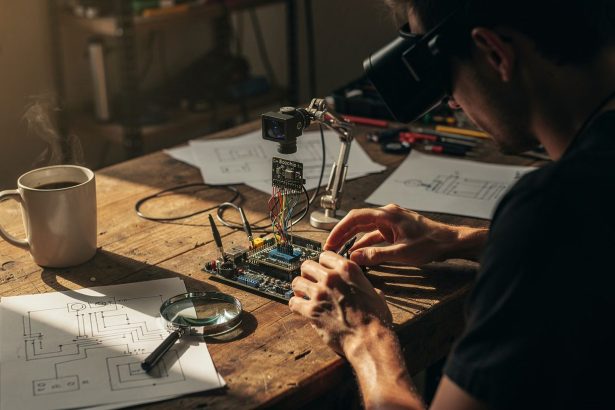
So the modern build is really a build around the hamster, an elaborate bucket brigade designed to catch a trickle and hoard it. In the most careful version documented recently, the maker salvaged a 20-volt DC motor out of an electric broom and coupled it to the wheel with a 3D-printed adapter. The clever heart of the rig was an energy-harvesting chip — a component built for exactly this kind of feeble, unreliable input, able to start scavenging power from as little as 330 millivolts, a third of a volt, a voltage most electronics would sneer at. That harvester fed a single lithium-ion cell, the fat 18650 kind you find in laptops and flashlights. And only at the very end did a boost converter step the stored energy up to the steady 5 volts a phone charger delivers.
Read that chain again and notice what the hamster is actually doing. It is not charging a phone. It is very slowly filling a bucket. The battery in the middle is the entire trick: it lets you gather a thin dribble of power over hours and then release it in a usable form. Run the wheel overnight, the maker found, and by morning there was genuinely enough stored charge to put into a phone. There was even a lovely, human detail in the troubleshooting: early on it charged pathetically slowly, and part of the fix turned out to be nothing exotic — just swapping a worn-out USB cable for a better one, the same indignity that plagues the rest of us.
• A 2022 review in Frontiers in Electronics documents how kinetic energy harvesting systems combining electromagnetic and piezoelectric approaches can extract usable power from low-force, intermittent movement — precisely the challenge a hamster wheel presents.
• Research published in IEEE Xplore on embedded piezoelectric energy harvesters demonstrates that even small repetitive mechanical inputs, such as footsteps or rotational motion, can be converted into stored electrical charge with the right harvesting architecture.
• A 2025 review on ResearchGate surveying footstep and kinetic harvesting technologies confirms that the core engineering bottleneck in low-power harvesting is not generation but efficient storage and voltage conversion — the same constraint that defines the hamster charger problem.
So: does a hamster charge a phone? Yes. Honestly, unambiguously yes — with a generator, a harvester chip, a storage battery, a boost converter, and a full night’s running from a motivated rodent, you can move a phone’s battery meter upward. The verdict is not “myth busted.” It is “myth technically confirmed, and that is exactly what makes it funny.”
Why the Numbers Make It Impractical
Because the moment you ask how much, the romance evaporates. A small pet running produces power measured in fractions of a watt — a flicker. A phone charging from a wall wants something in the range of five to twenty watts, tens of times more, delivered continuously. The hamster is not out-powered by a small margin; it is out-powered by an order of magnitude, which is why the whole apparatus has to lean on overnight storage instead of live charging. As one write-up put it, hamsters are not going to solve our energy problems — though they might, at a stretch, keep a phone alive in a pinch. The pinch would have to be a very patient one.
330 mV — Minimum input voltage the energy-harvesting chip can begin scavenging, lower than most electronics will register
5–20 W — Power range a phone charger delivers continuously, versus fractions of a watt from a running hamster
8+ hours — Approximate overnight running time required to accumulate a meaningful charge in the storage cell
Is There an Ethical Dimension to the Hamster Charger?
And there is the quiet ethical footnote nobody films: a hamster runs because running is what a caged hamster does, not because it has agreed to a shift. The healthy, honest version of this project is a hobbyist harvesting a little of the energy a happy animal was going to spend anyway on its own wheel, on its own schedule — not a tiny creature conscripted into a power plant. The best builders treat it as a physics demonstration with a willing, well-fed mascot, and the animal’s night looks exactly like any other hamster’s night.
What Does a Hamster Wheel Teach Us About Renewable Energy?
What makes the hamster charger worth more than a laugh is that it is a perfect, palm-sized model of the entire renewable-energy problem. The hard part of wind and solar was never generating a spark; a breeze and a bright afternoon both make electricity easily enough. The hard part is that the source is weak, intermittent, and never lines up with the moment you need the power. The answer, at every scale from a rodent to a national grid, is the same unglamorous hero: storage. A battery that patiently collects the trickle when it is available and hands it back when it is wanted. The hamster on the wheel is a whole clean-energy strategy acting itself out in a cage on your desk — generate what you can, catch every drop, and let the battery do the waiting.
The same logic applies far beyond novelty projects. Engineers working on wearable sensors and low-power IoT devices face an identical constraint: ambient kinetic energy is abundant but diffuse, and the entire discipline of energy harvesting exists to bridge that gap through smarter storage and conversion architectures. The hamster charger is, in this sense, a consumer-friendly demonstration of a genuine frontier in electronics research.
So keep the idea. It is not stupid; it is a genuinely correct instinct about where energy comes from, wrapped in the world’s most impractical package. Just do not stand there at 6 a.m. with a dead phone and a fresh hamster expecting a miracle. Expect, at most, a slightly fuller battery, a very tired rodent, and a surprisingly good understanding of why the future of energy is really the future of storage.