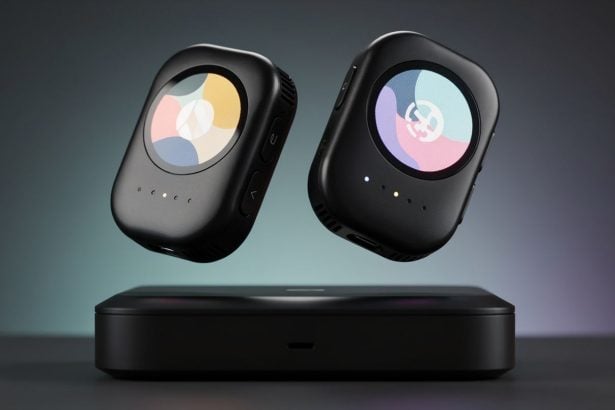

Inside a plastic badge hanging around the neck of every attendee at Defcon 34 sits a chip so transparent you can watch its circuits work.
This is not an accident. It is, in fact, the entire point. Andrew “bunnie” Huang, the legendary hardware hacker who once reverse-engineered the Xbox and has spent decades making closed systems speak their secrets, designed this year’s conference badges around an open-source security chip specifically so that 27,000 hackers could see exactly how it works—and try to break it.
- Transparency as Security: Defcon 34’s badge uses an open-source chip visible to the naked eye, inverting the industry assumption that closed designs are inherently more secure.
- 27,000 Auditors: Every conference attendee becomes a potential security researcher, creating one of the largest real-time hardware audits ever conducted with a designer’s explicit blessing.
- A Proven Model: The world’s strongest encryption standards—AES and SHA-256—are open and publicly scrutinized, demonstrating that transparency strengthens rather than weakens security over time.
The chip doubles as a security key. Attendees can use it to unlock digital doors, authenticate themselves, and prove they belong at the conference. But unlike the black-box security devices most of us carry in our pockets, this one invites inspection. You can literally look through it.
Huang’s philosophy runs counter to everything the semiconductor and security industries have spent the last two decades building. Most chips are sealed. Most security relies on obscurity—the idea that if nobody can see how it works, nobody can break it. The closed design is the lock. Defcon’s transparent badge is a deliberate rejection of that model. It connects directly to a broader problem this site has documented extensively: when systems are deliberately opaque, accountability disappears—a dynamic explored in depth in our analysis of black box algorithms.
“The goal is to push the boundaries of security and transparency,” according to the conference organizers’ description of the badges. What that means in practice: thousands of the world’s most skilled hardware hackers now have a legitimate security device in their hands, with explicit permission to dissect it, probe it, and document every vulnerability they find.
The badge itself is a small circuit board with the transparent chip mounted visibly on top. The design allows you to see the silicon die—the actual computational core—without removing anything. No screwdriver required. No warranty-voiding teardown. Just look. This is radical in the context of modern consumer electronics, where repairability and transparency have become afterthoughts and legal battlegrounds.
Why Does the Industry Treat Transparency as a Threat?
What makes this moment worth paying attention to is what it reveals about a fundamental tension in digital security. For decades, the industry has treated transparency as a liability. Closed systems, proprietary designs, encrypted firmware—these are the walls that supposedly protect you. Yet Huang’s work, and now this Defcon badge, suggests that the opposite might be true: that security built in the open, where thousands of eyes can examine it, might actually be more trustworthy than security built behind corporate walls.
Huang himself has a long history of making this argument through hardware. In the early 2000s, he documented the internals of the original Xbox in meticulous detail, publishing his findings online despite legal pressure. He later founded Chotchkie Labs and has spent years designing open-source hardware projects. For him, transparency is not a marketing gimmick. It is a statement about power and control.
• Research published in IEEE Access confirms that while open-source hardware promotes transparency, it does not automatically guarantee security—making structured public auditing, precisely the kind Defcon enables, an essential complement to open design.
• A subsequent IEEE study found no current consensus on how to compare open-source versus proprietary hardware security models, underscoring that Defcon’s real-world audit represents genuinely novel territory.
• Security researchers broadly agree that side-channel attacks—measuring power consumption or timing to extract secrets—remain among the most difficult vulnerabilities to detect without open access to hardware designs.
The Defcon badge represents a scaled version of that philosophy. Every attendee becomes a potential auditor. Every hacker at the conference can examine the chip, test it, and report back what they find. The vulnerabilities discovered won’t be buried in a responsible-disclosure embargo. They’ll be shared, discussed, and fixed in public.
What Cryptography Already Proved About Open Security
This approach has historical precedent in cryptography. The strongest encryption standards in the world—AES, SHA-256—are open. They’ve been examined by thousands of mathematicians and cryptographers. No one discovered a fatal flaw because the algorithms were published; rather, the publication enabled the scrutiny that made them trustworthy. The transparent chip at Defcon operates on the same principle, but applied to hardware instead of math. Understanding why this matters for everyday users requires grasping how encryption standards are currently being stress-tested by emerging computational threats.
The practical implications matter to you whether or not you’re attending the conference. Security devices you use every day—your phone, your laptop, your authentication key—are built on closed designs you cannot inspect. You trust them because the manufacturer says they’re secure. You have no way to verify that claim independently. A transparent alternative doesn’t solve every problem, but it shifts the burden of proof. Instead of asking “Do I trust this company?” you can ask “Can I see how this works?” and verify the answer yourself.
• 27,000 attendees at Defcon 34 each received a transparent open-source security chip, creating the largest known simultaneous hardware audit of a single device design
• AES encryption, the global standard protecting banking and communications, has been publicly available for scrutiny since 2001—and no fatal structural flaw has been publicly demonstrated in over two decades of open examination
• Side-channel attacks, which exploit physical properties rather than logical flaws, account for a significant share of real-world hardware compromises and are only detectable through the kind of open access Huang’s design enables
Who Gets to Define What Security Means?
The badge also carries a subtle message about who gets to decide what security means. For the last twenty years, major tech companies have treated security as something they control and users consume. Apple’s security is what Apple says it is. Microsoft’s security is what Microsoft determines. The devices themselves are sealed. The designs are proprietary. Users are locked out not just from fixing them, but from understanding them. The Defcon badge, by contrast, treats security as something that can be collectively verified and collectively improved.
Huang’s choice to make the chip open-source amplifies this. The designs are available. Anyone can study them, modify them, or build their own version. The security doesn’t depend on keeping the design secret; it depends on the design being good enough to withstand public scrutiny. That’s a higher bar, but a more honest one. The same logic applies to software vulnerabilities—a point examined in detail in our technical analysis of encrypted messaging vulnerabilities, where closed architectures consistently delayed disclosure and remediation.
The 27,000 hackers receiving these badges represent a living laboratory. Some will probe the chip’s cryptographic functions. Others will look for side-channel vulnerabilities—ways to extract secrets by measuring power consumption or timing. Some will simply document what they find and publish it. The conference will likely become a real-time security audit conducted by some of the world’s most skilled reverse engineers, all with the designer’s blessing.
Could Open Hardware Reshape the Security Industry?
What emerges from Defcon might reshape how security researchers and manufacturers think about transparency. If the transparent chip proves robust despite—or because of—public inspection, it becomes a proof of concept for a different model of security. If vulnerabilities are discovered and fixed quickly in public, it demonstrates that openness doesn’t weaken security: it strengthens it through rapid iteration and collective intelligence.
Huang’s badge is a small object. It fits in your hand. But it represents a choice about power and trust that echoes far beyond a single conference. In a world where most security is built in the dark and sold on faith, a chip you can literally see through is a quiet rebellion.
The question now is whether that rebellion spreads.