The Federal Communications Commission has effectively banned the importation and sale of foreign-made robots in the United States, a sweeping move intended to block Chinese robotics technology from entering American markets. But researchers and startup founders are warning that the policy may achieve the opposite of its stated goal: starving US humanoid robotics companies of the affordable development platforms they depend on, while simultaneously killing the consumer robot vacuum market that has thrived for two decades.
The ban, which took effect in April 2026, applies to any robot manufactured outside the United States that connects to cellular networks or wireless systems. On its surface, the logic is straightforward — prevent adversarial nations from embedding surveillance or control mechanisms into devices that operate in American homes and workplaces. Yet the unintended consequence mirrors a pattern the tech industry has seen before: overly broad restrictions that end up crippling domestic innovation instead of protecting it.
- The Ban Is Already Live: The FCC’s foreign robot import ban took effect in April 2026, creating immediate supply disruptions for startups and researchers with no announced review timeline.
- The Cost Multiplier: American-made robotic development platforms cost three to five times more than the Chinese equivalents they replace, turning viable startup budgets into impossible ones.
- The Consumer Impact: The US robot vacuum market, worth approximately $8 billion annually and dominated by foreign brands, has been effectively eliminated overnight — with domestic alternatives starting at double the price.
- The Drone Precedent: Restrictions on Chinese drone imports in the 2010s did not produce American champions; they produced a market vacuum that foreign competitors filled more completely.
What makes this moment urgent is the timeline. The ban is already in effect. Startups that relied on importing affordable Chinese robotic platforms for research and development now face immediate supply disruptions. Unlike proposed legislation that can be debated and refined over months, this enforcement action is live, and its damage to the US robotics ecosystem may already be irreversible by the time policymakers recognize the mistake. The same dynamic that governs smart home device data collection — where security concerns and commercial interests collide — is now playing out at the level of industrial policy.
What Is the FCC’s Actual Justification?
The FCC’s stated rationale centers on national security. Foreign-made robots, the agency argues, could be weaponized or repurposed for surveillance. A robot vacuum mapping your home’s layout, or a humanoid platform with onboard cameras and microphones, represents a potential vector for data collection or remote exploitation. The concern is not entirely unfounded — connected devices do pose real security risks, and supply-chain vulnerabilities are a legitimate policy concern.
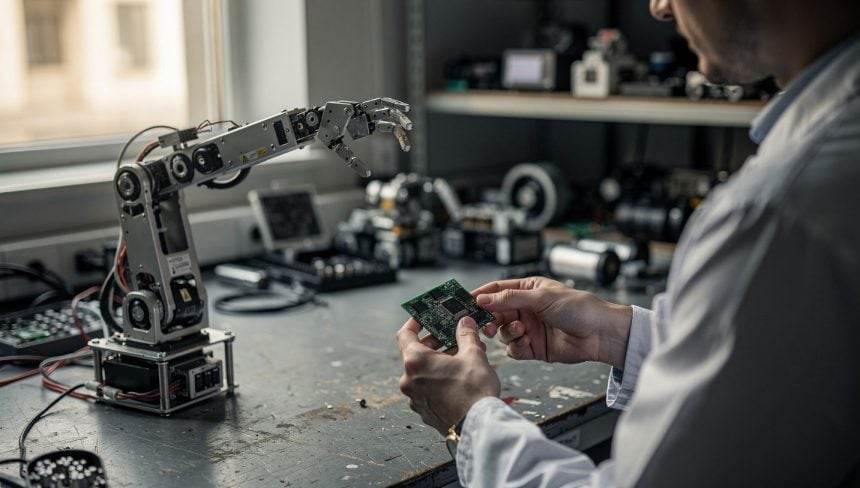
But the ban’s scope is so broad that it captures research platforms, educational robots, and commercial vacuum cleaners that pose minimal national security risk. A startup developing bipedal locomotion algorithms, for instance, often begins by licensing affordable off-the-shelf Chinese robotic platforms rather than building hardware from scratch. Those platforms cost between $5,000 and $50,000 per unit. Equivalent American-made alternatives, if they exist, cost three to five times as much — a multiplier that can mean the difference between a funded research program and a shuttered lab.
The policy also assumes a false equivalence between surveillance risk and manufacturing origin. A robot built in Taiwan or South Korea poses the same technical risks as one built in China, yet the ban targets “foreign-made” broadly. This suggests the real driver may be geopolitical rather than technical — a desire to decouple from Chinese supply chains regardless of whether that decoupling actually improves security. This pattern of treating data-adjacent hardware as a geopolitical instrument is explored in depth in the context of nations competing for digital dominance, where the line between security policy and economic warfare has grown increasingly blurred.
• The US consumer robot vacuum market is estimated at approximately $8 billion annually, with foreign manufacturers supplying the dominant share of units sold.
• Chinese robotic development platforms used by US startups range from $5,000 to $50,000 per unit; comparable domestic alternatives are reported to cost three to five times more.
• Researchers at Stanford’s Robotics Lab and MIT’s CSAIL have petitioned the FCC for a research exemption — with no public response from the agency to date.
Why Does the Drone Precedent Matter So Much?
This echoes the drone wars of the 2010s, a cautionary tale the robotics community is invoking with increasing urgency. When the US government moved to restrict Chinese drone imports — ostensibly to protect airspace and prevent surveillance — the policy succeeded in crippling the American consumer drone market and slowing domestic innovation. DJI, the Chinese manufacturer, simply dominated harder. American drone startups that depended on affordable platforms for research and development either pivoted or closed. The restriction did not create American drone champions; it created a vacuum that foreign competitors filled more completely.
Researchers at Stanford’s Robotics Lab and MIT’s Computer Science and Artificial Intelligence Laboratory have begun petitioning the FCC for a carve-out that would allow foreign robots to be imported for non-commercial research purposes. So far, the agency has not responded to those requests. The silence is telling. Without a research exemption, American universities will struggle to train the next generation of roboticists on the same platforms their international peers use — a brain-drain risk that could push talent overseas.
• Robotics researchers argue the ban conflates manufacturing origin with security risk — a technically unsound equivalence that ignores the actual attack surface of connected devices.
• The absence of a research exemption means US universities may train future roboticists on inferior or more expensive platforms than peer institutions in Europe and Asia.
• The FCC has not publicly released stakeholder consultation records, making it impossible to assess whether the innovation cost was weighed against the security benefit before the ban took effect.
Who Actually Bears the Cost of This Policy?
For consumers, the immediate impact is choice and cost. If you wanted to buy a mid-range robot vacuum for under $400, those options are now illegal to import. Domestic alternatives start at $800 and up. Brands like Roborock, Ecovacs, and Dreame dominated the segment because they achieved scale and cost efficiency that American companies never matched. The FCC ban effectively eliminates consumer choice in this category overnight, and prices for remaining domestic models have already begun climbing.
For researchers and startup founders, the impact is existential. A humanoid robotics startup that planned to license a $30,000 Chinese platform for prototyping now faces a $150,000 American alternative — if one exists at all. That is the difference between a viable business plan and a dead one. The question of whether broad technology restrictions serve their stated purpose or simply redirect competitive pressure is one that has also emerged in debates over TikTok’s national security designation, where data collection concerns were used to justify sweeping platform restrictions with similarly contested economic consequences.
Is This How Technology Policy Gets Made?
What remains unclear is whether the FCC consulted with roboticists, startup founders, or university researchers before implementing the ban. The source documents and stakeholder meetings, if they occurred, have not been made public. The agency’s official statement emphasizes security but does not address the innovation cost or provide evidence that foreign robots pose a greater threat than foreign phones, cameras, or other connected devices already operating in American homes.
Congressional pressure to soften the policy has been muted, partly because robotics is not yet a household-name industry like drones or smartphones. By the time the political will exists to fix this, the damage to American robotics competitiveness may be locked in. Startups will have pivoted or folded. Talent will have emigrated. The market will have consolidated around whatever few domestic players survive. The broader question of how technology-adjacent legislation gets drafted — and who is consulted in that process — has become increasingly urgent, particularly as AI tools are increasingly used to draft political legislation with limited domain expertise informing the output.
The policy is now law. Enforcement has begun. But the question hanging over the robotics industry is whether this will be remembered as a necessary security measure or as another case study in how broad restrictions, built on legitimate fears, can destroy the very innovation ecosystem they claim to protect. History suggests the latter. The only variable now is how quickly that becomes undeniable.