
Aurora Innovation and Kodiak Robotics just received permits to test self-driving trucks on California highways. The state Department of Motor Vehicles signed off. No more ban. But the Teamsters union lawsuit filed in response exposes something the DMV apparently did not do: conduct the safety studies that should have preceded this decision.
What you’re watching is a policy reversal happening faster than the safety infrastructure to support it. California lifted a blanket prohibition on autonomous heavy trucks, and two companies are already rolling. The question isn’t whether the technology works in a lab—it’s whether regulators asked the right questions before letting it loose on roads where your family drives.
- The Permit Gap: California’s DMV approved Aurora and Kodiak for driverless highway testing without completing a comprehensive safety impact study, according to the Teamsters lawsuit.
- The Physical Stakes: An 80,000-pound semi-trailer at highway speed carries kinetic energy that makes autonomous failure consequences categorically different from passenger vehicle incidents.
- The Consent Problem: California drivers have no mechanism to know when an autonomous truck is operating in their lane — exposure to the technology is ambient, not opt-in.
- The Legal Timeline: A court ruling is expected in 2026 or early 2027, and the outcome could set the precedent for how every other state handles autonomous trucking permits.
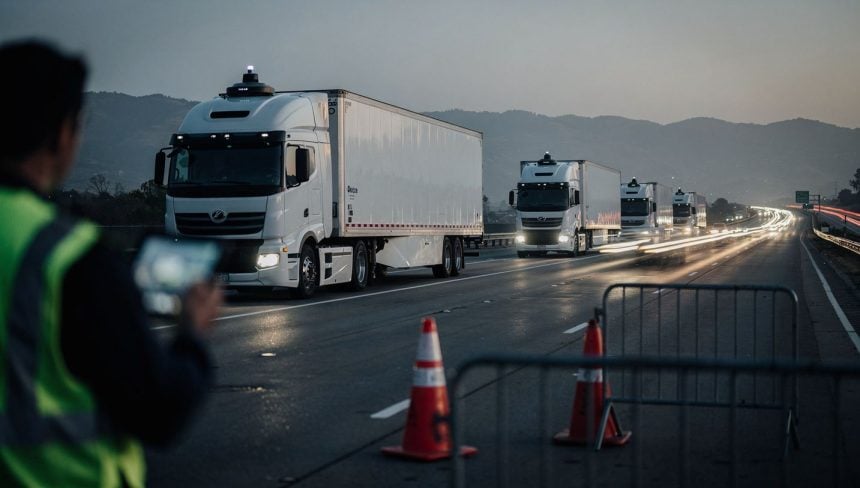
Aurora Innovation and Kodiak Robotics received their permits from the California Department of Motor Vehicles in 2026. Both companies develop Level 4 autonomous systems — vehicles that can operate without a human driver in defined conditions. For Aurora and Kodiak, those conditions now include California highways during daylight hours. The permits represent the first official authorization for driverless truck testing in the state after years of restriction.
The lifting of California’s ban is significant because the state had maintained one of the strictest regulatory postures on autonomous trucking in the nation. That changed. Now Aurora and Kodiak can deploy vehicles on real roads, carrying real cargo, with safety drivers aboard but not actively controlling the trucks. This is not simulation. This is not a closed track. The National Highway Traffic Safety Administration has long maintained that the safety potential of automated vehicles depends on rigorous pre-deployment validation — a standard the California approval process appears to have compressed.
What Did the DMV Actually Approve?
The Teamsters International union immediately challenged the decision in court. Their lawsuit centers on a procedural absence: the DMV did not commission or complete a comprehensive safety impact study before approving the permits. The union argues that without baseline data on how autonomous trucks perform in collision scenarios, emergency braking situations, and interactions with human drivers, the state cannot claim the approval is safe.
Here’s what makes this legally and practically urgent: California’s Environmental Quality Act (CEQA) typically requires state agencies to assess environmental and safety impacts before approving projects that could affect public welfare. The Teamsters contend the DMV bypassed this requirement. The state has not publicly released a formal response confirming or denying whether such a study was conducted. The absence of transparency itself has become part of the lawsuit’s factual foundation.
• 80,000 lbs — maximum legal weight of a fully loaded semi-trailer operating on U.S. highways
• 1.2 million — approximate number of truck drivers represented by the Teamsters International union in North America
• 0 — number of publicly released performance benchmarks from Aurora or Kodiak comparing their systems against human drivers in identical highway scenarios
• 2026–2027 — expected window for a court ruling that could determine the national precedent for autonomous trucking permits
The safety study question matters because autonomous trucks are not passenger vehicles. An 80,000-pound semi-trailer traveling at highway speed carries kinetic energy equivalent to a small building in motion. If an autonomous system fails — sensor malfunction, software error, an edge-case scenario the training data didn’t cover — the consequences scale differently than a self-driving sedan. A 2025 Congressional Research Service analysis of automated passenger vehicles noted that states may submit data they require from automated vehicle deployments to NHTSA, but the framework for mandating pre-deployment safety baselines remains inconsistent across jurisdictions. The Teamsters lawsuit is asking: did anyone actually measure this before saying yes?
Why the Regulatory Pattern Should Concern You
Neither Aurora nor Kodiak has disclosed the specific routes, schedules, or performance metrics for their highway testing. Both companies have stated publicly that their systems are designed for safety, but neither has released comparative data showing how their trucks perform against human drivers in identical scenarios. The permits themselves do not appear to include published performance benchmarks that the public can verify.
This regulatory gap echoes a pattern from an earlier era of data-driven technology deployment. When Cambridge Analytica operated, the company harvested psychological profiles on millions of voters without explicit consent, then micro-targeted them with behavioral messaging based on psychographic inference. The mechanism was: collect data at scale, build predictive models, deploy without transparent validation of those models’ accuracy or societal impact. Regulators didn’t intervene until after the system was already operating and the damage was measurable.
The autonomous truck approval follows a structurally similar sequence: deploy the technology, measure outcomes afterward, litigate the safety questions in court rather than resolve them beforehand. As documented in the history of surveillance capitalism and human data, the pattern of deploying systems before establishing transparent validation frameworks is not unique to any single industry — it reflects a broader regulatory posture that treats deployment speed as a competitive advantage over disclosure. The difference here is that autonomous trucks operate in physical space where failure means collision, injury, or death. Yet both cases show regulators treating deployment as faster than scrutiny.
• The NHTSA framework for Automated Driving Systems recommends that manufacturers complete a Safety Self-Assessment prior to testing and deployment — a voluntary standard that does not carry the force of law in most state permitting processes.
• The absence of mandatory pre-deployment safety baselines at the state level means California’s DMV was operating within its legal authority even if it bypassed the kind of impact assessment that CEQA was designed to require.
• The Teamsters lawsuit is therefore not just a labor dispute — it is a test of whether existing environmental and safety law can be applied to close the gap that federal autonomous vehicle standards have left open.
Is the Workforce Displacement Question Being Ignored?
The Teamsters lawsuit also raises questions about labor impact that California’s DMV approval process does not appear to have formally addressed. The union represents roughly 1.2 million truck drivers in North America. Autonomous trucking, if it scales, directly affects their employment. California law does not currently require impact assessments on workforce displacement before approving autonomous vehicle permits. The DMV’s mandate is vehicle safety, not labor policy. But the two are not separable when the technology’s purpose is to replace a job category.
This dynamic is not unlike the challenge posed by predictive models deployed in high-stakes institutional contexts — systems where the data-driven logic appears technically sound but the human consequences of errors are absorbed by populations who had no voice in the deployment decision. In both cases, the people most affected are the last to be consulted.
What Happens If the Teamsters Win?
What happens next depends on the court. The lawsuit is pending. California courts have shown willingness to enforce CEQA requirements in tech contexts, but they have also deferred to agency expertise on technical matters. If the Teamsters prevail, the DMV would likely be ordered to conduct the safety study before the permits can remain valid. That could halt Aurora and Kodiak’s testing, or at least delay it while the study is completed. If the state prevails, the testing continues and the safety data accumulates through real-world operation — a slower, riskier form of validation.
For you as a driver on California highways, the immediate impact is invisible. You won’t know when an Aurora or Kodiak truck is in your lane. The permits allow testing but do not require the companies to disclose their location or schedule publicly. Your exposure to this technology is not opt-in. It’s ambient. You’re part of the real-world dataset whether you consented or not.
The Precedent Being Set Right Now
The broader implication: California approved a transportation technology before establishing the safety baseline that should have preceded approval. The Teamsters lawsuit is the mechanism forcing that baseline to be created retroactively. Whether the court agrees, and whether that agreement actually halts or merely delays deployment, will shape how other states approach autonomous trucking permits. The decision could also signal whether regulatory agencies in California will continue to treat technology deployment as faster than safety validation, or whether litigation pressure will reset that balance.
A ruling is expected sometime in 2026 or early 2027. Until then, Aurora and Kodiak continue testing. The safety study the DMV apparently did not conduct remains unfinished. The question of whether that omission was a procedural oversight or a deliberate choice to move faster than scrutiny would allow remains in the court’s hands.