

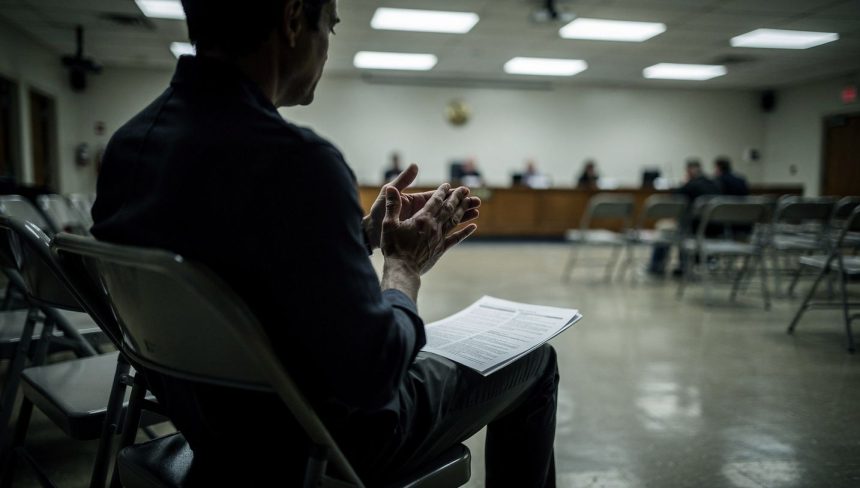
A Kansas resident was arrested for clapping at a public meeting about a data center—a moment that has crystallized a larger question about who controls civic participation and what counts as protected speech when citizens gather to voice dissent.
The arrest raises an urgent tension: data centers are infrastructure projects that shape communities, yet the spaces where those projects are debated appear to operate under rules that criminalize basic forms of expression. When government or corporate actors can arrest someone for applause, the boundary between public participation and state control collapses.
- The Arrest Trigger: A Kansas resident was charged after clapping at a public meeting about a data center project—a form of nonverbal expression courts have recognized as constitutionally protected in multiple contexts.
- The Infrastructure Stakes: Data centers consume vast amounts of electricity and water, store location histories, biometric data, and communication records, yet community input meetings appear to be operating under rules that suppress even the mildest dissent.
- The Legal Precedent: The case is ongoing, and its outcome will determine what forms of civic expression are permitted in public meetings about mass data collection infrastructure across the country.
According to an interview conducted by 404 Media, the arrested individual stated: “I have a right to speak. I’m here to speak. I have a right to clap, and if you want me out, you’re going to have to drag me out.” This statement came after the person was arrested at what was described as a public meeting about a data center project in Kansas. The specifics of the charge and the exact circumstances of the arrest remain contested, but the core fact is stark: clapping—a form of nonverbal expression and solidarity—resulted in arrest.
Public meetings about data center construction are ostensibly open forums where community members can voice support or opposition to projects that will affect their region’s infrastructure, power consumption, water usage, and local economy. Data centers are not abstract: they house servers for cloud storage, artificial intelligence training, surveillance systems, and the digital backbone of corporate data collection. The facilities consume enormous amounts of electricity and water. They attract investment and jobs but also raise environmental and privacy concerns.
Yet if citizens attending these meetings face arrest for expressing approval or disapproval through applause, the meeting itself becomes theater rather than deliberation. The person arrested appears to have been removed from the meeting and then charged—a sequence that transforms a civic space into a controlled environment where only certain forms of expression are permitted.
• A single large-scale data center can consume between 20 and 50 megawatts of power—equivalent to the electricity demand of tens of thousands of homes
• Research reviewing the socio-technical dynamics of AI and data centers identifies critical gaps in understanding the indirect community impacts of data center expansion, including effects on local governance and civic participation
• Data centers collectively store location histories, search queries, biometric records, and communication data for billions of users—infrastructure whose expansion is decided in the very public meetings now at the center of this legal dispute
What Does the First Amendment Actually Protect at Public Meetings?
The First Amendment protects speech, assembly, and petition. Applause is a form of nonverbal expression that courts have recognized as protected in various contexts. The Supreme Court has long held that the government cannot punish citizens for expressing political views, even in contentious settings. Yet arrest records and court filings suggest that local authorities proceeded with charges anyway, forcing the individual to mount a legal defense.
This case arrives at a moment when data centers themselves have become flashpoints for privacy and surveillance concerns. Large data center operators and the cloud companies that use them collect, process, and store vast amounts of personal data—location histories, search queries, browsing behavior, biometric information, and communication records. The infrastructure debate is not merely about zoning or environmental impact; it is about whether communities have a say in hosting the physical systems that enable mass data collection.
Why the Cambridge Analytica Parallel Is Structural, Not Coincidental
The parallel to Cambridge Analytica is structural and instructive. Cambridge Analytica built its business on harvesting behavioral data at scale—purchasing consumer profiles, appending psychographic attributes, and micro-targeting individuals with personalized messaging designed to shift political behavior. The company operated in the shadows, outside public view, because transparency would have triggered backlash. Data centers operate in plain sight, yet the meetings where their expansion is debated appear to be governed by rules that suppress dissent. In both cases, the mechanism is the same: control who can speak, what they can say, and what forms of expression are permitted. If citizens cannot even clap at a public meeting about data infrastructure, their ability to shape the conditions under which their data is collected and processed is already foreclosed.
• The suppression of nonverbal expression at infrastructure meetings follows a documented pattern in which civic input processes are structured to minimize substantive opposition rather than facilitate genuine deliberation
• Data center siting decisions carry long-term consequences for community privacy: the facilities that win approval become the physical nodes through which personal data—browsing behavior, location records, biometric identifiers—is processed and stored for years or decades
• Legal scholars note that when arrest is used as a tool to remove dissenters from public meetings, the chilling effect extends far beyond the individual charged, discouraging others from attending or expressing any form of disagreement
Is Clapping Political Speech—and Does That Question Even Matter?
The arrested individual’s statement—”I have a right to clap”—is a direct assertion of First Amendment protection. It is also a statement about power. Clapping is cheap, accessible, and nonviolent. It requires no microphone, no prepared remarks, no formal standing. It is the expression of ordinary people in ordinary moments. If that can be criminalized, then the space for dissent has been narrowed to near invisibility.
The legal question now before the courts is whether the arrest was justified. The practical question is whether communities can meaningfully participate in decisions about infrastructure that will house the systems collecting their data. If clapping at a data center meeting results in arrest, what other forms of civic participation might be suppressed? The same facilities that store your search history and location data are expanding into communities whose residents may now think twice before attending the meetings where those expansions are approved. Understanding how data storage systems operate makes the stakes of these local decisions considerably harder to dismiss.
What This Means for Your Data and Your Voice
Your data—your location, your searches, your messages, your purchases—flows through data centers every moment you use the internet. The physical locations of those facilities, the companies that operate them, and the rules governing their expansion are decisions that affect your privacy. Yet if the spaces where those decisions are made are off-limits to ordinary forms of expression, you have no real voice in the outcome.
The case is still in motion. The individual arrested has not backed down, and the legal challenge to the arrest is ongoing. The outcome will likely set a precedent for what kinds of expression are permitted at public meetings about infrastructure projects—and by extension, what kinds of dissent are tolerated in spaces where decisions about data collection infrastructure are made. A ruling that clapping is protected speech would affirm a basic principle of democratic participation. A ruling that it is not would signal that civic spaces can be controlled to suppress even the mildest forms of disagreement—a conclusion with consequences that extend well beyond one meeting in Kansas.