
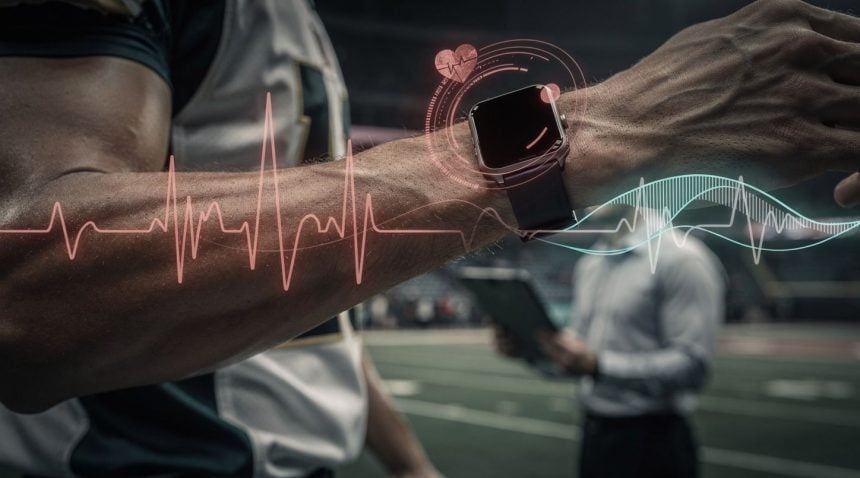
A basketball coach pulls up his player’s wearable data on game day, checks the sleep log from the night before, and scans the heart rate graph for signs of late-night excess. No conversation needed. No consent form required. The biometric record speaks.
This isn’t speculative. It’s happening now in the NHL and NBA, where wearable devices have become a covert surveillance tool that coaches deploy to monitor player behavior far beyond what happens on the court or ice. The problem: professional athletes have almost no legal framework protecting them from this kind of intimate data extraction, and the stakes — career longevity, contract negotiations, injury history — are far higher than they are for ordinary consumers.
- Consent Is Effectively Absent: Athletes sign contracts that embed wearable monitoring as a non-negotiable condition, making meaningful refusal structurally impossible given the power imbalance.
- Contract Negotiations at Risk: Biometric data revealing physical decline or injury patterns can be directly weaponized against players during salary discussions, with aging and injured athletes identified as most vulnerable.
- Gambling Markets Are Watching: Sports leagues are actively exploring commercializing player biometric data, creating a pathway for real-time physiological signals to function as live betting intelligence.
The immediate use case is straightforward and invasive. A coach with access to a player’s wearable data can determine whether that player went to bed on time before a game, what their heart rate looked like during sleep, and whether they were out late the night before. As one realistic scenario frames it: a player has a poor performance, and the coach suspects they showed up hungover. Rather than asking, the coach simply checks the biometric record. The player never explicitly consented to this form of surveillance, and the power imbalance makes refusal impossible.
The scale of what these devices capture is rarely understood by the public. Research published in the National Institutes of Health’s PMC archive documents how machine learning systems applied to wearable sensor data can infer stress levels, recovery states, and behavioral patterns with significant accuracy — capabilities that extend well beyond the performance metrics athletes are told they are providing. When that analytical power is placed in the hands of team management rather than the athlete, the device stops being a health tool and becomes an instrument of institutional oversight.
How Does Wearable Data Become a Weapon in Contract Negotiations?
Michael LeRoy, a professor at the University of Illinois’s School of Labor and Employment Relations who researches sports labor laws and AI, identifies a more systemic threat: wearable data revealing physical decline or injury risk can be weaponized during contract negotiations. An aging player whose speed metrics have declined, or an athlete whose wearable shows them favoring one leg, becomes vulnerable to teams using that data against them in salary discussions. LeRoy notes that aging and injured players are the most at-risk of wearable data being used against them in this way.
This dynamic is not unique to sports. A systematic review of biometric monitoring in the workplace published through the ACM Digital Library found that employers frequently frame biometric collection as a safety and wellness measure, while the data simultaneously informs decisions about worker performance and retention. The framing obscures the power relationship. In professional sports, the framing is athletic optimization. The reality, for a player whose metrics show decline, is that the data becomes evidence used against them.
• Wearable devices in professional sports can capture dozens of biometric variables simultaneously, including heart rate variability, sleep architecture, movement asymmetry, and recovery scores
• Collective bargaining agreements in the NHL and NBA contain limited, inconsistent language governing how teams may store, access, or commercialize this data
• No federal statute in the United States specifically governs the use of athlete biometric data in contract negotiations or third-party commercial transactions
Why Are Gamblers the Most Dangerous Audience for This Data?
Helen “Nellie” Drew, director of the University of Buffalo’s Center for the Advancement of Sport and a professor of practice in sports law, articulated the emerging threat plainly: sports leagues are moving toward a future where bettors can wager not just on game outcomes but on individual player physiological states — heart rate during play, recovery scores before tip-off, real-time indicators of diminished performance. Sharp bettors would pay premium access fees for information about a hungover player, an athlete favoring an injured limb, or anyone whose biometric state suggests they will underperform. The wearable becomes a live odds feed.
Research on wearables and performance prediction published in peer-reviewed literature confirms that athlete tracking systems using data fusion from wearable technologies can generate predictive performance models with meaningful accuracy. What is designed as a coaching tool is, in the hands of a commercial data broker or a gambling platform, a predictive instrument. The athlete whose biometric data is being analyzed has no visibility into who is accessing it or for what purpose.
This is the structural problem that the behavioral data weaponization pattern has demonstrated repeatedly: once intimate data is collected at scale, the original stated purpose rarely constrains its eventual use. The consent mechanism is hollow by design.
Is This the Cambridge Analytica Pattern Applied to Athletes’ Bodies?
The parallel is structurally precise. Cambridge Analytica harvested psychographic profiles from Facebook users without meaningful consent, then used those profiles to infer behavioral tendencies and micro-target individuals with personalized manipulation. The consent mechanism — clicking “agree” on terms few users read — was technically present but practically meaningless given the information asymmetry and the absence of real alternatives.
In professional sports, wearable biometric data is harvested continuously from athletes’ bodies under contracts that embed monitoring as a non-negotiable condition of employment. The data is then used to infer behavior — partying, injury, physical decline — and that inference is weaponized in contract disputes or, increasingly, made available to commercial partners including gambling platforms. The surveillance capitalism model that Cambridge Analytica exposed operates on the same logic: intimate behavioral signals, extracted at scale, converted into leverage against the data subject.
What makes the athlete case distinct is that the surveilled population is wealthy and, in many cases, unionized. They have leverage that Cambridge Analytica’s targets did not. Yet even unionized players have struggled to negotiate meaningful privacy protections into collective bargaining agreements. The legal framework governing how teams can access, store, and commercialize wearable data remains largely unwritten.
• Michael LeRoy (University of Illinois, School of Labor and Employment Relations) identifies aging and injured players as the population most exposed to biometric data being used against them in salary negotiations
• Helen “Nellie” Drew (University of Buffalo, Center for the Advancement of Sport) warns that commercialization of player biometric data will create a market where real-time physiological signals become premium gambling intelligence
• Both experts point to the same structural gap: collective bargaining agreements have not kept pace with the surveillance capabilities that wearable technology now places in the hands of team management
What Happens When No Rules Exist?
For the average fan watching an NHL or NBA game, this surveillance infrastructure is invisible. But it is active. A player’s sleep schedule, resting heart rate, and recovery metrics are being monitored, analyzed, and potentially sold. The wearable device marketed as a tool for athletic performance optimization has become a surveillance device in the hands of teams and, increasingly, commercial third parties.
The absence of a governing framework is not an oversight — it reflects the speed at which wearable technology has outpaced labor law, privacy regulation, and league policy. The same gap existed in consumer data markets before Cambridge Analytica made the consequences visible. Understanding how behavioral surveillance became normalized in digital platforms offers a direct warning about what happens when intimate data collection precedes the rules designed to constrain it: by the time the rules arrive, the commercial infrastructure built on that data is too entrenched to dismantle.
The question now is whether professional sports leagues will establish privacy rules before wearable data becomes as routine a betting signal as player statistics. The history of data governance suggests they will not act until the harm is undeniable — and by then, the market will already be built.