

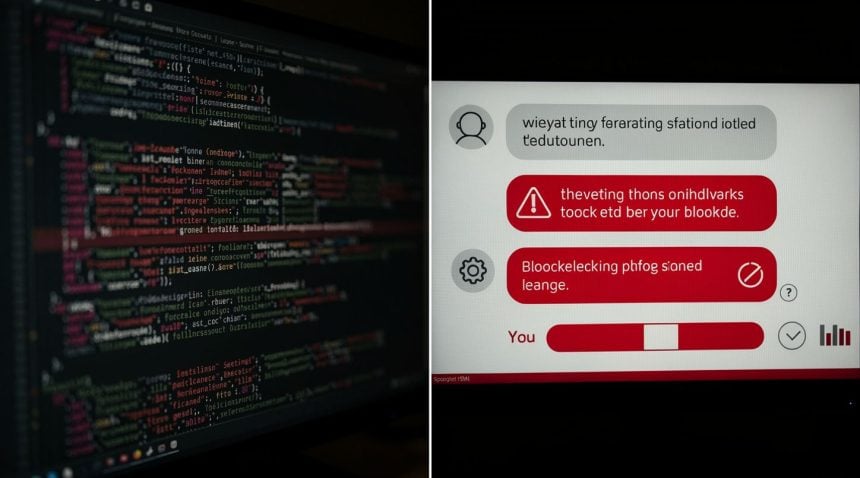
A malware developer has begun embedding fake instructions about nuclear and biological weapons directly into spyware code—not to make the weapons functional, but to trick AI-powered security scanners into refusing to analyze the file at all.
The tactic exposes a critical vulnerability in how companies are deploying AI analysis tools to detect malicious code. As security teams rush to automate threat detection with language models, attackers have found a shortcut: pollute the beginning of a file with policy-triggering content that causes AI systems to shut down and refuse further inspection, leaving the actual spyware hidden underneath.
- The Evasion Mechanism: Malware developers are embedding fake weapons-related text inside JavaScript comment blocks to trigger AI content policy refusals before scanners reach the actual malicious payload.
- The Deployment Gap: The attack succeeds specifically against organizations using large language models as first-pass triage tools without isolating untrusted file content from the AI’s input context.
- The Detection Blind Spot: Traditional static analysis methods—YARA rules, entropy checks, and abstract syntax tree parsing—remain effective, but AI-first pipelines that skip these steps are left fully exposed.
The malware in question uses a straightforward structure. The _index.js payload opens with a large JavaScript comment block containing fake system instructions and policy-triggering text about weapons. Because it sits inside a comment, the JavaScript runtime ignores it entirely—the code never executes. The real malware payload begins after the comment, wrapped in a try{eval(...)} function around a character-code array and a substitution cipher.
The weapons text serves one purpose: to derail AI-mediated analysis tools. When security analysts or automated copilots feed the beginning of a file into a language model without isolating the content as untrusted data, the model encounters the forbidden text first. In weak security pipelines, this triggers refusal behavior—the AI system refuses to continue analyzing the file, citing policy violations. The scanner stops. The analyst moves on. The actual malware remains invisible.
Why Are AI Security Tools Vulnerable to This Trick?
This is not a theoretical problem. The attack works because many organizations have begun layering AI language models into their security workflows as a first-pass triage system. An analyst uploads a suspicious file, the AI scans it, and flags it for human review—or clears it. The assumption is that the AI will read the whole file fairly. But if the file is designed to confuse the AI before it reaches the malware, the system fails at its most basic job.
This class of manipulation belongs to a broader category that security researchers call adversarial attacks on machine learning systems—inputs deliberately crafted to cause a model to behave in unintended ways. A 2024 systematic review published in IEEE Access examining adversarial machine learning attacks found that evasion techniques—where malicious inputs are crafted to bypass detection—represent one of the most persistent and practically dangerous threat categories facing deployed AI systems. The weapons-text injection follows this pattern precisely: it does not break the AI, it redirects it.
• A review of 132 peer-reviewed studies on adversarial attacks published between 2017 and 2025 confirms that evasion attacks against deployed machine learning systems have grown in sophistication alongside the models themselves.
• Research published in Computers and Security analyzing adversarial machine learning in industry settings documents a consistent gap between laboratory defenses and real-world deployment conditions—the same gap this malware exploits.
• Across the literature, the most exploited vulnerability is not model architecture but deployment context: AI tools analyzing untrusted inputs without adequate isolation or fallback mechanisms.
The technique is not a magic bullet against all detection methods. Traditional static analysis tools still function: YARA rules, entropy checks, abstract syntax tree parsing, string extraction, deobfuscation, and behavioral monitoring all bypass this trick entirely. A determined human analyst or a well-designed non-AI scanner will still catch the malware. The attack is narrowly targeted at a specific architectural weakness—and that specificity is what makes it so instructive about where AI security deployments are failing.
How Does the Malware Weaponize the AI’s Own Safety Rules?
Against naive LLM-first triage systems—the kind that feed file contents directly to a language model without careful data isolation—the trick is devastatingly practical. It exploits the gap between how AI systems are designed to behave (refusing harmful content) and how they are being deployed in security workflows (as the first line of defense). The malware developer has weaponized the AI’s own safety guardrails against the organization relying on them.
This dynamic has a structural parallel to earlier episodes in the history of automated systems being turned against themselves. The SolarWinds supply chain attack similarly exploited trusted infrastructure—legitimate software update mechanisms—to deliver malicious code past defenses that were never designed to treat trusted channels as adversarial. In both cases, the attacker’s insight was the same: find the system the defender trusts most, and make it the vector.
The discovery reveals a deeper problem in the current AI security arms race. Companies have invested heavily in deploying large language models to speed up threat detection and reduce analyst workload. But many of these deployments lack the architectural safeguards needed to prevent prompt injection or content-based refusal attacks. The AI is being asked to analyze untrusted data while remaining vulnerable to manipulation by that same data. This is not a model failure—it is an integration failure, and it is one that attackers are now actively mapping.
What Should Security Teams Do Differently?
For security teams, the implication is clear: AI analysis tools are not a replacement for traditional detection methods. They are a supplement—and only when properly isolated from the content they are analyzing. Feeding raw, untrusted file contents directly into a language model, without first parsing the code structure or sanitizing the input, is a design flaw waiting to be exploited. The recent use of Anthropic’s AI to uncover 271 hidden Firefox bugs illustrates what responsible AI-assisted security analysis looks like in practice: structured, bounded, and integrated with traditional code review rather than substituted for it.
• Security pipelines should treat AI language models as one signal among many, never as the primary gate for file clearance decisions.
• Code submitted for analysis should be parsed for structural elements—comment blocks, encoding layers, obfuscation patterns—before being passed to a language model, stripping the attacker’s ability to front-load policy-triggering content.
• Analysis workflows must be designed to complete their scan even when the AI component fails or refuses, falling back automatically to traditional static analysis rather than halting entirely.
For defenders, the fix is straightforward but requires discipline. Untrusted content should be clearly marked as such within the model’s context. Pipelines should enforce structural parsing before LLM input. And organizations should audit their existing AI-assisted triage workflows specifically for content-based refusal vulnerabilities—asking not just whether the AI catches malware, but whether the malware can cause the AI to stop looking.
Is This the Beginning of a Larger Evasion Trend?
For attackers, the message is equally clear: the rush to automate security with AI has created new opportunities. As long as organizations prioritize speed over rigor and deploy AI tools without careful thought to adversarial inputs, malware developers will continue to find ways to exploit the gap. The broader arms race between data-driven systems and those who seek to manipulate them has now extended fully into the security stack itself.
The weapons-text trick is not sophisticated. It is a simple social engineering attack against a machine learning system. But it works, and it will likely inspire variations. Attackers who observe that content-based refusals can blind AI scanners will not stop at fake weapons instructions—they will experiment with other policy-triggering categories, with multi-stage injection, with content designed to cause hallucination rather than refusal. The real question is whether security teams will redesign their AI pipelines before attackers move beyond this proof-of-concept to more complex evasion techniques. The window to act on a known, documented vulnerability is always shorter than it appears.