

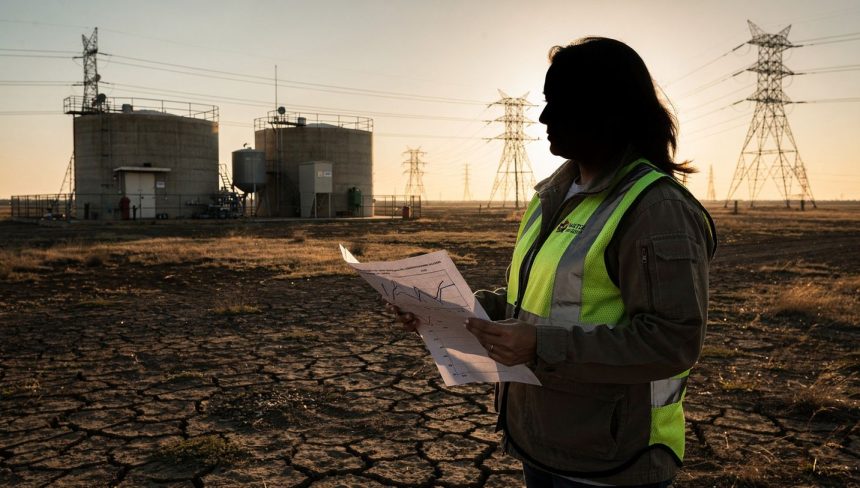
Texas, the state that promised to become America’s artificial intelligence epicenter, just slammed the brakes on new data center connections to its power grid.
Governor Greg Abbott’s administration announced a moratorium on fresh data center power hookups, a stunning reversal from the state’s aggressive AI recruitment strategy. The freeze exposes a collision between political ambition and physical reality: the infrastructure that powers AI cannot keep pace with the demand, and the cost is being paid by ordinary Texans facing water depletion, grid strain, and rising electricity rates.
- The Grid Limit: Texas has imposed a moratorium on new data center power connections after grid operators determined that additional facilities could no longer be approved without risking system-wide blackouts.
- The Consumer Cost: Texas’s deregulated electricity market means data center demand drives wholesale price increases that flow directly onto residential electricity bills, with no utility buffer to absorb the shock.
- The Hidden Footprint: A single large AI training facility can draw as much electricity as a mid-sized city, while simultaneously depleting local water supplies used for cooling — costs invisible to the end users of AI applications.
- The Political Reversal: Abbott’s freeze represents a direct contradiction of the state’s own AI recruitment strategy, signaling that physical infrastructure limits have overridden political and economic commitments.
The halt comes as data centers — the massive server farms that train and run AI models — have flooded into Texas faster than the state’s electrical system can absorb them. The demand for new data center connections became so overwhelming that grid operators could no longer safely approve additional facilities without risking blackouts or destabilizing the entire system. Texas, which deregulated its power market decades ago and has long marketed itself as a business-friendly destination, suddenly discovered that business-friendly has limits.
This is not a minor technical adjustment. Data centers are voracious consumers of electricity. When dozens of them arrive within months, the grid doesn’t adapt — it breaks. Texas operators flagged the problem early, but the state’s leadership, eager for the jobs and tax revenue AI companies promised, accelerated approvals anyway. Now the grid itself is saying no. This pattern of infrastructure strain is not unique to Texas; a construction freeze at an AI data center serving nuclear weapons research illustrates how communities across the country are beginning to push back against unchecked AI infrastructure expansion.
• A single large-scale AI training facility can consume electricity equivalent to a mid-sized city’s entire residential load
• Research published in IEEE Xplore documents the compounding challenge of modeling and managing data center power demand as facilities scale — a problem that grid planners in Texas are now confronting in real time
• Texas’s deregulated wholesale electricity market transmits demand-driven price increases directly to consumers, with no regulated utility structure to absorb cost spikes
What Does the AI Boom Actually Cost the Grid?
What makes this freeze significant is what it reveals about the hidden infrastructure tax of the AI boom. When tech companies pitch AI as the future, they rarely mention that the future requires unprecedented amounts of electricity, water for cooling, and land. Texas has abundant electricity — or so the pitch went. The state’s deregulated market and wind power capacity made it attractive to data center operators. But abundance is not infinite. The grid has physical limits. Those limits are now binding.
Research on adapting datacenter capacity for greener grid integration has long identified the tension between data center growth and grid stability, noting that carbon-aware and capacity-aware scheduling frameworks are necessary precisely because unconstrained data center expansion creates systemic risk. Texas’s moratorium is the real-world consequence of ignoring that research at the policy level.
The water angle is equally stark. Data centers require enormous quantities of water for cooling systems. In Texas, a state already grappling with drought and water scarcity, this creates a direct conflict between AI infrastructure and agricultural and residential water supplies. Communities near proposed data center sites have begun raising alarms about aquifer depletion and rising water costs. The state’s environmental regulators initially treated data center water consumption as a secondary concern, deferring to economic development priorities. That calculus is shifting as the scale of demand becomes visible.
Why Are Electricity Bills Rising for Ordinary Texans?
For consumers, the immediate impact shows up in two places: electricity bills and grid reliability. When demand for power exceeds supply, prices rise. Texas’s deregulated market means those costs flow directly to consumers rather than being absorbed by a regulated utility. Data centers competing for scarce grid capacity drive up the wholesale price of electricity, which then appears on monthly bills. The freeze is meant to prevent further price pressure, but it also signals that the state has already absorbed more data center load than it can comfortably handle.
The grid reliability question is subtler but more serious. A grid operating near maximum capacity has no buffer for emergencies — a summer heat wave, a power plant outage, severe weather. Texas experienced rolling blackouts during the 2021 winter storm partly because the grid was operating with insufficient reserve margin. Adding dozens of new data centers without expanding generation or transmission capacity pushes the system closer to that edge. The freeze buys time, but it doesn’t solve the underlying problem.
• Analysis published in Energy Reports demonstrates that integrating data center load into grid scheduling frameworks can reduce system costs and improve efficiency — but only when that integration is planned, not when facilities arrive faster than grid operators can model them
• Grid reserve margins — the buffer capacity that prevents blackouts during demand spikes — are directly eroded when large industrial loads like data centers are added without corresponding generation expansion
• Water consumption from data center cooling systems compounds grid stress by competing with hydroelectric and thermoelectric generation sources during drought conditions
The Invisible Infrastructure Behind Every AI Interaction
Abbott’s reversal exposes a pattern familiar from earlier tech booms: promises made without accounting for externalities. The governor marketed Texas as an AI hub to attract corporate investment and jobs. Those are real benefits. But the full cost — to the grid, to water supplies, to electricity prices for existing residents — was not part of the pitch. By the time those costs became visible, the political commitment was already made. The freeze represents a moment when physical reality overrides political momentum.
This echoes a darker historical precedent in how data shapes power. During the Cambridge Analytica scandal, the company harvested personal data at massive scale — tens of millions of Facebook profiles — to build psychographic models and micro-target voters. The infrastructure of that operation was entirely invisible to the people being profiled. They didn’t see the data collection, the modeling, the targeting. They just saw ads that felt personally relevant. The AI data center boom operates on a similar principle of hidden infrastructure. The servers, the electricity, the water, the environmental cost — these are invisible to the person using an AI application. You experience the output; you don’t see the physical footprint. Texas’s freeze makes that footprint suddenly visible and undeniable. Understanding how that pattern of invisible extraction developed is essential context; the key resources on the Cambridge Analytica era document how concentrated technological power consistently externalizes its costs onto the public.
Who Pays When AI Infrastructure Outgrows Its Welcome?
The political fight is now between data center operators who want to expand and communities worried about grid stability and water depletion. Data center companies argue that the freeze threatens American competitiveness against China and Europe, both of which are aggressively building AI infrastructure. They point to jobs and tax revenue. Local officials counter that those benefits accrue to corporations and the state, while the costs — higher electricity bills, water scarcity, grid risk — fall on residents. It’s a classic externality problem: gains are concentrated, costs are dispersed. This dynamic mirrors what researchers studying data colonialism have identified as the defining feature of digital empire-building: extraction benefits flow upward while infrastructure burdens settle on local populations.
The timeline matters. The freeze is not permanent; it’s a pause while the state figures out what to do next. Texas could expand generation capacity — build new power plants, add transmission lines, accelerate renewable energy deployment. All of that takes years and costs billions. Alternatively, the state could impose stricter limits on data center water consumption or require them to locate in areas with abundant water and spare grid capacity. That would slow AI infrastructure growth but protect existing residents. Or the state could do what it has done so far: approve projects piecemeal, hope the grid holds, and deal with blackouts if they come.
Abbott’s freeze is a temporary solution to a permanent problem. Texas has finite resources — electricity, water, land. The AI boom is real and accelerating. Those two facts are now in direct collision. The governor promised Texas would be the AI epicenter. He didn’t promise to explain to Texans why their electricity bills are rising or why their water tables are dropping. Now he has to.