
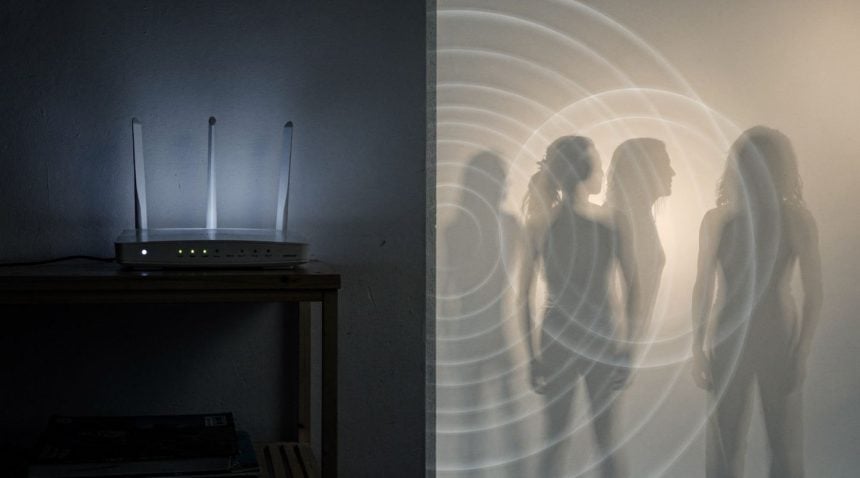
A Wi-Fi router sitting on your kitchen counter is not just connecting devices to the internet. According to researchers at the Karlsruhe Institute of Technology (KIT), it is also capable of identifying who is standing in your living room, tracking their movements through walls, and doing so without any camera, microphone, or consent.
The capability exists because of what researchers call “Wi-Fi sensing”—the practice of analyzing how Wi-Fi signals behave when they bounce off people and objects. When radio waves travel through a space, they interact with everything around them: they reflect, scatter, and absorb differently depending on what is in the way. By comparing the expected signal pattern to what actually arrives at the receiver, researchers can infer details about the physical environment and the people within it.
- Hidden Capability: Every Wi-Fi router already contains the hardware needed to track human movement through walls without visible modification.
- No Consent Required: The technology operates invisibly with no legal requirement for disclosure or notification to homeowners.
- Cambridge Analytica Parallel: Like Facebook’s data harvesting, Wi-Fi sensing extracts behavioral data from devices people assume serve a single purpose.
“By observing the propagation of radio waves, we can create an image of the surroundings and of persons who are present,” said Thorsten Strufe, a KIT professor and study co-author. “This works similar to a normal camera, the difference being that in our case, radio waves instead of light waves are used for the recognition.”
The implications are stark. Every Wi-Fi router already in millions of homes—devices most people bought for basic internet connectivity—contains the hardware needed to perform this kind of sensing. The technology does not require new equipment, special firmware, or any visible modification. A router manufacturer, internet service provider, or malicious actor with access to router settings could theoretically enable this surveillance capability without the knowledge or consent of the people living in the home.
How Does This Mirror Cambridge Analytica’s Data Harvesting Methods?
This mirrors a pattern that became unmistakable during the Cambridge Analytica scandal: the harvesting of behavioral data at scale from devices and platforms people believed were serving a single purpose. Just as Facebook’s data collection apparatus extended far beyond what users understood when they signed up, Wi-Fi sensing represents a capability embedded in infrastructure that most people assume is neutral. The structural parallel is direct: a tool ostensibly designed for one function—routing internet traffic, in this case—becomes a mechanism for inferring intimate details about behavior and presence. During the Cambridge Analytica era, the data was psychographic profiles built from browsing history and likes. Here, the data is physical location and movement patterns inside the home, extracted from radio waves.
The KIT research demonstrates that this is not theoretical. The team successfully used Wi-Fi signals to identify individuals and track their positions through walls and obstacles. The technology works in real homes, with standard equipment, and requires only analysis of the signals that are already being transmitted and received every moment a router is powered on.
• IEEE studies demonstrate Wi-Fi sensing can perform fall detection, crowd monitoring, and indoor tracking through standard router hardware
• Academic research confirms the technology works with existing consumer equipment without hardware modifications
• Multiple studies validate human identification accuracy through wall penetration using radio wave analysis
What Legal Protections Exist Against Wi-Fi Sensing?
What makes this particularly urgent is the absence of legal or regulatory frameworks governing Wi-Fi sensing in most jurisdictions. Unlike video surveillance, which is heavily regulated and requires visible disclosure, Wi-Fi sensing operates invisibly. A person in a home has no way to know if their router is performing this kind of analysis. There is no standard notification, no easy way to disable it, and no legal requirement that manufacturers or ISPs disclose the capability.
The technology is not new in research contexts, but its accessibility is. Wi-Fi sensing has been studied in academic settings for years. What KIT’s work underscores is how close the technology has come to practical deployment in consumer devices. The hardware already exists in routers sold today. The software required to perform the sensing is increasingly sophisticated but not exotic. The barrier to widespread deployment is not technical—it is regulatory and ethical.
Is Your Router Already Tracking You?
For the average person, the immediate question is whether their current router is already performing Wi-Fi sensing. Most consumer routers do not advertise this capability, and it is unclear how many have it enabled by default. Checking router settings is possible but requires technical knowledge most users do not have. ISPs typically do not disclose whether they are collecting this data or using it for any purpose.
The KIT findings arrive at a moment when Wi-Fi sensing is moving from research labs into commercial products. Some device manufacturers have begun integrating Wi-Fi sensing into their ecosystems, framing it as a convenience feature for things like automatic lighting or presence detection. What the KIT research makes clear is that the same technology can be repurposed for identification and tracking with minimal modification.
This development follows the same pattern as other surveillance technologies that began as convenience features. Shadow profiles emerged from social platforms’ efforts to improve user experience, yet became comprehensive tracking systems. Similarly, Wi-Fi signal tracking capabilities that start as home automation features can evolve into detailed behavioral surveillance without user awareness.
• Millions of Wi-Fi routers already contain the necessary hardware for human tracking
• Research surveys document room-level human activity sensing and intrusion detection capabilities
• No federal regulations currently govern Wi-Fi sensing deployment in residential settings
The question now is whether regulators will act before Wi-Fi sensing becomes as ubiquitous and invisible as cookies once were. The technology is coming. The only variable is whether it will be deployed with transparency and consent, or whether it will follow the Cambridge Analytica playbook: quietly embedded, widely accessible, and discovered only after the capability is already widespread.