
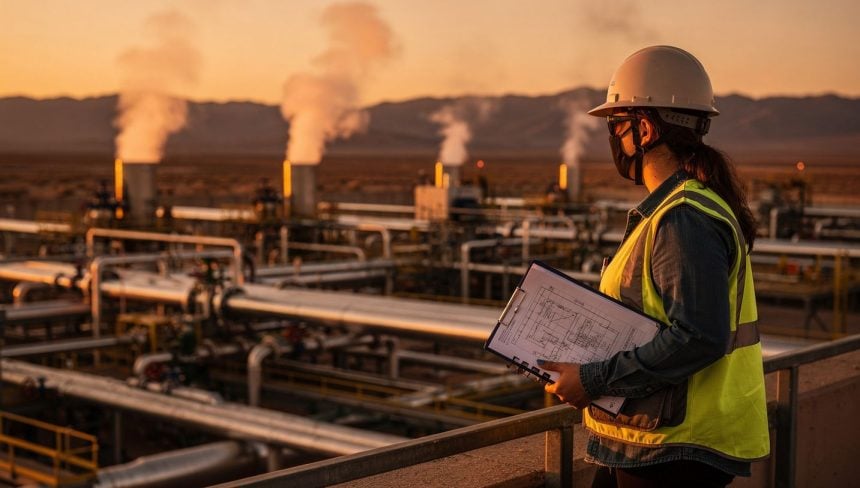
In June 2024, Zanskar bought a dying geothermal power plant in New Mexico—the kind of asset most energy companies would have abandoned. The water temperature was dropping fast, day after day, making the economics impossible. By all conventional logic, Lightning Dock was finished.
Two years later, that same plant is running at full capacity.
The reversal hinges on a deceptively simple insight: what geothermal engineers thought they knew about underground heat distribution was incomplete. Using AI-driven subsurface modeling, Zanskar drilled deeper than the original operators ever considered, and found hot water that existing geological surveys had missed entirely. The discovery doesn’t just salvage one struggling facility in New Mexico—it suggests that hundreds of geothermal sites across the United States may be sitting on untapped potential, invisible to the tools and assumptions that have guided the industry for decades.
- The Hidden Reservoir: AI subsurface modeling revealed that Lightning Dock’s rapid temperature decline was caused by a narrow cooler channel, not resource depletion—hotter water existed at greater depth than original operators ever drilled.
- The Industry Blind Spot: Most geothermal operators still rely on decision-making frameworks developed in the 1990s, despite dramatic advances in seismic data collection, computational power, and machine learning.
- The Scale of Opportunity: If AI modeling can consistently identify hidden heat at depths older surveys missed, hundreds of abandoned or underperforming geothermal facilities across the United States may harbor untapped capacity.
What happened at Lightning Dock is a quiet inversion of how we usually think about energy infrastructure. Old plants don’t get better; they get decommissioned. But this one did something stranger: it revealed that the problem wasn’t the geology. It was the blindness.
Why Did a Functioning Geothermal Plant Suddenly Fail?
The plant’s original operators had drilled to a certain depth and found a geothermal reservoir performing as expected—until it wasn’t. Water temperatures began declining at an alarming rate, roughly ten times faster than standard models predicted. The facility became economically unviable. It sat dormant, a sunk cost in the New Mexico desert.
Zanskar approached the site with a different toolkit. Rather than accepting the cooling trend as evidence of resource depletion, the company applied machine learning models trained on subsurface data from across the western United States. These models could ingest seismic readings, rock composition data, temperature gradients, and fluid flow patterns to construct a three-dimensional picture of what lay beneath the surface—including areas the original drilling campaign had never penetrated.
• Research published in PMC on enhanced geothermal heat recovery demonstrates that 3D hydrothermal coupling models incorporating initial temperature distribution are critical for accurately characterizing reservoir productivity—precisely the kind of modeling gap that led to Lightning Dock’s premature abandonment.
• A 2024 Stanford geothermal conference paper confirms that distributed temperature sensing and predictive modeling for reservoir productivity are now considered pivotal elements in shaping drilling decisions—tools that were not standard practice when Lightning Dock was originally developed.
• The convergence of these methods points to a systematic underestimation of geothermal resources at sites where early-generation surveys set the operational boundaries.
The AI analysis suggested something counterintuitive: the rapid cooling wasn’t a sign the reservoir was exhausted. Instead, it indicated that the original well had tapped into a narrow, cooler channel. Hotter water existed elsewhere in the same field, at greater depth than the previous operators had reached. The models pointed to specific coordinates and depths where drilling would likely find it.
Zanskar drilled. They found hot water.
Now the plant operates at full capacity again, generating electricity from a geothermal resource that had been written off as spent. The second well feeds into the same power generation system, but the temperatures and flow rates are stable—no rapid decline, no economic death spiral.
What Does This Mean for Geothermal Energy’s Future?
This outcome matters far beyond one New Mexico facility. Geothermal energy in the United States has always carried a reputation problem: it’s reliable, it produces no carbon emissions, but it’s also geographically limited and risky. Drilling is expensive. If you hit the wrong spot, you lose millions. Operators have historically drilled to a certain depth, assessed the resource, and made a go-or-no-go decision based on conventional subsurface geology. If the resource looked marginal, the project died.
But if Zanskar’s experience is repeatable—if AI modeling can consistently identify hidden heat at depths that older surveys missed—the geography of viable geothermal suddenly expands. A site that looked marginal under the old assumptions might be rich under the new ones. Hundreds of abandoned or underperforming geothermal facilities might harbor untapped capacity.
30+ years – The approximate age of the subsurface decision-making frameworks still used by most geothermal operators today
Hundreds – Estimated number of U.S. geothermal sites that may harbor untapped capacity invisible to older survey methods
24/7 – Geothermal energy’s operational availability, making it one of the only renewables unaffected by weather or time of day
Is the Industry Using Outdated Tools to Map the Earth’s Heat?
The Lightning Dock case exposes a structural problem in how we evaluate energy infrastructure. Geothermal plants are capital-intensive and site-specific. Once built, they’re expected to run for decades. But the subsurface models used to site them haven’t changed much in thirty years. Seismic data collection has improved, computational power has exploded, and machine learning can now find patterns in geological noise that human analysis would miss. Yet most geothermal operators still rely on the same decision-making frameworks their predecessors used in the 1990s.
Zanskar’s approach—combining AI-driven subsurface modeling with deeper drilling—suggests that this gap between available technology and industry practice is where real innovation happens. The company didn’t invent new physics. It applied better pattern recognition to data that already existed. This dynamic is not unique to geothermal energy. The same tension between legacy analytical frameworks and modern machine learning capabilities appears across infrastructure sectors—a pattern worth understanding in any field where decisions are made from incomplete data models. The way machine learning models extract insight from distributed, fragmented datasets has broad implications beyond energy, reshaping how institutions interpret data they have held for decades.
How Does This Change the Economics of Decarbonization?
For the reader, this story touches something immediate: the grid that powers your home, your phone, your car. Geothermal energy is one of the few renewable sources that runs 24/7, regardless of weather or time of day. It’s also scarce. Every geothermal megawatt that comes online is one less megawatt that has to come from natural gas or coal. If AI modeling can unlock geothermal capacity that was previously invisible, it reshapes the economics of decarbonization.
The broader pattern here is worth noticing. Across energy, agriculture, materials science, and infrastructure, AI is functioning less as a creator of new knowledge and more as a translator—converting raw data into usable insight using methods that scale faster than human expertise can. Zanskar didn’t discover a new geothermal principle. It found hot water that was always there, using tools that older operators simply didn’t have access to.
That gap—between the data we’ve collected and the insights we’ve extracted from it—is enormous across almost every physical system we depend on. Bridges, power plants, water systems, mines. Decades of operational data sits in databases, analyzed according to frameworks that predate modern machine learning. The Lightning Dock story is a proof-of-concept that revisiting those datasets with contemporary tools can yield surprises. The same logic applies to how organizations handle behavioral and operational data more broadly: the gap between data collected and insight extracted is not a technical problem so much as a structural one, driven by institutional inertia rather than technological limits. Understanding how data collection shapes operational decisions in other sectors illustrates just how pervasive this pattern has become.
What Are the Real Limits of This Approach?
There are limits to this narrative. One successful geothermal rescue doesn’t guarantee the method scales across the industry. Geology is local; what works in New Mexico may not work in Nevada or California. Zanskar is a startup with access to capital and specialized expertise—not every geothermal operator has those resources. And the company hasn’t published detailed technical results yet, so the exact mechanisms driving the success remain somewhat opaque.
• The core technical challenge in geothermal revival is distinguishing between genuine resource depletion and localized thermal channeling—a distinction that conventional single-well assessments are structurally ill-equipped to make.
• Stanford geothermal research highlights that predictive modeling for reservoir productivity requires integrating multiple data streams simultaneously—precisely the kind of multi-variable pattern recognition where machine learning outperforms traditional geological analysis.
• The practical implication is that geothermal site assessments conducted before approximately 2015 may systematically underestimate resource depth and lateral extent, making retrospective AI-driven analysis a potentially high-value investment for operators sitting on dormant assets.
But the implication is clear: we may have been underestimating geothermal resources in the United States not because the heat isn’t there, but because our tools for finding it have lagged behind what’s possible. The next question is whether other energy companies will adopt similar approaches, and how quickly. If they do, the map of viable geothermal sites in America could look very different in five years than it does today. The Lightning Dock story is ultimately about the cost of institutional inertia—and what becomes possible when someone decides to ask whether the old assumptions were ever actually correct.