

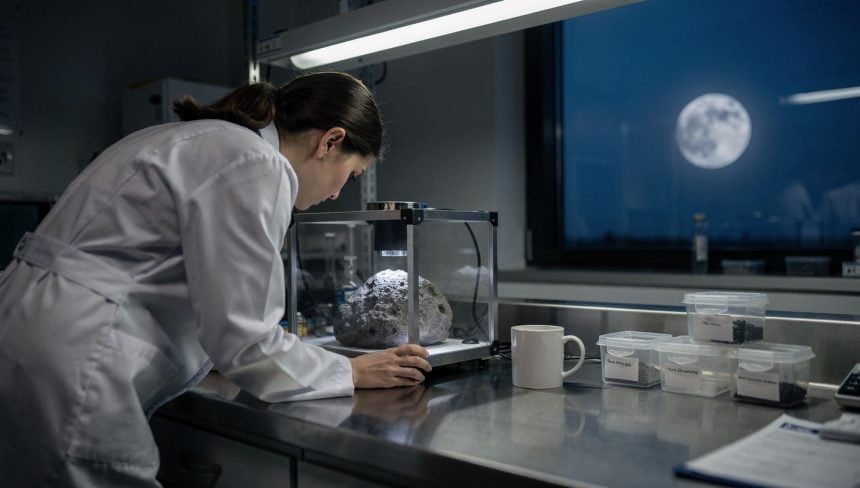
A sample returns from Mars. Inside the sealed container: microbes unlike anything Earth’s biosphere has ever encountered. Instead of bringing it directly to a laboratory in Houston or Geneva, scientists are now seriously proposing something that sounds like science fiction: build a quarantine facility on the Moon first.
This isn’t idle speculation. Researchers have begun arguing that a lunar biocontainment facility for extraterrestrial samples could prevent what they describe as “the potential ecological devastation of an invasive extraterrestrial organism.” The proposal hinges on a counterintuitive logic: if we’re uncertain whether alien life might pose an existential risk to Earth’s ecosystems, the safest place to study it is somewhere alien life has already proven it cannot spontaneously reach—the Moon itself.
- The Core Risk: Planetary protection protocols have historically focused on protecting other planets from Earth microbes, not on protecting Earth from what sample-return missions might bring back.
- The Lunar Logic: A Moon-based quarantine facility would place 238,855 miles of vacuum between any extraterrestrial sample and Earth’s biosphere, functioning as a structural fail-safe that no terrestrial BSL-4 lab can replicate.
- The Timeline Pressure: NASA’s Mars Sample Return campaign targets the early 2030s, making the question of where and how to study Martian material an urgent policy decision, not a theoretical one.
The concern driving this proposal reveals a hidden gap in how we prepare for the unknown. When NASA’s Perseverance rover collects Martian soil samples, or when future missions bring back rock cores from the subsurface of Enceladus or Europa, we face a genuine epistemic problem: we don’t know what we don’t know about extraterrestrial biology. A microorganism adapted to Martian conditions might be harmless to Earth life. Or it might find our biosphere hospitable in ways we cannot predict until it’s already here.
The Moon offers something Earth cannot: distance, vacuum, and proven sterility.
• Research published in the International Journal of Astrobiology by the Sterilization Working Group concludes that existing frameworks for preventing contamination from putative extraterrestrial life forms during sample-return missions remain incomplete, tracing the problem back to protocols first established during the Apollo 11 mission in 1969.
• A 2023 analysis of planetary protection policy notes that NASA’s Artemis planning—which includes lunar orbit operations and crew habitats—is already forcing a reassessment of what containment infrastructure in cislunar space would need to look like.
• The asymmetry between forward contamination (Earth microbes reaching other worlds) and backward contamination (extraterrestrial material reaching Earth) has been consistently underweighted in mission planning, despite representing a categorically different order of risk.
How Does a Lunar Quarantine Actually Work?
Consider the mechanics. A sample collected on Mars would be sealed in a return vehicle, launched into space, and intercepted not by Earth but by a lunar orbital station. From there, robotic systems would transfer the material to a surface facility—perhaps buried beneath regolith for additional radiation shielding. Scientists would conduct initial analysis remotely, using telepresence technology and automated instruments. Only after exhaustive study, and only if the samples posed no detectable threat, would they be returned to Earth.
This layered containment strategy mirrors the logic of biosafety levels in terrestrial laboratories, but with an additional moat: 238,855 miles of vacuum. If something went wrong in a BSL-4 lab on Earth, there are protocols—negative pressure chambers, HEPA filtration, decontamination procedures. But those are human-designed safeguards against known pathogens. An organism we’ve never encountered, with biochemistry potentially based on different nucleic acids or amino acids, might bypass every assumption we’ve built into our containment systems. The Moon, by contrast, offers a fail-safe: if a sample somehow escaped the facility, it would encounter an environment where no Earth organism survives. Extraterrestrial life might not survive either—but we wouldn’t have to bet Earth’s biosphere on that assumption.
Why Have Existing Protocols Left Earth Exposed?
The researchers proposing this acknowledge an uncomfortable truth: we’ve been assuming for decades that planetary protection protocols—sterilizing our rovers before they land on Mars, for instance—are sufficient to prevent contamination in both directions. But as NASA’s Astrobiology program has noted, the ethical and technical frameworks governing planetary protection were built primarily around the risk of Earth microbes contaminating other worlds before we can study them. The reverse scenario—what happens when the sample comes home—has received comparatively little structural attention.
Those protocols were designed to protect other planets from Earth microbes, not to protect Earth from what we might find. The asymmetry matters. We’ve never had to contain something that evolved under completely different selective pressures, in an environment with different chemistry, different temperature ranges, different radiation exposure. The gap between what our containment systems were designed to handle and what an extraterrestrial organism might represent is not a gap we can close through monitoring alone.
• The Sterilization Working Group’s findings make clear that backward planetary protection—containing material returning to Earth—requires a fundamentally different framework than the forward contamination protocols that have governed space exploration since the 1960s.
• The core challenge is epistemological: standard risk assessment requires prior knowledge of the hazard. With extraterrestrial biology, that prior knowledge does not exist until exposure has already occurred.
• A lunar facility addresses this by creating a category of containment that does not depend on knowing what you are containing—the environment itself becomes the safeguard.
What Makes the Moon the Right Buffer Zone?
What makes this proposal particularly striking is how it inverts our usual relationship with space exploration. We’ve spent seventy years launching things away from Earth and bringing things back as a routine part of discovery. The Moon quarantine idea suggests that maybe the safest way to explore is to create a buffer zone—a kind of cosmic airlock between the unknown and home.
There’s also a practical dimension. Building a lunar facility would require sustained investment, international coordination, and technological capabilities we’re only now developing. It’s not a near-term solution. But as sample-return missions from Mars move from concept to concrete timeline—NASA’s Mars Sample Return campaign aims for the early 2030s—the question of where and how to study those samples becomes urgent. Do we accept the risk of bringing Martian material directly to Earth? Do we accept the risk of studying it in orbit, where a containment breach could eventually lead to reentry? Or do we accept the cost and complexity of a lunar facility?
Is This a Model for Managing Risks We Cannot Yet Measure?
The proposal also reflects something deeper about how we approach invisible risks in an era defined by systems whose consequences outpace our ability to evaluate them. We’ve become accustomed to managing uncertainty through data collection and analysis—gathering as much information as possible before making a decision. But with extraterrestrial biology, there’s a category of risk we literally cannot gather data on until we’ve already exposed ourselves to it. A lunar quarantine is, in essence, a way to gather that data safely: to learn about alien life in an environment where the stakes of being wrong are contained.
The same structural logic applies in other domains where genuinely novel systems are being deployed before their failure modes are understood. The question of how to build buffer zones between experimental systems and the populations they affect is not unique to astrobiology. It surfaces in debates over smart home data collection, where devices gather intimate behavioral data in environments we cannot fully audit, and in the governance of AI systems whose emergent behaviors resist prediction under real-world conditions. In each case, the underlying problem is the same: conventional containment assumes knowledge of the hazard. Structural separation does not.
For most people, this remains abstract. Alien microbes feel distant, theoretical. But the underlying principle—that some risks are too uncertain to manage through conventional containment, and that physical distance might be the most reliable safeguard—applies to other domains where we’re experimenting with genuinely novel systems. It’s a reminder that as we build new technologies and systems, from AI to synthetic biology, we should ask: where is the Moon in our containment strategy? What buffer zones do we need before we’re certain something is safe? The same question that drives the debate over personal data insurance—how do you price and contain a risk you cannot fully characterize in advance—sits at the center of the lunar quarantine debate.
The researchers haven’t yet secured funding or institutional backing for a lunar biocontainment facility. But the proposal itself signals a shift in how the scientific community thinks about planetary protection. We’re moving from the assumption that we can manage any risk through monitoring and protocols, to the recognition that some risks require structural separation. The Moon, it turns out, might be the safest laboratory we have—precisely because it’s the farthest from everything we’re trying to protect.