

SpaceX has already spent $329 million on Tesla Megapacks in the first four months of 2026—a staggering sum that reveals the true scale of Elon Musk’s interconnected corporate empire and the infrastructure demands of his artificial intelligence ambitions.
The battery purchases tell a story that quarterly earnings reports and press releases rarely expose: Musk’s companies are not operating as independent entities competing in separate markets. They are deeply, financially entangled in ways that suggest a coordinated strategy to build the energy and computational infrastructure needed to power what may become the world’s largest private AI training operation.
- The Battery Commitment: SpaceX spent $329 million on Tesla Megapacks in just four months of 2026, translating to approximately 1.6 gigawatt-hours of battery storage capacity—far beyond routine procurement.
- The AI Power Problem: xAI’s Colossus data center requires stable, uninterruptible electricity; a single millisecond of power instability can corrupt AI training runs costing millions of dollars and weeks of compute time.
- The Structural Advantage: By buying from Tesla during a period of constrained global battery supply, Musk’s AI operation secures priority infrastructure access while independent competitors wait in queue.
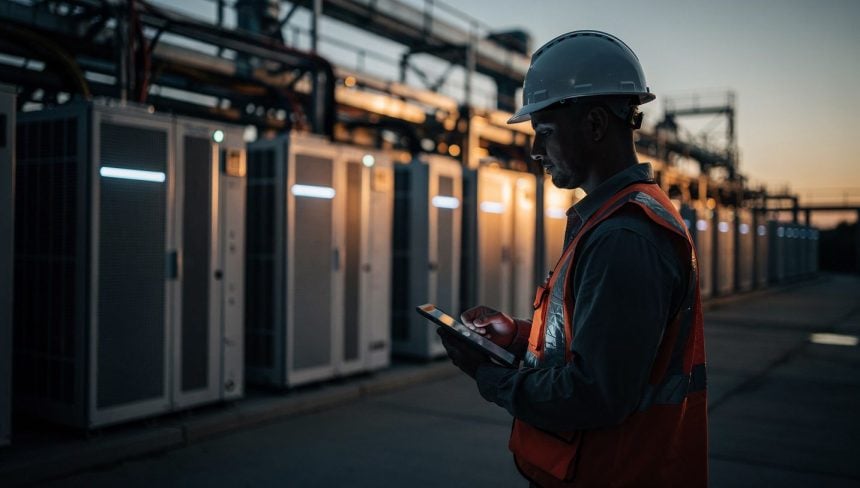
Tesla Megapacks are industrial-scale battery systems designed to store energy from solar and wind installations, or to provide backup power for data centers and heavy industrial operations. A single Megapack can store up to 15 megawatt-hours of energy. SpaceX’s $329 million commitment—at roughly $200 per kilowatt-hour for Megapack systems—translates to approximately 1.6 gigawatt-hours of battery storage capacity deployed or ordered so far this year. That is not a routine procurement. That is infrastructure buildout.
Why would a rocket company need that much battery storage? The answer lies in understanding what SpaceX actually does beyond launching Starship. The company operates Starlink, a satellite internet constellation with over 6,000 active satellites in orbit. Starlink ground stations—the facilities that receive and transmit data to and from those satellites—require massive amounts of reliable, uninterruptible power. A single ground station can draw 500 kilowatts or more during peak operation. Multiply that across hundreds of stations globally, and the energy demand becomes enormous. Understanding the data center infrastructure behind large-scale digital operations helps clarify why power stability is not a secondary concern—it is the foundation.
Why Does an AI Company Need a Power Grid of Its Own?
xAI, Musk’s artificial intelligence company founded in 2023, has been building Colossus, what it describes as the world’s largest AI training cluster. Colossus requires not just electricity—it requires stable, consistent electricity. Research reviewing the socio-technical dynamics of AI and data center energy consumption confirms that large-scale AI training operations place demands on power infrastructure that are qualitatively different from conventional computing workloads—requiring not merely high volumes of electricity but continuous, fluctuation-free delivery. A millisecond of instability can corrupt training runs costing millions of dollars and weeks of computational time. Battery backup systems are not optional infrastructure for AI facilities. They are essential.
• A 2026 review in ScienceDirect documents that AI data centers present unique energy stability requirements distinct from conventional computing, making battery storage systems a critical operational dependency rather than a backup measure.
• Research on electricity-computility integration shows that data centers are increasingly being designed around co-located energy storage to manage the volatility of grid supply during peak AI workloads.
• Analysis from the University of Chicago, citing the Electric Power Research Institute’s 2024 report on AI energy consumption, identifies battery storage as a key enabler of data center grid decarbonization and operational resilience.
The $329 million figure illustrates just how interconnected Musk’s universe of companies has become. SpaceX buys batteries from Tesla. Tesla manufactures the batteries. xAI’s computational demands drive the need for reliable power. Starlink’s ground infrastructure requires backup systems. All three companies benefit from shared energy infrastructure, and all three are ultimately controlled by the same person. This pattern of closed-loop capital flow and shared supply chains is worth examining carefully—not because it is unlawful, but because of what it reveals about how competitive advantages are being constructed in the AI era. The dynamics are not entirely unlike how cloud infrastructure wars between major AI platforms are reshaping market access for independent competitors.
How Does Vertical Integration Translate Into a Competitive Moat?
Consider the sequence: Tesla produces batteries at scale. SpaceX needs batteries for Starlink and ground operations. xAI needs power for Colossus. Rather than SpaceX or xAI negotiating with third-party battery manufacturers—Eos Energy, LG Chem, Redwood Materials—Musk’s companies are buying from Tesla, keeping capital and decision-making within his ecosystem. Tesla benefits from a guaranteed large customer. SpaceX and xAI get priority access to battery supply at a time when industrial battery production is constrained globally.
The timing matters. In 2025 and 2026, demand for large-scale battery systems has outpaced supply. Major data center operators, renewable energy companies, and governments are all competing for Megapacks. Tesla’s production capacity, while expanding, is finite. A SpaceX order for $329 million worth of inventory cuts into what would otherwise be available for external customers. This gives Musk’s AI operation a structural advantage: guaranteed power infrastructure while competitors wait in queue.
$329M – SpaceX’s Tesla Megapack spend in the first four months of 2026 alone
1.6 GWh – Approximate battery storage capacity that figure represents at current Megapack pricing
500 kW+ – Power draw of a single Starlink ground station during peak operation
6,000+ – Active Starlink satellites in orbit, each requiring ground-side power infrastructure
There is also a financial dimension that rarely receives attention. When SpaceX buys from Tesla, the transaction stays within Musk’s consolidated wealth. Tesla’s revenue increases. SpaceX’s balance sheet shows a capital expenditure. But the cash ultimately flows through entities Musk controls or owns substantial stakes in. Compare this to a scenario where SpaceX buys batteries from an independent manufacturer: capital leaves Musk’s sphere entirely. The internal procurement loop is not merely operationally convenient—it is financially self-reinforcing.
What Does This Mean for Users Who Depend on These Systems?
For users—whether relying on Starlink for internet access, interacting with xAI’s Grok chatbot, or owning a Tesla—this infrastructure consolidation carries real implications. The companies providing these services are increasingly dependent on shared power systems and supply chains controlled by a single individual. Decisions about energy allocation, infrastructure investment, and technology development are made within a closed loop rather than through competitive market dynamics. The degree to which a single actor can shape the conditions of AI development through infrastructure control is a question that extends well beyond corporate strategy—it touches on how AI systems influence decisions at scale when the underlying infrastructure is concentrated in few hands.
The interconnection also creates concentration risk. If SpaceX’s Starlink operations face regulatory restriction, demand for batteries drops, affecting Tesla’s revenue. If xAI’s data center operations face power constraints, the infrastructure investments become less valuable. Efficiency and fragility are two sides of the same vertical integration strategy.
Is This the Apple Playbook—or Something Larger?
The $329 million battery purchase is not an anomaly. It is a data point in a larger pattern. Musk has spent the last five years building vertical integration across his companies—controlling raw materials, manufacturing, energy, and distribution where possible. Tesla owns lithium mines and battery plants. SpaceX manufactures rockets and operates satellite networks. xAI is building its own AI models and infrastructure. The goal appears to be reducing dependency on external suppliers and creating a self-contained ecosystem where capital and resources can be moved rapidly in response to competitive or regulatory threats.
This strategy has precedent. Apple vertically integrated chip design and manufacturing to gain control over its supply chain and product roadmap. Amazon built AWS partly to solve its own infrastructure problems, then monetized the excess capacity. Musk appears to be executing a similar playbook, but with higher stakes and broader scope—attempting to control the energy, satellite, manufacturing, and AI infrastructure needed to dominate multiple industries simultaneously.
The question now is whether regulators and competitors will allow this consolidation to continue unchecked. The $329 million battery purchase is legal and transparent. But it is also a visible marker of how deeply entangled Musk’s companies have become, and how that entanglement gives his AI operation advantages that purely independent competitors cannot match.
As xAI continues scaling Colossus and competing with OpenAI and Google for AI dominance, every megawatt-hour of battery storage, every Starlink ground station, and every Tesla manufacturing facility becomes part of the same competitive advantage. The battery purchase is not really about Starlink or SpaceX. It is about powering the future Musk is building—one where his companies control the infrastructure that everyone else depends on.