

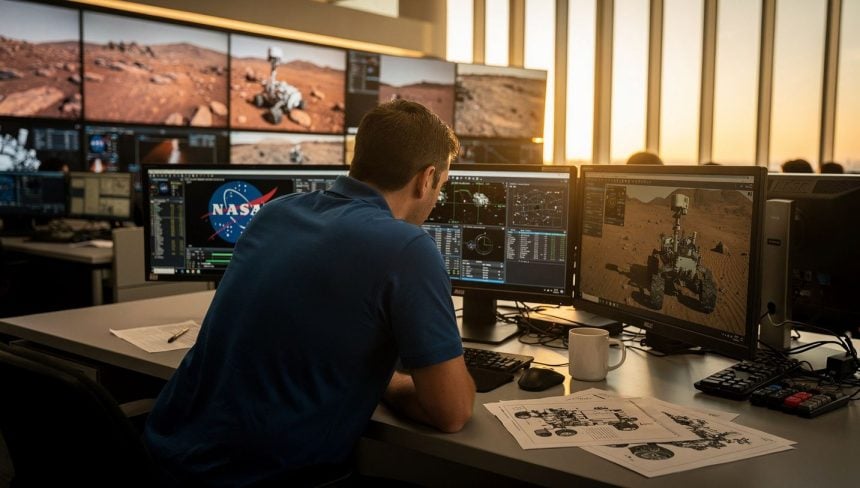
A six-wheeled robot the size of a car is steering itself across an alien planet 140 million miles away, making split-second decisions about where to go without waiting for instructions from Earth.
NASA’s Perseverance rover has spent the last few years proving that autonomous vehicles work best when humans aren’t in the loop—at least not in real time. About 90 percent of the distance Perseverance has driven has been autonomous, a dramatic shift from earlier Mars rovers that spent most of their time idle, waiting for commands to arrive from mission control after a 5- to 20-minute communication delay.
- Autonomy at Scale: Approximately 90 percent of Perseverance’s total driving distance has been completed autonomously, without real-time human instruction.
- The Latency Problem: Commands sent from Earth to Mars take between 3 and 22 minutes to arrive, making human-in-the-loop control functionally incompatible with productive exploration.
- The Governance Gap: The same edge-computing logic that freed Perseverance from human oversight now powers recommendation algorithms and behavioral targeting systems that operate far beyond meaningful human review.
The gap between Perseverance and its predecessors reveals something counterintuitive about automation: sometimes the best way to make a machine smarter is to cut the cord entirely.
Curiosity, Perseverance’s predecessor, operated almost the opposite way. Engineers on Earth would plan a route, transmit it to Mars, wait for confirmation, and then watch the rover execute. If Curiosity encountered an obstacle or sandy patch it couldn’t navigate, it would stop and wait. The rover could move autonomously for short stretches, but the default mode was deference to human command. Over its 13-year mission, Curiosity drove roughly 30 kilometers total—impressive by Mars standards, but glacial by Earth automotive timescales.
Perseverance changed the equation with a single hardware addition: a more powerful onboard computer. That upgraded processor gave the rover the computational muscle to run sophisticated image-recognition algorithms in real time. As Perseverance rolls across the Martian surface, its cameras feed visual data to onboard AI models that identify hazards—rocks, cliffs, sand traps—and calculate safe routes autonomously. The rover no longer needs to phone home for permission to turn left or right. It decides, it moves, it reports back what it found.
Why Does Latency Make Human Control Impossible?
The physics of deep-space communication make the case for autonomy more clearly than any engineering argument could. Every command sent from Earth travels at the speed of light, taking anywhere from 3 to 22 minutes to arrive, depending on planetary positions. Research on network latency in teleoperation of connected and autonomous vehicles confirms that even multi-second delays fundamentally degrade a remote operator’s ability to make safe, accurate decisions—and Mars introduces delays measured in minutes, not milliseconds.
A rover that waits for human instruction after every meter of movement is a rover that barely moves at all. A rover that trusts its own perception and judgment can cover kilometers in a single Martian day. IEEE analysis of teleoperation interfaces under multi-second latency conditions documents how engineers have attempted to compensate for these adverse effects—but the conclusion is consistent: beyond a certain latency threshold, autonomous onboard decision-making is not just preferable, it is necessary.
• 3 to 22 minutes: the one-way communication delay between Earth and Mars, depending on orbital positions
• 30 kilometers: Curiosity’s total driving distance over more than 13 years of human-directed operation
• 90 percent: the share of Perseverance’s total distance covered through autonomous navigation, without real-time human input
The result is a vehicle that operates more like a truly independent agent than a remote-controlled machine. In the time it took Curiosity to cover 30 kilometers over more than a decade, Perseverance has covered far greater distances in a fraction of the time. The rover doesn’t wait. It doesn’t hesitate. It drives.
How Does Perseverance Make Decisions Without Human Oversight?
The autonomy works because Perseverance’s engineers built constraints into the system from the beginning. The rover doesn’t roam freely across the landscape chasing whatever looks interesting. It operates within a predetermined mission zone, follows pre-planned routes, and applies conservative thresholds for what counts as a navigable surface. The AI isn’t making exploratory decisions—humans did that work months or years in advance. The AI is executing those decisions in real time, adapting to conditions on the ground that no amount of Earth-based planning could have anticipated.
This pattern—humans set the goals and boundaries, machines handle the moment-to-moment execution—mirrors the most successful autonomous systems on Earth. Self-driving vehicles don’t choose their own destinations; they navigate to destinations humans specify. Warehouse robots don’t decide what to move; they execute movement orders with autonomous precision. The most effective automation isn’t about replacing human judgment entirely. It’s about removing humans from the feedback loop where latency kills productivity.
Understanding how these bounded systems behave differently from unbounded ones is essential context for anyone tracking how recommendation engines shape user behavior at scale. The distinction between a rover navigating a crater and an algorithm navigating a human attention span is not merely technical—it is a question of what the system is optimizing for, and who defined that objective.
What Happens When the Domain Is Unbounded?
For the person reading this in 2026, Perseverance’s success carries an implication that extends far beyond Mars exploration. It suggests that the future of autonomous systems—whether rovers, vehicles, or recommendation algorithms—depends on pushing decision-making to the edge, closer to the data and further from human oversight.
That shift has consequences. When a rover makes its own navigation decisions, it can move faster, but it can also make mistakes humans might have caught. When a content-recommendation algorithm makes its own ranking decisions based on user behavior, it can personalize faster, but it can also amplify misinformation or manipulate behavior in ways humans never explicitly authorized. The computational power that freed Perseverance from Earth’s control is the same power that allows digital systems to operate at scales and speeds that make human review impossible.
• The core engineering principle behind Perseverance—push computation to the edge, minimize latency, maximize local decision-making—is now the dominant architecture for consumer-facing AI systems, from content feeds to behavioral prediction engines.
• The critical difference is constraint design: Perseverance’s autonomy is bounded by mission parameters set by accountable engineers; commercial AI systems are often bounded only by engagement metrics and advertiser objectives.
• This gap between bounded and unbounded autonomy is where the most consequential questions about AI governance are being decided, largely without public input.
This is precisely the dynamic that made Cambridge Analytica’s data operation so effective and so difficult to detect in real time. The firm’s psychographic profiling system didn’t require human review of individual targeting decisions—it pushed behavioral inference to the algorithmic edge, processing millions of data points and generating micro-targeted content at a speed and scale that made meaningful human oversight structurally impossible. The architecture was not a bug; it was the product. Speed and autonomy were what made the system work. The same logic applies to any autonomous system designed to act on behavioral data faster than humans can evaluate what is happening. Those interested in how predictive modeling extends this logic further should read about how digital twins predict behavior using similar inference architectures.
The rover’s success story is genuinely impressive engineering. But it also illustrates a deeper truth about autonomous systems: they thrive when oversight is minimal and constraints are baked into the code itself. That works fine when the system’s only goal is to safely navigate a desert. It becomes more complicated when the system’s goal is to maximize engagement, or predict behavior, or sort people into categories for targeting.
Is Trusting Autonomous Systems a Question of Design or Governance?
Perseverance proves that machines can be trusted to make good decisions within bounded domains. The harder question—the one Mars rovers don’t have to answer—is what happens when the domain is unbounded, and the machine’s incentives don’t align with human welfare.
The rover operates in a domain with no commercial pressure, no engagement metric, no advertiser demanding that it linger in a particular crater. Its constraints were written by engineers whose professional accountability is to mission success, not quarterly revenue. That institutional context is not incidental to the rover’s trustworthiness—it is foundational to it. The broader implications of how AI systems are deployed in commercial contexts, and who bears accountability when they cause harm, are increasingly being examined through frameworks like enterprise AI adoption and digital ethics.
For now, Perseverance keeps driving, making its own way across Jezero Crater, sending back data about what it finds. It is a machine that learned to trust itself within a system designed by people who thought carefully about what that trust should cost. The question for the rest of us is whether we are equally careful about which machines we trust, what constraints we have actually written into their objectives, and whether the institutions deploying them are accountable to the people those machines affect.