
Eight instructional videos materialized on Valve’s servers last week, each one a small window into how the company expects you to wear, adjust, and sign into its upcoming Steam Frame virtual reality headset—and the login method is so stripped-down it borders on parody.
The leaked footage reveals something rarely visible in hardware design: the moment when engineering pragmatism collides with the reality of shipping a consumer device. No biometric scanning. No iris recognition. No blockchain-verified authentication. Just you, your phone, and a QR code.
- The Login Method: Valve’s Steam Frame uses QR-code authentication via smartphone rather than any embedded biometric sensor, a deliberate departure from industry norms.
- The Design Philosophy: Eight leaked training videos reveal a headset built around physical accommodation—fit dials, nose blockers, modular adjustments—over specification-sheet spectacle.
- The Security Trade-off: By delegating authentication to your phone, Valve effectively inherits your device’s existing biometric security layer without building one into the headset itself.
The eight videos, discovered and reported by Engadget on April 18, 2026, walk through the Steam Frame’s physical setup with the precision of IKEA furniture instructions. One video demonstrates how to wear the headset itself—a process that appears to involve settling it onto your face and adjusting a fit dial. Another shows how to achieve what Valve calls “the perfect fit,” suggesting the device has enough mechanical adjustment that getting it wrong is possible. A third addresses the sign-in flow, and that’s where things get genuinely interesting from a design and privacy standpoint.
The QR-code login system is staggering in its simplicity.
Why Did Valve Choose a QR Code Over Biometric Authentication?
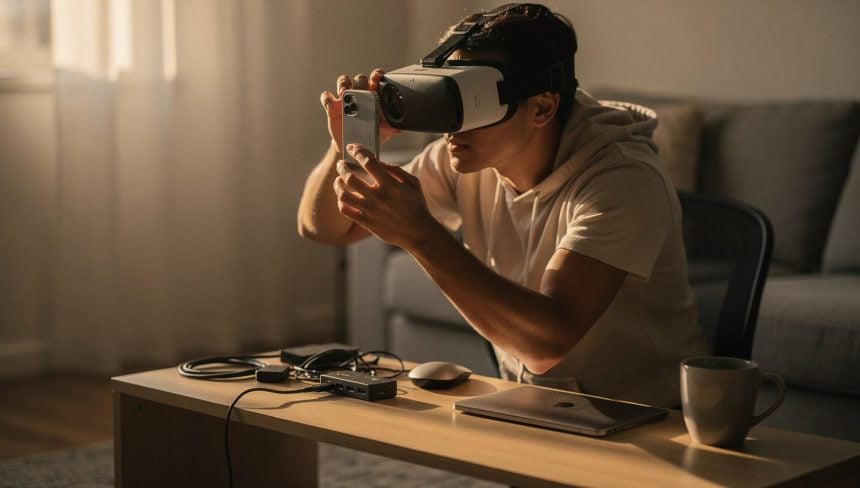
Rather than embedding a camera or biometric sensor into the headset itself, Valve’s approach appears to require you to hold your phone up to the Steam Frame’s front panel, scan a code displayed on the device, and authenticate through your phone. It’s the kind of solution that feels like it emerged from a design meeting where someone said, “What if we just… didn’t overthink this?” The method bypasses the entire category of friction that typically surrounds VR headset setup—no pairing protocols, no Bluetooth negotiation, no account linking wizardry. Point phone. Scan. Done.
That choice carries real implications for how user data is handled at the point of authentication. The question of whether to embed biometric hardware directly into a consumer device is not merely an engineering decision—it is a privacy architecture decision. Biometric data collected at the device level creates a local data store that must be secured, potentially updated, and in some regulatory contexts, disclosed. By offloading authentication entirely to the user’s existing smartphone, Valve sidesteps that obligation. The headset itself never captures or stores a fingerprint, a facial geometry map, or an iris scan.
• A survey of continuous authentication systems published in PMC found that physiological biometric approaches—face and fingerprint recognition—are now widely adopted in smart devices, but introduce persistent privacy trade-offs around data storage and breach exposure.
• Research published in IEEE Xplore on privacy-preserving biometric systems documents the technical complexity of securing iris and face recognition data within hardware-based devices, complexity that Valve’s QR approach avoids entirely.
• A 2026 PMC study proposing lattice-integrated biometric frameworks underscores how difficult it remains to preserve both integrity and privacy when consumer hardware collects biometric data directly.
This is not how premium consumer electronics usually present themselves. The leaked videos show a device that seems almost aggressively modular and low-tech in spots. One video demonstrates a nose-sized light blocker—a small accessory designed to prevent ambient light from leaking into your field of view. It’s the kind of detail that suggests Valve’s design team spent time thinking about the experience of wearing the thing for hours, not just the specs sheet. For readers interested in how privacy considerations get embedded into product design from the ground up, the principles at work here connect directly to what researchers call privacy by design—the idea that data minimization should be an architectural choice, not an afterthought.
What Does the Accidental Leak Actually Reveal?
The accidental leak itself is instructive. These videos were not meant for public consumption yet. They exist on Valve’s infrastructure as training materials, likely destined for retail staff, customer support, and early adopters. The fact that they surfaced unannounced, without press release or controlled rollout, means we’re seeing Valve’s actual design philosophy unfiltered by marketing language. No aspirational language about “immersive presence” or “next-generation interaction.” Just: here’s how you put it on, here’s how you make it fit, here’s how you log in.
The QR-code approach also reveals something about Valve’s assumptions regarding the Steam Frame’s relationship to your existing devices. The headset is not designed as a standalone authentication hub. It’s designed as a peripheral to your phone—the device you already trust, already carry, already use to sign into everything else. From a security standpoint, this is arguably sound: your phone’s biometric authentication (face or fingerprint) becomes the actual gatekeeper, not the headset itself. The QR code is just the bridge.
• The decision to delegate authentication to a user’s existing smartphone rather than embed biometric hardware represents a meaningful data minimization choice—the headset collects no biometric data of its own.
• This architecture means Valve is not subject to the regulatory obligations that would arise from storing facial geometry or fingerprint data on a consumer device, a consideration that grows more significant as biometric privacy laws expand across jurisdictions.
• The trade-off is dependency: the Steam Frame requires a smartphone nearby for initial authentication, which narrows its use cases compared to fully standalone headsets.
But it also exposes a design constraint that Valve seems to have accepted: the Steam Frame, at least at launch, will require your phone nearby for initial setup. That’s not a flaw, necessarily. It’s a choice. And choices in hardware design often reveal what engineers believe users actually need versus what marketing teams believe users want to hear about. The broader conversation around consumer tech innovation often focuses on feature addition, but Valve’s approach here is notable precisely for what it chose not to add.
Is Simplicity a Legitimate Security Strategy?
The fit-adjustment system shown in the leaked videos suggests Valve has learned from the VR headset market’s history of discomfort complaints. The dial mechanism appears to allow for quick micro-adjustments without removing the headset entirely. Other videos show how to position the device for different head shapes and sizes. This is the unglamorous work of hardware design: not innovation, but accommodation. Making sure the thing doesn’t hurt after twenty minutes.
Valve has not officially confirmed the authenticity of these videos or provided a timeline for the Steam Frame’s public release. The company also has not commented on the leak itself. The videos appear to have circulated among tech enthusiasts and VR communities before being reported by mainstream outlets, suggesting the leak was discovered organically rather than through a coordinated disclosure. The episode is a reminder that even companies with tight operational security occasionally expose their internal assumptions to public scrutiny—and that those assumptions can be more revealing than any press release. It echoes a pattern seen elsewhere in the tech industry, where accountability surfaces not through official channels but through unplanned exposure, a dynamic explored in the case of tech accountability in other product contexts.
For you, the potential user, these videos sketch out a device that prioritizes simplicity over complexity in places where other manufacturers have gone the opposite direction. The QR-code login won’t feel futuristic. It will feel refreshingly practical—like Valve’s engineers asked themselves what problem actually needed solving, rather than what features competitors were advertising.
The broader implication is that sometimes the most interesting design choices are the ones that don’t try to be interesting. A nose blocker. A fit dial. A QR code. These are the details that determine whether a headset is something you’ll wear for an hour or something you’ll tolerate for ten minutes before removing it in frustration. The willingness to accept a simpler, less data-hungry authentication method may ultimately matter more to users than any specification the marketing team could have invented for it.
Valve’s official announcement and full specifications for the Steam Frame have not yet been released. The company is expected to provide more details about the device, its pricing, and its availability timeline in the coming months.