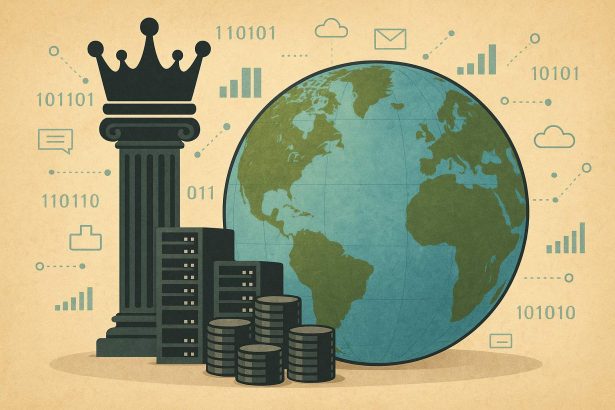


Personal data used to be a byproduct of daily life — a leftover trace of online activity.
Today, it is a strategic resource, a geopolitical asset, and in many ways the fuel of modern power.
Governments around the world are no longer just regulating data; they are actively competing for it.
This new reality is known as the global war for personal data.
- Why personal data has become a national resource
- The new digital arms race
- Data as a tool of influence and control
- The role of big tech in global data competition
- How nations gather personal data
- Data colonialism: a modern form of power imbalance
- The cybersecurity dimension
- The legal vacuum
- Can the global data race be slowed — or made fair?
- What this means for ordinary people
- Conclusion: data is now a tool of power
The Cambridge Analytica scandal exposed how data could influence political outcomes.
Since then, nations have realized that whoever controls data controls public opinion,
technological innovation, economic forecasting, and even national security.
Why personal data has become a national resource
Data is often described as “the new oil,” but that analogy is incomplete.
Oil is finite; data multiplies.
Once collected, it can be copied, analyzed, sold, and reused at virtually no cost.
For governments, personal data provides:
- Economic power — fueling AI development and global competitiveness
- Security intelligence — monitoring threats and understanding social dynamics
- Political advantage — shaping narratives and predicting public reactions
- Social control — tracking populations and enforcing policy at scale
This makes data not just a commercial asset, but a pillar of geopolitical strategy.
The new digital arms race
Countries once competed for land, military power, or natural resources.
Today, competition increasingly centers on:
- Who can collect the most data
- Who can process it fastest
- Who can build the most powerful predictive algorithms
The race is international — and intensely secretive.
Governments rarely admit how deeply they rely on commercial or state-operated surveillance systems,
but the outcomes are visible:
- National AI strategies fueled by massive data pipelines
- Cyber espionage targeting industries and citizens
- Government-backed data-collection partnerships with tech giants
Behind the scenes, nations are building vast data infrastructures designed to give them strategic advantage.
Data as a tool of influence and control
Personal data allows governments to predict and shape population behavior.
That power can be used for:
- Public policy — analyzing mobility patterns or health trends
- Political messaging — targeting voters with tailored content
- National security — detecting extremist networks or foreign interference
- Social regulation — enforcing compliance through digital monitoring
The danger, of course, is when legitimate tools turn into instruments of surveillance or manipulation —
especially in times of political instability.
The role of big tech in global data competition
In the past, governments collected data directly.
Today, much of the world’s personal data is owned by private corporations — social networks,
search engines, cloud providers, and smartphone ecosystems.
This creates two key dynamics:
- Governments depend on corporations for access to behavioral data
- Corporations depend on governments for market access and regulatory protection
This interdependence fuels a new type of diplomacy, where tech companies act as geopolitical actors —
shaping everything from public discourse to international negotiations.
How nations gather personal data
Data collection is no longer limited to official channels.
Governments gather personal information through multiple pathways, including:
- Digital identity systems (national ID programs, biometric databases)
- Telecom infrastructure (metadata from calls, texts, and connections)
- Border surveillance (facial recognition, visa databases)
- Health apps (introduced during pandemics and rarely removed afterward)
- Private-sector partnerships (data-sharing agreements with tech companies)
- Cyber espionage (targeting corporations, universities, and critical systems)
In many cases, users never learn how deeply their information is woven into national strategies.
Data colonialism: a modern form of power imbalance
Scholars describe “data colonialism” as a system where powerful nations or corporations extract data
from populations the way colonial powers once extracted natural resources.
Examples include:
- Developing nations relying on foreign companies for cloud storage
- Foreign analytics firms managing national databases
- Data-rich regions becoming dependent on external AI systems
Control of data becomes a form of control over political, economic, and technological futures.
The cybersecurity dimension
If data is the new battleground, then cybersecurity is the new defense infrastructure.
Nations invest heavily in protecting:
- Healthcare databases
- Financial systems
- Energy grids
- Military networks
- Electoral infrastructure
Yet even the most advanced defenses can be breached.
Nation-state attacks increasingly target personal data because it reveals vulnerabilities
that can be exploited for leverage, extortion, or influence operations.
The legal vacuum
Most privacy laws were designed for companies — not governments.
As a result, many nations operate in poorly regulated spaces where:
- Surveillance is legal but undisclosed
- Data-sharing agreements are opaque
- Cross-border transfers are difficult to track
International treaties on data governance remain limited, leaving a patchwork of inconsistent rules.
Can the global data race be slowed — or made fair?
Several proposals aim to bring accountability to the digital power struggle:
- Global standards for data protection (similar to climate treaties)
- Transparency requirements for government data partnerships
- Limits on predictive profiling in political contexts
- Democratic oversight of national AI and surveillance systems
But these measures face resistance — especially from governments that view data as a strategic advantage.
What this means for ordinary people
Individuals are part of a global contest they never chose to enter.
Their data flows across borders, devices, and databases in ways they cannot easily see.
To protect themselves, users can:
- Limit unnecessary data sharing
- Use privacy-focused tools and browsers
- Review app permissions frequently
- Avoid linking accounts across services
While personal action cannot stop geopolitical competition, it can reduce exposure.
Conclusion: data is now a tool of power
The global race for personal data is not just about technology — it is about sovereignty,
political influence, and control.
As Cambridge Analytica demonstrated, data can shape opinions and alter the direction of societies.
Today, that power is no longer in the hands of one company, but in the strategies of nations.
The question now is not whether the data war will continue, but how societies will respond —
and whether democratic principles can survive in a world where information is the ultimate weapon.