

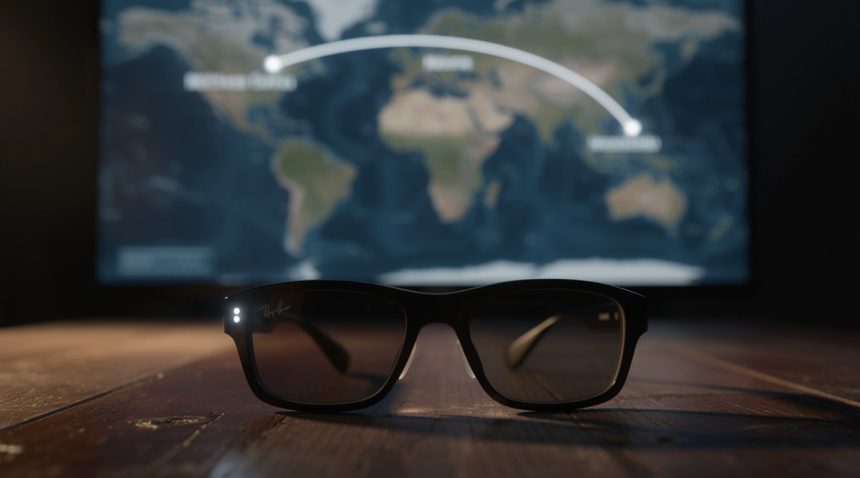
Meta’s AI-powered smart glasses look like any ordinary pair of Ray-Bans. But a bombshell investigation reveals that the footage they capture — including intimate moments in your bedroom, your bank card details, even explicit content — is being reviewed by human contractors thousands of miles away.
- The Human Review Reality: Every AI interaction from Ray-Ban Meta glasses gets sent to Kenyan contractors who see unfiltered footage of users’ private lives.
- The Privacy Failure: Meta’s automated face-blurring fails in 15-20% of cases, exposing intimate moments and explicit content to foreign workers.
- The GDPR Violation: 7 million European users’ data flows to Kenya without adequate privacy protections, triggering formal EU parliamentary inquiry.
The Investigation That Changed Everything
On February 27, 2026, two Swedish newspapers — Svenska Dagbladet and Göteborgs-Posten — published a joint investigation that sent shockwaves through the tech world. Their reporters had spoken with data annotators working for Sama, a Nairobi-based outsourcing company subcontracted by Meta to help train the artificial intelligence built into its Ray-Ban smart glasses.
What those workers described was deeply unsettling: a daily stream of unfiltered, highly personal footage from the private lives of glasses wearers — footage those users never intended anyone to see. This represents the same kind of surveillance tactics that platforms now deploy across consumer devices.
This is not a story about hackers or a data breach. This is how the product is designed to work.
How Do Ray-Ban Meta Glasses Actually Work?
The Ray-Ban Meta glasses look like a stylish pair of sunglasses. But they have a built-in camera, microphone, and an AI assistant you activate by saying “Hey Meta.”
When you do that, the glasses start recording what you see and hear, and send that footage to Meta’s servers for processing. The AI can then answer questions, translate languages, identify objects, and more. It sounds convenient — and it has been popular, with over 7 million pairs sold in 2025 alone.
Here is what most users do not know: that footage does not stay inside an automated system. It gets sent to human workers who review it, label it, and use it to train Meta’s AI models. This is called data annotation, and it is a standard practice in the AI industry. But the scale of what those workers are seeing raises serious questions about privacy, consent, and corporate accountability.
• 7 million Ray-Ban Meta glasses sold in 2025 alone
• Thousands of hours of intimate footage reviewed daily by Kenyan contractors
• 15-20% failure rate for automated privacy safeguards in difficult lighting
What Are Workers in Nairobi Actually Seeing?
The Kenyan contractors spoke to Swedish journalists anonymously, afraid of losing their jobs. Their accounts are striking.
“In some videos, you can see someone going to the toilet, or getting undressed,” one worker said. “I don’t think they know, because if they knew, they wouldn’t be recording.”
Another described a clip in which a wearer set their glasses on the bedside table and left the room — only for their partner to walk in and undress, completely unaware the camera was still running. Workers also reported seeing bank card numbers filmed by accident, people watching pornography while wearing the glasses, and in some cases, explicit sexual activity.
“We see everything — from living rooms to naked bodies. Meta has that type of content in its databases.” – Kenyan data annotator, Svenska Dagbladet investigation, 2026
And if workers start asking questions about what they are seeing? “If you start asking questions, you are gone,” one employee said.
Why Don’t the Technical Safeguards Work?
Meta claims that footage sent for annotation is first filtered and that faces are automatically blurred to protect privacy. But according to the Nairobi workers, those safeguards frequently fail.
“The algorithms sometimes miss,” a former Meta employee confirmed to the Swedish outlets. “Especially in difficult lighting conditions, certain faces and bodies become visible.”
According to research published in IEEE Xplore, device-free human activity recognition systems struggle with accuracy in variable lighting conditions, validating the contractors’ reports of failed privacy filters.
There is also no way to opt out. Users who activate the AI assistant must agree to have their data processed by Meta’s servers — including the possibility of human review. And the AI functions are entirely cloud-dependent: when journalists tested the glasses with no internet connection, the AI stopped working completely.
Is This Legal Under European Privacy Law?
This is where things become particularly serious for European users.
The GDPR requires that companies be transparent about how user data is collected and processed, and that data sent outside the European Union be subject to equivalent privacy protections. Kenya does not currently have EU “adequacy” status — meaning its data protection standards have not been recognised as equivalent to European law.
Following the investigation, 17 Members of the European Parliament from four political groups formally asked the European Commission whether Meta’s practices comply with GDPR.
Data protection lawyer Kleanthi Sardeli, from the privacy NGO NOYB, pointed to a “clear transparency problem.” Petter Flink, a security specialist at the Swedish data protection authority, was blunt: users have “really no idea what is happening behind the scenes.”
• CA harvested Facebook data without explicit user consent for profiling
• Ray-Ban glasses harvest intimate visual data without bystander consent
• Both cases reveal how “convenience” features mask extensive surveillance infrastructure
What Should You Know Before Wearing These Glasses?
The Ray-Ban Meta affair is a textbook case of what surveillance researchers call the normalization of ambient data collection — the gradual erosion of privacy through devices that feel ordinary, even fashionable, while silently harvesting data at scale.
The glasses do not look like surveillance tools. They look like sunglasses. That is precisely the point. Analysis by researchers at Nature demonstrates how wearable devices can capture detailed behavioral patterns through seemingly innocuous activity tracking.
If you own a pair, the key questions to ask are: Do you fully understand what happens to the footage your glasses capture? Did you read the AI terms of service before activating the assistant? Did the people around you — your partner, your family, strangers on the street — consent to being recorded and having that footage sent to a third-party contractor in another country?
In most cases, the honest answer is no.
Meta directed media inquiries to its privacy policy, which states that human review of AI interactions may occur “in some cases.” The full investigation by Svenska Dagbladet and Göteborgs-Posten was published on February 27, 2026.