

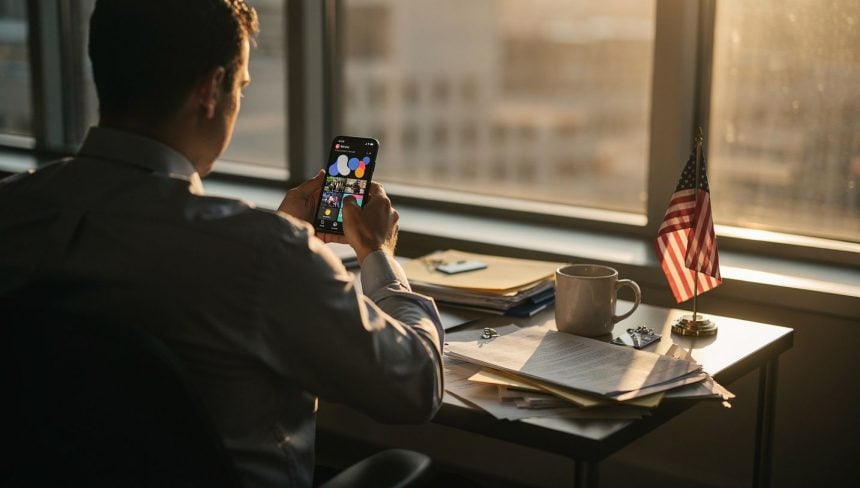
Federal workers can download TikTok on their government devices again. The Trump administration reversed a sweeping 2022 ban on the app, citing what it calls a fundamentally altered platform with new algorithmic controls and American ownership structures. But buried in the Justice Department’s legal opinion is a detail that undercuts the entire rationale: ByteDance, TikTok’s Chinese parent company, still retains nearly 20 percent ownership of the platform.
The reversal marks a sharp pivot from the national-security posture that dominated the previous four years. In 2022, the Office of Management and Budget issued a directive prohibiting federal agencies from using TikTok on government-issued devices, citing risks that user data could be accessed by the Chinese government or used for surveillance purposes. That ban affected millions of federal employees across the Department of Defense, the State Department, and dozens of civilian agencies. Now, that prohibition is lifted—at least for the moment—pending what the administration describes as sufficient safeguards.
- Ownership Gap Remains: ByteDance retains nearly 20 percent of TikTok despite the administration’s claim of fundamentally altered ownership structures.
- Scope of Reversal: The 2022 ban covered millions of federal employees across the Department of Defense, State Department, and dozens of civilian agencies — all now permitted to use the app on government devices.
- Structural Risk Unaddressed: The Justice Department’s opinion focuses on algorithmic controls but does not resolve how ByteDance’s ownership stake interacts with the data-protection commitments made by TikTok’s American management team.
What changed? According to the Justice Department opinion released this month, TikTok has implemented new algorithmic systems and operational structures that the administration believes mitigate foreign-government access risks. The company has also made commitments around data handling and user privacy that the administration found credible enough to reverse course. But the ownership question remains unresolved in the public record. For readers tracking how TikTok’s algorithm became a national-security flashpoint in the first place, the current reversal represents a significant departure from the logic that drove the original ban.
ByteDance’s 20 percent stake is not a footnote. It represents a structural claim on the company’s future profits, governance decisions, and strategic direction. When a foreign entity retains meaningful ownership of a platform handling the personal data of millions of American federal workers — people with security clearances, access to sensitive information, and positions within the national-security apparatus — the question of algorithmic controls becomes secondary to the question of who ultimately benefits from the data flowing through those systems.
• Analysis published in the Journal of Political Power examines ByteDance’s ownership structure through the lens of inter-capital relations, finding that the company’s path to its current configuration reflects competing pressures from Chinese regulatory frameworks and international investor demands.
• A Congressional Research Service report on TikTok documents that ByteDance operates through a variable interest entity structure, a mechanism that China uses to restrict direct foreign investment in its internet sector while maintaining effective control over strategic assets.
• Bipartisan Senate correspondence to the Committee on Foreign Investment cited ByteDance’s ownership of TikTok as a direct national-security concern, specifically referencing the company’s obligations under Chinese law to cooperate with state intelligence requests.
How Does ByteDance’s Ownership Structure Actually Work?
The variable interest entity structure documented by the Congressional Research Service is central to understanding why the Justice Department’s framing is incomplete. Under this arrangement, ByteDance maintains effective control over TikTok’s operations through contractual agreements rather than direct equity ownership in the conventional sense. China prohibits foreign investors from holding direct stakes in domestic internet companies, so the VIE structure allows ByteDance to satisfy both Chinese regulatory requirements and international capital markets simultaneously. The result is a corporate architecture deliberately designed to obscure the lines of control — which is precisely why a 20 percent ownership figure, however it is calculated, does not capture the full picture of who can influence the platform’s direction.
This mirrors a pattern that emerged during the Cambridge Analytica scandal, when the boundary between data collection and data weaponization proved far more porous than regulators assumed. Cambridge Analytica didn’t need to own Facebook outright to harvest tens of millions of user profiles through a personality quiz app. It needed access to the data, the ability to infer behavioral patterns, and a financial incentive to monetize those inferences. The company’s business model — selling psychographic profiles to political campaigns — depended entirely on the assumption that data collection could be separated from data use. It couldn’t. Similarly, TikTok’s algorithmic systems and American operational structures do not eliminate ByteDance’s financial interest in the behavioral data generated by federal workers using the platform. The data itself remains an asset.
Why Algorithmic Safeguards Are Not the Same as Ownership Safeguards
The Justice Department’s opinion does not address the ownership structure directly. Instead, it focuses on algorithmic transparency, data-access protocols, and commitments from TikTok’s American management team. Those are real safeguards. But they operate within a corporate structure where a foreign entity still owns a substantial piece of the company’s future value. If ByteDance’s stake is ever sold, transferred, or leveraged as collateral, the data-protection commitments made by the current American management team could shift with new ownership.
The distinction matters because algorithmic controls are reversible. They depend on the continued willingness of the current management team to enforce them, the continued political will of the current administration to monitor compliance, and the continued absence of financial or political pressure from Beijing. None of those conditions are guaranteed. The legacy of Cambridge Analytica is instructive here: the safeguards that Facebook believed were in place — terms of service, developer agreements, data-use policies — proved entirely inadequate once a third party had a financial incentive to circumvent them. The mechanism of circumvention was not a technical breach. It was a contractual one, enabled by the assumption that data-access agreements would be honored in good faith.
• The bipartisan Senate position, as documented in correspondence to the Committee on Foreign Investment, holds that ByteDance’s ownership creates an inherent conflict: TikTok’s American management may be operationally independent, but ByteDance remains subject to Chinese national intelligence laws that require cooperation with state security requests.
• The VIE structure, as analyzed in the Congressional Research Service report, means that effective control and nominal ownership can diverge significantly — making percentage-ownership figures an unreliable proxy for actual influence over data governance decisions.
• The practical implication for federal agencies is that data-protection commitments made under the current administration’s framework could be structurally undermined by corporate events — a sale, a restructuring, or a change in Chinese regulatory posture — that have nothing to do with TikTok’s American operations.
What the 2022 Ban Got Wrong — and What the Reversal Gets Wrong
The timing of the reversal is notable. The Trump administration took office in January 2025, and the ban reversal came just months later. The previous administration had pursued a more aggressive posture toward Chinese technology companies, including efforts to force a sale of TikTok’s American operations or face a nationwide ban. That pressure never materialized into law. The current administration’s approach is different: it accepts TikTok’s continued operation under its current ownership structure, provided certain algorithmic and operational safeguards are in place.
The 2022 ban was crude. It treated TikTok as a monolithic security threat without distinguishing between the platform’s technical architecture, its data-handling practices, and its ownership structure. The current reversal is more nuanced, but it may be too trusting. It assumes that algorithmic changes and American management can overcome the fundamental reality of foreign ownership. The broader pattern of how data monetization structures create leverage — explored in depth in analyses of surveillance capitalism — suggests that financial stakes in data-generating platforms consistently create incentives that operational safeguards alone cannot neutralize.
What Happens Next for Federal Agencies?
For federal workers, the practical effect is immediate. Employees at agencies including the Department of Defense, the State Department, and the Treasury Department can now access TikTok on government-issued phones and computers. The app was previously blocked at the network level on most federal devices. That blockade is now lifted, subject to agency-specific policies that may impose additional restrictions.
Federal agencies will now face a choice: whether to permit employees to use TikTok on government devices, or to maintain internal restrictions despite the national reversal. Some agencies may choose to keep the ban in place. Others may adopt it immediately. The Justice Department’s opinion does not mandate adoption — it simply removes the blanket prohibition that has been in place since 2022.
• ByteDance retains approximately 20 percent ownership of TikTok under the current corporate structure, according to the Justice Department’s own reversal documentation.
• The 2022 OMB directive affected federal employees across the Department of Defense, State Department, Treasury Department, and dozens of additional civilian agencies.
• ByteDance operates through a variable interest entity structure that, per the Congressional Research Service, China uses specifically to maintain effective control over domestic internet companies while satisfying international capital requirements.
What remains unanswered is whether ByteDance’s 20 percent ownership stake will eventually become a political or legal issue. The Trump administration has not addressed it in the reversal. Congress has not weighed in. And TikTok has not provided a detailed explanation of how that ownership structure coexists with the data-protection commitments the company has made to the federal government. Until those questions are answered, the reversal remains incomplete — a policy shift that addresses the symptoms of the security concern without resolving its underlying cause.