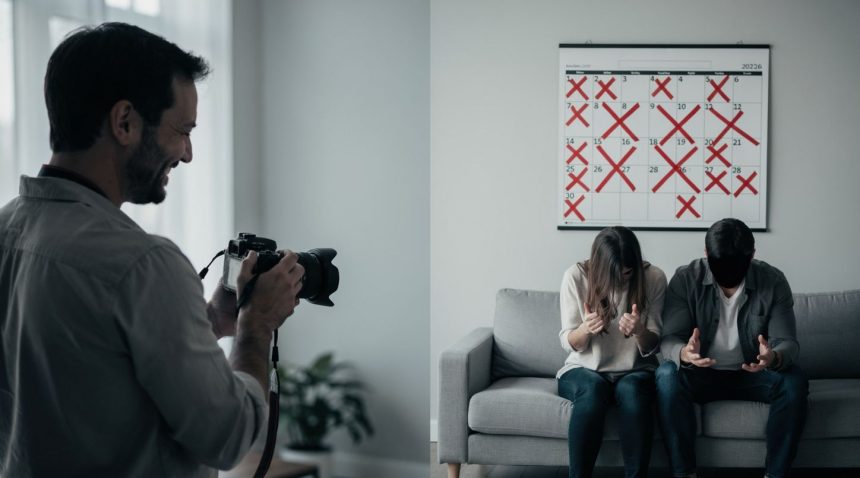
Ben MacAskill, President and COO of SmugMug’s parent company Awesome, has a simple way to explain what Section 230 repeal would mean for photographers: imagine waiting one to two weeks for your wedding photos because they’re stuck in a moderation queue.
That scenario isn’t hyperbole. It’s the concrete, daily consequence MacAskill warns would follow if Congress eliminates or significantly narrows Section 230, the 1996 law that shields online platforms from liability for user-generated content. Without it, he says, platforms like SmugMug—a family-owned photo hosting and e-commerce service founded in 2002—would face an impossible choice: pre-screen tens of millions of uploads daily or go bankrupt.
- The Scale Challenge: SmugMug processes tens of millions of photo uploads daily across its platforms, making pre-screening economically impossible.
- The Timeline Impact: Section 230 repeal would create 8-12 day delays for every upload as platforms implement mandatory content review.
- The Economic Reality: Mid-sized platforms like SmugMug would face bankruptcy from liability costs, while only tech giants could afford compliance.
“There’s a high chance that it would bankrupt platforms like ours,” MacAskill said in an interview with the Electronic Frontier Foundation’s policy analyst Joe Mullin. “They’re not wildly profitable. If Section 230 is done away with, we have to check content that goes online to make sure we’re not liable. That means policing tens of millions of uploads per day.”
SmugMug’s scale makes the stakes concrete. The company owns Flickr, the long-running photo-sharing community it acquired in 2018, which added tens of millions of active hobbyist photographers to its user base. Awesome, MacAskill’s parent company, also operates This Week in Photo media network and the Flickr Foundation, a nonprofit focused on preserving publicly available photography. Across these properties, the volume of daily uploads is staggering—and that’s precisely the problem a Section 230 repeal would create.
How Does Current Content Moderation Actually Work?
Under current law, platforms aren’t required to pre-screen content. They respond to reports and discovery—users flag problematic material, platforms investigate and act. This model has allowed small and mid-sized companies to operate at scale without the resources of Meta or Google. Repeal that protection, and the economics flip entirely. “If we don’t have legal protections, and we get one nefarious customer—if something goes sideways—then I’m liable for that,” MacAskill explained. “I don’t, and can’t possibly know, whether every single photo is appropriate or legal, as it’s uploaded.”
The alternative would be offshore call centers working around the clock, or an 8-to-12 day delay for every upload—essentially transforming the real-time internet into a batch-processing system. “Imagine posting something to Instagram and having the platform say, ‘Cool, we’ll get back to you in 8 to 12 days,'” MacAskill said. This reactive approach to content moderation has enabled the internet’s current speed and accessibility.
• SmugMug actively moderates for child sexual abuse material through NCMEC partnerships
• Platform enforces community guidelines against hate speech and harassment on Flickr
• DMCA takedown requests for copyrighted material are handled through Trust and Safety teams
This isn’t a hypothetical concern from a platform that ignores illegal content. SmugMug actively moderates for child sexual abuse material (CSAM), working closely with the National Center for Missing and Exploited Children. The company enforces community guidelines against hate speech, harassment, and threats on Flickr. It handles DMCA takedown requests for copyrighted material. But all of this happens through a Trust and Safety Team that operates reactively, not by pre-screening everything that goes online.
Does Section 230 Really Provide Unlimited Protection?
MacAskill emphasized that Section 230 doesn’t give platforms a “get out of jail free” card, as some policymakers assume. “I am accountable for the content on my platform,” he said. “We’re not given this ‘get out of jail free’ card.” The law simply makes enforcement scalable. Without it, the burden becomes prohibitive for any company without massive resources.
The threat hits hardest at smaller and mid-sized platforms. “I think it’s a much more existential threat for middle and small tech companies,” MacAskill said. “It also shuts off the next generation of these platforms. The computer science student in a dorm room right now won’t have the legal protections to launch, to even try to build something new. At least not here in the United States.”
Why Are Lawmakers Targeting Section 230 Now?
Section 230 has faced bipartisan criticism in recent years, with lawmakers from both parties proposing amendments or full repeal. The debate often frames the law as a shield for irresponsible platforms. But for family-owned businesses like SmugMug—operating globally across dozens of jurisdictions with varying privacy and likeness laws—the law is the only thing that makes operation feasible at all.
• Family-owned platforms like SmugMug operate across dozens of international jurisdictions with varying content laws
• Pre-screening requirements would favor tech giants who can afford massive moderation infrastructure
• Innovation in platform development would shift offshore to countries with more permissive liability frameworks
The question now is whether policymakers will distinguish between the platforms they’re trying to regulate and the infrastructure companies that enable photographers, artists, and small business owners to operate online. Without that distinction, Section 230 repeal could collapse an entire tier of the internet economy before most users even notice it’s gone.