

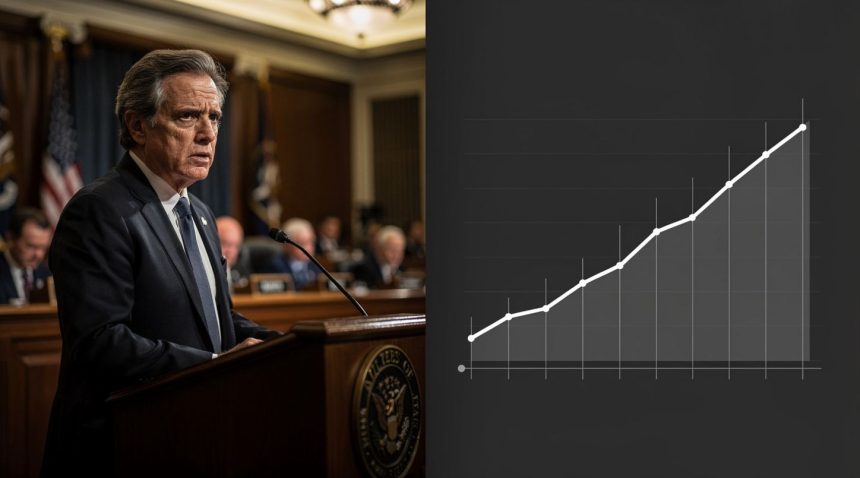
Robert F. Kennedy Jr. stood before the Senate and claimed that vaccines played only a minor role in reducing childhood deaths—a statement that contradicts decades of documented public health outcomes and mortality records.
The claim matters because Kennedy’s statements carry weight in policy circles. His testimony at the Senate hearing represents a direct challenge to the scientific consensus on vaccine impact, at a moment when vaccine hesitancy remains a public perception concern. If such claims influence policy or public behavior without factual grounding, the consequences ripple outward to vulnerable populations, particularly children in communities with lower vaccination rates.
- The Historical Record: Measles alone killed hundreds of American children annually before vaccination campaigns began in the 1960s.
- The Scientific Contradiction: Kennedy simultaneously rejects germ theory while claiming vaccines are ineffective—two incompatible positions.
- The Policy Risk: Senate testimony carries institutional weight that can legitimize false claims and influence vaccination rates in vulnerable communities.
According to reporting on the Senate hearing, Kennedy argued that vaccines did little to lower childhood deaths. This assertion stands in direct opposition to historical mortality data. Before widespread vaccination campaigns in the United States, childhood death rates from vaccine-preventable diseases were substantially higher. Measles alone killed hundreds of children annually in the pre-vaccine era. Polio paralyzed thousands. Whooping cough, diphtheria, and other now-rare diseases were leading causes of childhood mortality.
What Does the Historical Evidence Actually Show?
The public health record is unambiguous on this point. Research on vaccine impact documents dramatic declines in childhood mortality from infectious diseases across the developed world. The introduction of the polio vaccine in the 1950s, for instance, corresponded with the near-elimination of a disease that had previously killed or permanently disabled thousands of American children each year. Similar patterns hold for measles, rubella, and pertussis vaccination programs.
• Pre-vaccine era: Measles killed 400-500 children annually in the US
• Post-vaccination: Measles deaths dropped to fewer than 2 per year by 1980
• Polio impact: From 15,000+ cases annually to complete elimination in the Americas
Kennedy’s Senate testimony also reportedly involved a rejection of germ theory itself—the foundational scientific principle that infectious diseases are caused by pathogens. This position places him outside the mainstream of modern medicine and microbiology, fields built on germ theory for over a century. The rejection of germ theory as a framework makes it logically impossible to explain how vaccines, which work by training the immune system to recognize and fight specific pathogens, could have any effect at all.
Why Does Senate Testimony Matter for Public Health?
The contradiction is stark: Kennedy simultaneously claims vaccines did not reduce childhood deaths while rejecting the biological mechanism by which vaccines are understood to function. These two positions are incompatible with each other and with observable epidemiological data.
What makes this moment significant is the venue. Senate hearings carry institutional weight. Testimony delivered there shapes legislative conversations, influences media coverage, and can affect public understanding of scientific questions. When false claims about vaccine efficacy are made in such a setting without immediate, forceful correction embedded in the hearing record itself, they can acquire a veneer of legitimacy they do not deserve.
The gap between Kennedy’s claims and documented reality is not a matter of interpretation or competing studies. Childhood mortality rates before and after vaccination campaigns are measurable facts. Death certificates, hospital records, and epidemiological surveys from the pre-vaccine era provide clear baseline data. The decline in deaths from measles, polio, pertussis, and other vaccine-preventable diseases after vaccine introduction is one of the most thoroughly documented public health achievements in modern history.
• Studies on vaccine hesitancy confirm that vaccination programs have been the primary driver of childhood mortality reduction from infectious diseases
• Historical mortality data shows consistent patterns across all developed nations following vaccine introduction
• Epidemiological evidence demonstrates direct correlation between vaccination rates and disease elimination
How Should Readers Evaluate Vaccine Claims?
For readers evaluating vaccine safety and efficacy, the key question is straightforward: where does the evidence point? Public health agencies, medical organizations, and peer-reviewed research consistently document that vaccines have prevented millions of deaths globally and continue to do so. Individual cases of vaccine adverse events are tracked and investigated, but the overall safety profile, measured against the diseases prevented, shows a massive net benefit to health outcomes.
Kennedy’s statements in the Senate hearing represent a departure from evidence-based reasoning about infectious disease and public health. His rejection of germ theory as a framework is particularly concerning because it suggests a fundamental disagreement with the scientific basis of modern medicine itself, not merely a difference of opinion about vaccine policy.
What Are the Real-World Consequences?
The real-world impact of such claims depends partly on whether they influence policy decisions or public behavior. Vaccination rates in the United States remain high overall, but pockets of lower vaccination coverage exist. In those communities, vaccine-preventable disease outbreaks have already occurred in recent years, resulting in preventable illness and death. Claims that vaccines did not meaningfully reduce childhood mortality, if believed, could further erode vaccination confidence in vulnerable populations.
As Senate committees continue to examine public health policy and vaccine oversight, the factual record on vaccine efficacy remains available for review. Prevention research consistently demonstrates the effectiveness of vaccination programs in reducing disease burden. The question is whether testimony based on claims contradicted by that record will be treated as equivalent to evidence-based analysis, or whether the distinction between assertion and documented fact will be maintained.