

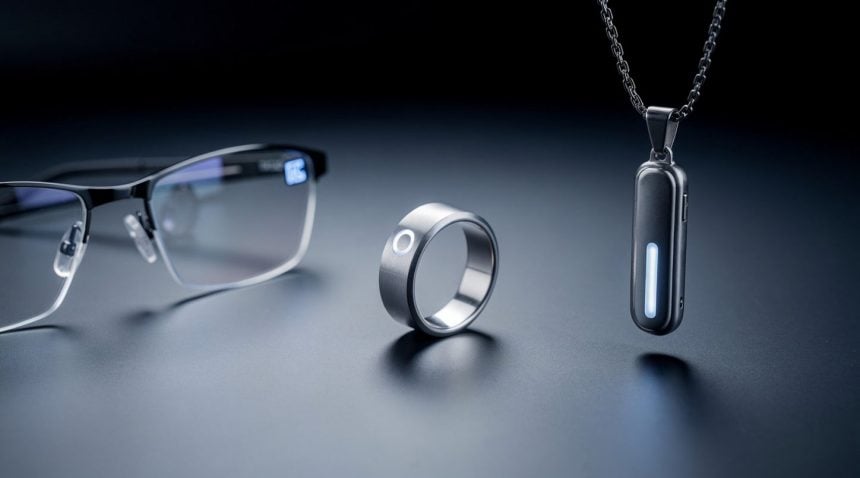
Era Computer just closed an $11 million funding round to build the operating system that will run on a wave of AI wearables coming to market—glasses, rings, pendants, and other form factors yet to emerge.
The bet is straightforward but consequential: as AI hardware splinters into dozens of different devices worn on the body, each with its own processor and always-on microphone, someone needs to build the software layer that lets them talk to each other and to you. Era thinks that’s a $11 million problem worth solving right now, before the hardware market crystallizes around incompatible standards.
- The Privacy Stakes: AI wearables with cameras and motion sensors will collect intimate data about your surroundings and interactions, with the OS controlling where that data goes.
- The Fragmentation Risk: Without a unified platform, each hardware maker builds its own privacy defaults and security standards, creating inconsistent protection.
- The Control Layer: Whoever builds the dominant wearable OS will become the privacy and security checkpoint for an entire category of always-on devices.
The startup’s core thesis is that we will see many form factors of AI hardware, not just one dominant device. Glasses will handle visual tasks. Rings might manage quick inputs and notifications. Pendants could serve as standalone AI assistants. Each device will need an operating system—the foundational software that manages power, connectivity, sensors, and the AI models running on them. Rather than let Apple, Meta, or Google each build proprietary stacks, Era is positioning itself as the neutral platform layer underneath.
This matters because the last time hardware fragmented like this—the early smartphone era—whoever controlled the operating system controlled the ecosystem. Google’s Android became the default choice for manufacturers who didn’t want to build their own software. Microsoft’s Windows dominated personal computing for decades on the same principle. Era is explicitly betting that AI wearables will follow the same pattern: hardware makers will choose a standard OS rather than each building from scratch.
Why Are Tech Giants Struggling with Wearable Fragmentation?
The timing is acute. Companies like Meta, Apple, and smaller startups are shipping AI glasses and wearable prototypes now. Samsung, Google, and others are experimenting with AI rings. Pendant-style devices are emerging from research labs and startups. None of these devices yet talk to each other seamlessly. None have a unified way to manage battery life, privacy settings, or which AI models run locally versus on the cloud. That fragmentation creates friction for users and developers.
Era’s $11 million funding round signals that venture capital sees this problem as real and solvable. The capital will likely go toward building the core OS, establishing partnerships with hardware makers, and recruiting engineers who understand both embedded systems and AI inference—the process of running trained AI models on resource-constrained devices like wearables.
• Always-on microphones and cameras create continuous data collection opportunities
• Multiple form factors mean inconsistent privacy controls across device types
• OS-level decisions determine local vs. cloud processing for sensitive data
What Happens to Your Data in a Fragmented Wearable World?
What makes this particularly relevant to your daily life is the privacy angle. AI wearables—especially glasses with cameras and rings with motion sensors—will collect intimate data about your surroundings, your movements, and your interactions. Research on privacy in sensing devices documents how always-on devices can engage in stealthy data collection without user knowledge, particularly through sensors and continuous monitoring capabilities.
The operating system layer is where that data gets managed, encrypted, and routed. If Era’s OS becomes a standard, it will essentially become the privacy and security checkpoint for an entire category of devices. That’s immense responsibility and immense power. The company’s approach to personal data marketplace dynamics will determine whether wearable data flows to the same buyers that currently purchase smartphone and web data.
The alternative is worse: each hardware maker builds its own OS with its own privacy defaults, its own data-handling practices, and its own level of security rigor. A small startup’s AI ring might have weaker encryption than a major tech company’s glasses. Users won’t know which devices are safer. The OS layer is where standards get enforced.
How Does Era’s Strategy Compare to Previous Platform Wars?
Era’s approach also sidesteps the immediate threat from established players. Apple and Google could theoretically dominate AI wearables the way they dominate smartphones—by controlling both hardware and software. But the diversity of form factors makes that harder. A company that builds great glasses might not build great rings. An OS that optimizes for visual processing might waste battery on audio-focused devices. That fragmentation is Era’s opening.
The precedent of surveillance networks built through connected devices shows how quickly hardware ecosystems can create privacy implications that users don’t anticipate. Ring’s doorbell network demonstrated how individual privacy decisions aggregate into neighborhood-wide surveillance systems—a dynamic that could accelerate with body-worn AI devices.
• The dominant wearable OS will control data routing decisions for billions of intimate interactions
• Unlike smartphones, wearables collect biometric and environmental data continuously
• OS-level privacy defaults will shape user expectations across the entire category
The company remains largely stealth, which is typical for infrastructure plays in their early stage. Hardware makers are unlikely to commit publicly to an unproven OS platform before it ships. But the $11 million raise suggests Era has already convinced some of them—or at least convinced investors that it will.
What’s at Stake in the Next 18 Months?
The real test comes in the next 18 to 24 months, when AI glasses and wearables move from prototype to consumer availability. If Era’s OS ships on multiple devices from different manufacturers, and those devices work together reliably, the company will have solved a genuine infrastructure problem. If not, the OS layer might remain fragmented, with each hardware maker building its own stack or licensing from tech giants who may prioritize data collection over privacy protection.
Studies on wearable health monitoring security highlight how passive sensor devices create ongoing privacy challenges through continuous physiological data collection—issues that will only intensify as AI processing capabilities move directly onto wearable hardware.
Either way, the operating system running on your AI glasses or ring in 2027 will shape what data that device collects, where it goes, and who can access it. Era’s bet is that you’ll want that layer to be open, neutral, and built by someone other than the hardware maker itself.