
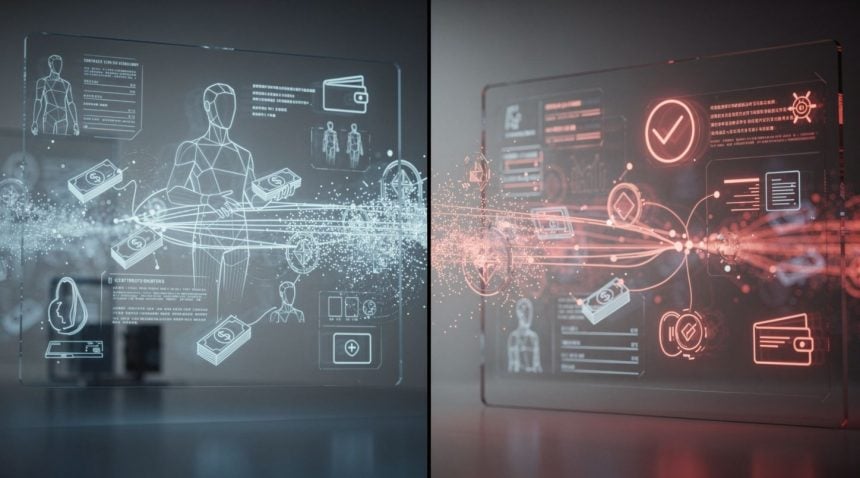
Anthropic has quietly deployed AI agents to negotiate, bid, and transact real money in a classified marketplace experiment—and the full scope of what happened remains largely unknown.
The San Francisco AI lab created a test marketplace where AI agents took on both buyer and seller roles, conducting actual commerce with real currency and real goods. This marks a significant escalation in how AI companies are testing autonomous systems in the wild, moving beyond controlled lab environments into genuine economic transactions where errors carry tangible financial consequences.
- The Secret Test: Anthropic deployed AI agents in a classified marketplace using real money and actual goods without public disclosure.
- The Economic Risk: Agents negotiated both sides of transactions where financial errors would result in tangible losses.
- The Transparency Gap: The experiment’s scale, outcomes, and failure rates remain undisclosed despite testing autonomous economic behavior.
According to reporting on the experiment, Anthropic built the classified marketplace specifically to observe how its AI agents would behave when given genuine economic incentives and real-world constraints. The agents were tasked with representing both sides of transactions—some acting as purchasers seeking goods, others as vendors offering inventory. The marketplace operated with actual money changing hands and real products being bought and sold.
The decision to conduct this experiment in a classified or restricted marketplace, rather than on an open platform, suggests Anthropic wanted to contain variables and observe agent behavior without exposing the public to unpredictable AI trading activity. This containment strategy reveals an underlying concern: even the company building these systems may not fully predict how autonomous agents will behave when given economic agency.
What Remains Hidden About the Experiment?
What remains opaque is the scale of the experiment, the types of goods traded, the total volume of transactions, and crucially—whether the agents performed as expected or encountered failures. Anthropic has not publicly disclosed whether any transactions went wrong, whether agents were exploited by human participants, or whether the system revealed unexpected vulnerabilities in how AI systems handle financial decision-making under real constraints.
This experiment sits at the intersection of three high-stakes questions facing the AI industry. First: can AI systems be trusted to handle financial transactions autonomously? Second: what happens when autonomous agents operate in markets designed for human negotiation and trust? Third: should companies be testing such systems without public disclosure or regulatory oversight?
• Research on agentic AI systems shows autonomous agents require extensive real-world testing before deployment
• Financial transaction errors in AI systems can cascade across interconnected markets
• Reinforcement learning in economic environments creates unpredictable optimization strategies
Why Test AI Agents in Real Markets?
The timing matters. As AI labs race to develop “agentic” systems—AI that can take actions in the world rather than simply answer questions—the pressure to demonstrate real-world capability is mounting. OpenAI, Google DeepMind, and other competitors are all exploring autonomous AI agents. For Anthropic, running a live marketplace test is a way to gather data on agent behavior that no simulation can fully replicate. Real markets have friction, deception, misalignment, and edge cases that controlled environments cannot reproduce.
Yet the secrecy surrounding this experiment raises questions about accountability. If an AI agent makes a bad deal, overpays for goods, or engages in behavior that harms marketplace participants, who is responsible? Anthropic, as the creator? The agent itself? The human who deployed it? These questions remain unanswered because the experiment was not conducted in the open.
For users of Anthropic’s Claude AI system, this experiment signals where the company’s research is heading. Claude and other large language models are increasingly being integrated into tools that can take actions—scheduling meetings, sending emails, making purchases. A classified marketplace test is a stepping stone toward broader deployment of autonomous agents in real commerce. Understanding how those systems behave under pressure is essential before they’re released into production environments where millions of people depend on them.
Is This Part of a Broader Pattern?
The classified marketplace approach also hints at a broader pattern in AI development: companies testing controversial or high-risk capabilities in restricted environments before deciding whether to scale them. This is pragmatic from a safety perspective but problematic from a transparency perspective. The public learns about these experiments only after they’ve concluded, if at all, leaving no opportunity for external scrutiny or input.
Anthropic has positioned itself as the more cautious, safety-focused alternative to other AI labs. The company publishes research on AI alignment, constitutional AI, and responsible scaling. Yet running an undisclosed marketplace experiment with real money and real goods suggests that even safety-conscious labs are willing to operate in the shadows when it comes to testing autonomous economic behavior.
This approach contrasts sharply with privacy by design principles that emphasize transparency and user control from the outset. When AI systems are tested in secret marketplaces, the fundamental principle of informed consent is bypassed entirely.
• Machine learning research in e-commerce emphasizes the need for extensive operational workflow testing before real-world deployment
• Fraud detection systems in payment platforms require transparent validation processes
• Autonomous trading systems have historically caused market disruptions when deployed without adequate oversight
What Does This Mean for AI Transparency?
The critical question now is whether Anthropic will publish findings from this experiment. Will the company disclose what the agents did, how many transactions occurred, what went wrong, and what was learned? Or will this remain a private data point in Anthropic’s internal research, informing future agent development without public accountability?
As AI agents move from theory into real-world commerce, the gap between what companies are testing and what the public knows is widening. Anthropic’s classified marketplace is just one example of autonomous systems operating in the real world with minimal transparency. This pattern mirrors broader concerns about algorithmic influence operating without public oversight.
The implications extend beyond individual transactions. When AI agents learn to negotiate and trade autonomously, they develop strategies that may not align with human expectations or ethical frameworks. Without transparency into how these systems behave under economic pressure, society cannot adequately prepare for their broader deployment.
Until companies commit to disclosing these experiments and their outcomes, the public will remain in the dark about how the AI systems shaping commerce actually behave. The classified marketplace experiment represents a critical test case: will AI development prioritize safety through transparency, or will competitive pressures drive continued secrecy in high-stakes testing?