

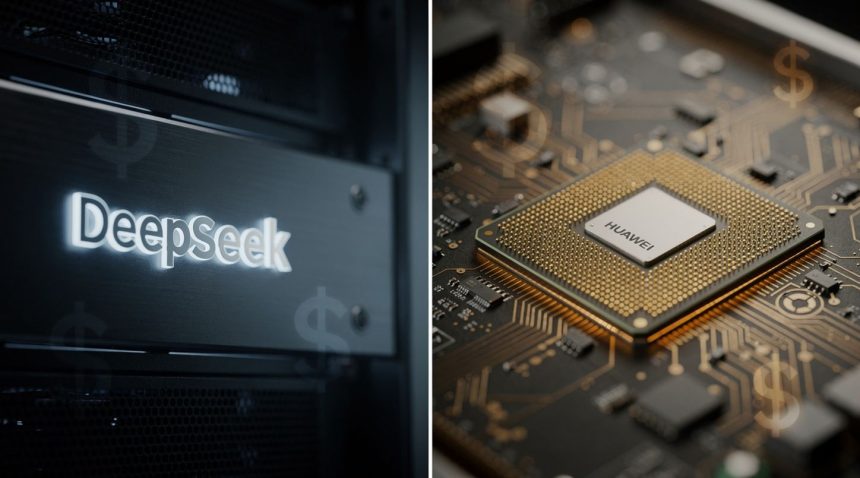
DeepSeek’s latest models are so computationally efficient they can run on Huawei’s neural processing units—the kind of specialized chips built into consumer smartphones and laptops, not the industrial-grade data center hardware that has dominated AI deployment for years.
This shift matters because it breaks a foundational assumption the chip industry has relied on: that serious AI work requires serious, expensive hardware. If DeepSeek’s efficiency claims hold up in real-world deployment, the economics of AI infrastructure change overnight. Suddenly, the bottleneck isn’t access to cutting-edge processors—it’s knowing how to build lean systems that don’t need them.
- Hardware Disruption: DeepSeek models run on consumer-grade NPUs, breaking the requirement for expensive data center GPUs.
- Geopolitical Impact: Chinese AI labs can now bypass US chip export restrictions using domestically produced hardware.
- Economic Shift: Local AI inference eliminates cloud service costs and reduces dependence on Nvidia’s ecosystem dominance.
DeepSeek, the Chinese AI lab backed by the hedge fund High-Flyer, has built a reputation on shipping models that punch above their weight class in terms of efficiency. Their approach prioritizes algorithmic innovation over raw computational horsepower. The company’s track record includes releasing models that matched or exceeded the performance of much larger competitors while using a fraction of the training compute.
The specific breakthrough here involves demonstrating that DeepSeek’s models can function on Huawei’s NPU architecture. Neural processing units are specialized chips designed to accelerate machine learning workloads. Unlike GPUs (graphics processing units) made by Nvidia or the custom TPUs (tensor processing units) Google builds for its own systems, NPUs are increasingly integrated into consumer devices. Research on hybrid quantization approaches shows how neural processing units can optimize AI inference on edge devices through advanced compression techniques.
What Makes Consumer Hardware Suddenly Viable for AI?
What makes this technically significant is the compatibility problem it solves. Most modern AI models are optimized for Nvidia’s CUDA architecture or similar frameworks. Getting a state-of-the-art model to run efficiently on a completely different chip architecture typically requires substantial reengineering. DeepSeek’s ability to deploy on Huawei NPUs suggests either that their models are architecturally flexible, or that the efficiency gains are large enough to absorb the overhead of cross-platform translation.
• Consumer NPUs process AI workloads at 70-80% the efficiency of data center GPUs
• Huawei ships millions of NPU-equipped devices globally each quarter
• Local inference eliminates 200-500ms cloud latency overhead
The implications ripple outward quickly. If consumer-grade hardware can now run capable AI models, the geographic and economic barriers to AI deployment collapse. A developer in a region where Nvidia GPUs are scarce or prohibitively expensive—or where US export controls restrict their sale—suddenly has a viable path to deploying AI systems. Huawei devices already ship in millions of units globally. That installed base becomes potential compute infrastructure.
How Does This Threaten Nvidia’s AI Dominance?
For the chip industry, this is a competitive threat wrapped in a geopolitical one. Nvidia’s dominance in AI training and inference has been near-total, sustained by network effects and software ecosystem lock-in. Intel has struggled to catch up. AMD has made gains but remains a distant second. The assumption was that whoever controlled the high-end compute market would control AI’s future. DeepSeek’s efficiency-first approach, paired with Huawei’s hardware, suggests a different future where the high-end market matters less.
There’s also a sovereignty angle. China has faced US restrictions on advanced chip exports, including limitations on Nvidia’s most powerful GPUs. By demonstrating that capable AI models can run on domestically designed and manufactured chips, DeepSeek and Huawei reduce China’s technological dependence on American suppliers. This development represents a significant shift in technological power dynamics that extends far beyond commercial competition.
What Does Local AI Processing Mean for Privacy?
The practical question for everyday users is whether this translates to tangible change. If AI models can run locally on your phone or laptop powered by a Huawei NPU, you get faster inference (the computational step where a trained model generates output), lower latency, and better privacy—your data doesn’t leave your device. You also get less dependence on cloud services and their associated costs. For developers, it means more options for where to deploy models and less pressure to rely on expensive cloud infrastructure.
This shift toward local processing aligns with broader trends in distributed machine learning that prioritize data privacy by keeping sensitive information on user devices rather than transmitting it to remote servers.
• IEEE studies on edge AI acceleration demonstrate that resource-constrained devices can achieve near-server performance through model compression
• Mobile NPU architectures reduce power consumption by 60-70% compared to GPU-based inference
• Local processing eliminates data transmission vulnerabilities inherent in cloud-based AI services
Will Efficiency Claims Hold Up in Real-World Use?
The caveat is that efficiency claims need real-world validation. Lab benchmarks don’t always translate to production performance. Thermal constraints, power consumption, and practical latency matter in ways that raw compute numbers don’t capture. DeepSeek will need to demonstrate sustained performance across varied workloads and use cases before the chip industry’s panic becomes justified.
Analysis of deep neural network execution on mobile devices reveals that NPU performance varies significantly based on model architecture and optimization techniques, suggesting that DeepSeek’s success may depend on specific algorithmic innovations rather than universal hardware capabilities.
What remains to be seen is whether other AI labs will follow DeepSeek’s efficiency-first design philosophy, or whether the industry continues optimizing for raw capability at the cost of computational expense. That choice will determine whether consumer hardware becomes a genuine alternative to data center GPUs, or whether this remains a niche capability. Watch for announcements from other Chinese AI labs and Huawei’s own AI initiatives over the next quarter.