
The thing about a ghost is that it never lets you look at it directly. It hovers at the edge of vision, a grey smear of not-quite-a-person, and the instant you turn your head to confront it, it is gone. For most of human history that evasiveness was taken as proof of the supernatural — spirits do not hold still to be examined. In the early 1980s, in a nondescript laboratory belonging to a medical equipment company, a man named Vic Tandy turned that same evasiveness into a clue, and followed it to an answer that has nothing to do with the dead.
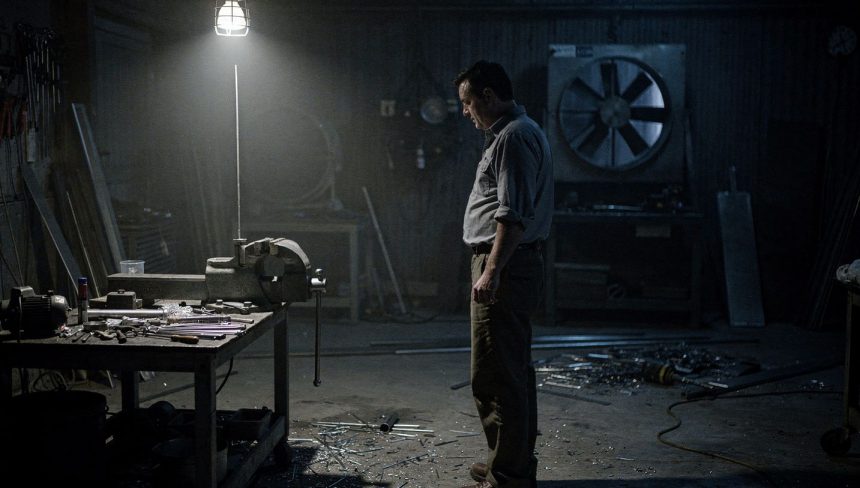
Tandy was working late, alone, in a lab his colleagues had already half-decided was haunted. He felt it before he saw anything: a creeping cold, a wave of low dread, the hair-raising certainty that he was not alone. Then, in his peripheral vision, a grey shape resolved — a figure, indistinct, sitting at the edge of the room. His heart hammered. He turned to face it. There was nothing there.
- The Frequency Threshold: Infrasound at approximately 19 hertz — below the range of conscious human hearing — is sufficient to produce documented sensations of dread, chilling, and perceived presence in ordinary environments.
- The Eyeball Mechanism: The human eyeball’s resonant frequency sits close to 19 hertz, meaning infrasound can induce faint involuntary trembling in the eye itself, generating peripheral visual distortions that the brain interprets as figures or shapes.
- The Verified Sources: Infrasound has been detected at measurable levels in specific locations associated with reported hauntings, including a tourist centre cellar in Coventry and corridors at Warwick Castle, where low-frequency sources were found near clusters of sightings.
Most people would have gone home, poured a drink, and never spoken of it. Tandy went home, came back the next day, and — by pure accident — caught the culprit.
He was an amateur fencer, and he had brought one of his foils into the workshop to work on it. He clamped the blade in a bench vice, stepped away, and noticed it was vibrating. Not gently swaying — visibly shuddering, on its own, held rigid at one end. A blade does not move by itself. But a blade will move if something is pushing on it at a rhythm that matches its own natural frequency, feeding energy into it wave after wave until the vibration builds. Something in that room was pulsing the air, and it was invisible and silent.
What Was Actually Haunting the Laboratory?
The something was a newly installed extractor fan. It was throwing off a low-frequency pressure wave — infrasound, sound too low for human ears to consciously register — and when Tandy measured the room, the intensity peaked at exactly the spot where he had been sitting when the ghost appeared. The desk. The chair. The corner of the eye.
Working with Dr Tony Lawrence, Tandy laid this out in a paper with a wonderfully dry title, “The Ghost in the Machine,” published in the Journal of the Society for Psychical Research in 1998. Their claim was narrow and testable: infrasound at or around 19 hertz can produce, in an ordinary human body, exactly the sensations people report in haunted places — a sense of fear, a chill, shivering, the feeling of a presence. The link between low frequencies and unease was not brand new. What was new was connecting it to the ghost story itself, and offering a mechanism for the part everyone found spookiest: the figure at the edge of sight.
• Infrasound is defined as sound below 20 Hz — a frequency range that, as documented in research on the full spectrum of sound wave effects, sits entirely outside conscious human auditory perception yet interacts measurably with biological tissue
• A review of audiovestibular responses to infrasound exposure confirmed that human perception of infrasound requires higher sound pressure levels at lower frequencies — meaning the body registers the effect before the ear does
• The resonant frequency of the human eyeball is estimated to sit in the range of 18 to 19 Hz, placing it directly within the infrasound band implicated in Tandy’s findings
Why Does the Ghost Disappear the Moment You Look?
Here is where it gets satisfying. The human eyeball has its own resonant frequency, and it sits close to that same 19-hertz range. Tandy’s suspicion — and it is worth being honest that this is the leading hypothesis rather than closed-case fact — was that when infrasound in a room hits that frequency, it can set the eyeball itself faintly trembling. The world stays still; your eyes do not. And a tiny, involuntary smear at the periphery of your vision, where detail is poor and the brain is already primed to detect lurking threats, is precisely the kind of signal a nervous mind will assemble into a shape. A figure. Sitting just over there. Gone the moment you turn, because turning points your sharp central vision at it, and central vision does not smear.
So the reason the ghost will not let you look at it directly is not coyness. It is optics. It literally cannot survive being looked at head-on, because it only exists in the blurry margins your trembling eyes are producing. The mechanism is not mystical — it is a collision between physics and the architecture of human perception, and the result is indistinguishable, in the moment, from something genuinely supernatural.
This intersection of physical signals and subjective experience is not unique to infrasound. Research into AI emotion recognition has similarly revealed how unreliable the gap between felt experience and its external cause can be — systems that read fear, discomfort, or unease from observable signals face the same fundamental problem Tandy encountered: the body’s response is genuine, but the attributed cause may be entirely wrong.
Has the Infrasound Hypothesis Been Tested at Scale?
The idea has been prodded and tested since. In one widely discussed experiment, hundreds of people at a concert were exposed to infrasound quietly laced into the music without being told; afterwards, reports of chills, anxiety, and strange feelings rose noticeably among the audience. Investigators have gone looking for infrasound in specific haunted locations — a tourist centre cellar in Coventry, the corridors of Warwick Castle — and sometimes found low-frequency sources humming away where the sightings clustered.
• Controlled exposure studies have found that infrasound introduced into ambient environments without participants’ knowledge produces measurable increases in self-reported anxiety, unease, and perceptual anomalies
• Field investigations at locations with documented haunting reports have identified mechanical infrasound sources — ventilation systems, pipe resonance, industrial equipment — in proximity to the areas where experiences clustered
• The effect is not universal: individual sensitivity to infrasound varies, and not every reported haunting location yields a detectable low-frequency source, which limits the hypothesis to a specific and identifiable category of experiences rather than a general explanation
It is not a universal skeleton key; plenty of hauntings have no fan, no pipe, no rumbling machinery, and infrasound does not pretend to explain every cold spot and creaking stair. But it explains a real and repeatable category of them, and it does so without asking you to believe in anything except air pressure and biology.
The broader implication is worth sitting with. The brain’s threat-detection systems evolved to act on incomplete information — a rustle in the undergrowth, a shadow at the cave mouth. Speed mattered more than accuracy. What Tandy’s work demonstrates is that those same systems can be triggered by inputs that have no threat attached to them at all, and that the resulting experience — the dread, the presence, the figure — is phenomenologically identical to what a genuine threat would produce. The body is not malfunctioning. It is doing exactly what it was built to do, with the wrong input.
What Does This Tell Us About the Reliability of Human Perception?
What lingers about Tandy’s story is not the debunking. It is the shape of the reversal. He did not stand in that room and reason his way to skepticism. He was genuinely frightened — cold, dread, the whole primal package — and his body was not lying to him. The fear was real. The presence was real, in the sense that his nervous system truly registered one. What was false was only the explanation his mind reached for first, the oldest one we have. Between the honest terror and the wrong conclusion sat a silent wave he could not hear, and it took a vibrating sword to make it visible.
There is a small, useful comfort in that. It suggests that the feeling of being watched in an empty room is not a character flaw or a failure of nerve. It can be a finely tuned instrument doing its job, picking up a genuine physical signal and misfiling it under the only category our ancestors had. The question of how systems — technological or biological — interpret ambiguous signals and assign them to the nearest available category is one that extends well beyond ghost stories. It surfaces in how insurance companies interpret behavioral signals to make consequential decisions, and in how automated systems increasingly make inferences from data that is real but whose meaning is contested.
The next time the back of your neck prickles in a quiet building and something grey slides past the edge of your eye, the rational move is not to insist you felt nothing. You did feel something. It might just be nineteen hertz, moving the air and moving your eyes, doing an impression of the dead.