

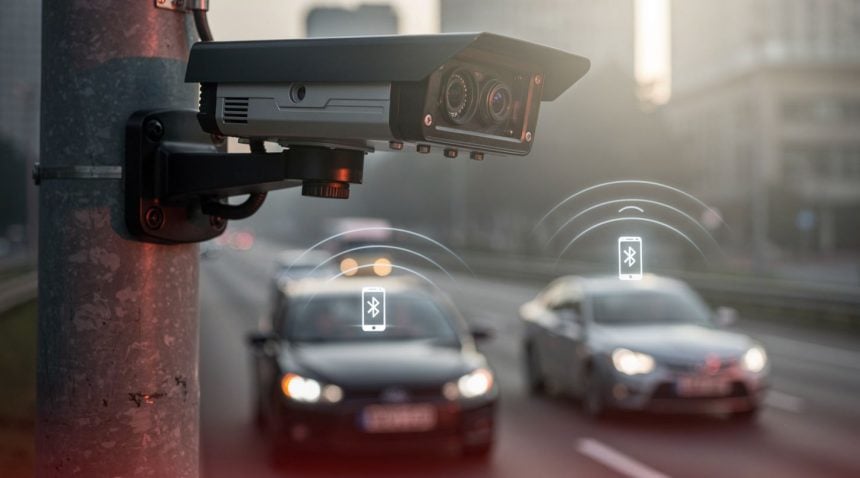
The license-plate camera you drive past without a second thought may soon do far more than read your plate. A new capability from the defense contractor Leonardo, marketed under its ELSAG license-plate brand as SignalTrace, is designed to reach past your bumper and into your pockets — logging the Bluetooth signature of your phone, the earbuds in your ears, the watch on your wrist, and tying all of it to your car. First reported by 404 Media in June 2026 and since covered by TechRepublic and Jalopnik, it quietly turns roadside cameras from plate scanners into wide-net device trackers. And you were never asked.
- What is Leonardo SignalTrace?
- How SignalTrace turns license-plate cameras into phone trackers
- Does SignalTrace track your AirPods, smartwatch and other devices?
- How this mirrors Cambridge Analytica’s data-correlation playbook
- Is SignalTrace legal? The data-broker and consent problem
- Which agencies are using it — and what we don’t yet know
- How to reduce Bluetooth tracking from ALPR cameras
What is Leonardo SignalTrace?
Leonardo SignalTrace is an add-on for automatic license-plate reader (ALPR) systems that captures the wireless signals — Bluetooth, Wi-Fi and RFID — broadcast by nearby consumer devices, turns them into unique “digital fingerprints,” and links those fingerprints to the vehicles passing the camera. It does not read message contents; it identifies and correlates the devices themselves. In short: it matches your gadgets to your car.
That is the whole idea, and it is worth sitting with. A traditional plate reader answers one question: which car was here? SignalTrace bolts on a second, far more personal one: and who — or which devices — were inside it?
How SignalTrace turns license-plate cameras into phone trackers
Almost every device you carry is chatty. Your phone, your wireless earbuds and your smartwatch constantly emit low-level radio signals to stay paired and discoverable. SignalTrace listens for those emissions — Bluetooth, Wi-Fi and RFID — as a vehicle rolls past a camera. According to Leonardo’s own marketing, the system captures these wireless signatures, classifies them by device type, associates them with the nearby vehicle, and stores the records for investigators to query later.
Crucially, the company says it never decrypts or reads what is on your devices. But it does not have to. The signature alone is enough. Do it at one intersection and you have a snapshot; do it across a network of cameras and you have a map — of where a device went, when, and, tellingly, which other devices kept showing up alongside it. Leonardo pitches exactly this: the ability to spot devices that routinely travel together and to surface convoys and repeated movement patterns. Your morning commute, your therapist’s office, your union meeting, the friend whose earbuds are always in your passenger seat — all of it becomes a queryable pattern.
Does SignalTrace track your AirPods, smartwatch and other devices?
Yes — and the list is broader than most people assume. Reporting on SignalTrace describes it capturing signatures from smartphones, wireless earbuds including AirPods, smartwatches, Apple AirTags, tire-pressure sensors, employee access badges, connected cars, and even pet microchips. Anything that emits a wireless identifier is fair game.
That is what makes the AirPods detail more than a headline. You can leave your phone at home and still be trackable by the buds in your ears or the tag on your keys. The tracking surface is no longer “your phone” — it is the small constellation of always-broadcasting objects you carry without thinking about them.
How this mirrors Cambridge Analytica’s data-correlation playbook
There is a familiar shape here. Cambridge Analytica’s power never came from any single, secret data point — it came from correlation: stitching scattered, individually harmless signals into a profile no one consented to build. SignalTrace applies the same logic to physical movement. No individual Bluetooth ping means much. Linked across time and cameras, and cross-referenced with your plate, those pings become a behavioral profile of where you go and who you go with. The lesson of the last decade of privacy scandals is that the danger lives in the joins, not the fields — and SignalTrace is a joining machine.
Is SignalTrace legal? The data-broker and consent problem
This is where it gets uncomfortable, because the honest answer is: the law hasn’t caught up. There is no federal statute that squarely governs roadside collection of wireless device identifiers, and there is no opt-out — the capture happens without notice or consent as you simply drive by. The Supreme Court’s 2018 Carpenter decision recognized that long-term location tracking can require a warrant, but it addressed cell-site records held by phone carriers; passively harvesting Bluetooth signatures at the roadside sits in a largely untested gray zone.
The data-broker angle sharpens the worry. ALPR ecosystems already have a documented history of data leaving its intended lane: officers have been arrested for misusing plate-reader data to stalk people, more than 50 agencies have used ALPR data to track activists, and Texas police used a network of cameras to track a woman’s out-of-state abortion. Location data has also been fed into immigration enforcement, with agencies paying data brokers millions for Americans’ personal records. Layer persistent device identities on top of that infrastructure and the potential for abuse — or for quiet resale and sharing — grows accordingly.
Which agencies are using it — and what we don’t yet know
For now, the reach is limited, and it is important to be precise about that. SignalTrace is newly marketed rather than widely deployed, and Leonardo has not publicly named the agencies or states using it; most drivers are unlikely to encounter it today. Privacy organizations, in part because the product is so new, had not yet mounted a specific campaign against it at the time of reporting.
But “not yet widespread” is not the same as “not a concern.” The ALPR base it plugs into is already national, and adoption could scale quickly if departments choose to upgrade — even as basic transparency shrinks, with seven states recently blocking public access to police plate-reader records. A 2024 CISA advisory about vulnerabilities in a competitor’s plate-reader systems is a reminder that this kind of infrastructure is also a security target — a database tying your devices to your movements is exactly the sort of thing you do not want breached.
How to reduce Bluetooth tracking from ALPR cameras
You cannot fully opt out of a camera you drive past, and it would be dishonest to pretend otherwise — but you can shrink your footprint. Turning off Bluetooth and Wi-Fi when you do not need them (especially while driving) reduces what your phone and accessories broadcast. Modern iPhones and Android phones randomize their Wi-Fi MAC addresses, which helps against some fingerprinting, though device-type classification can persist. Be mindful of the quieter broadcasters — AirTags, earbuds, fitness bands — that keep transmitting even when your phone is put away. It is also worth scrubbing your profile from the data brokers that this kind of location data can eventually flow into.
Realistically, though, individual settings are a small lever against roadside collection. The bigger one is policy: warrant requirements, retention limits, and transparency rules for wireless capture are where this fight is actually decided. The first step is simply knowing the cameras can now see more than your plate — because the systems counting on your not knowing are the ones with the most to gain.
Sources: 404 Media (original reporting), TechRepublic, Jalopnik.