
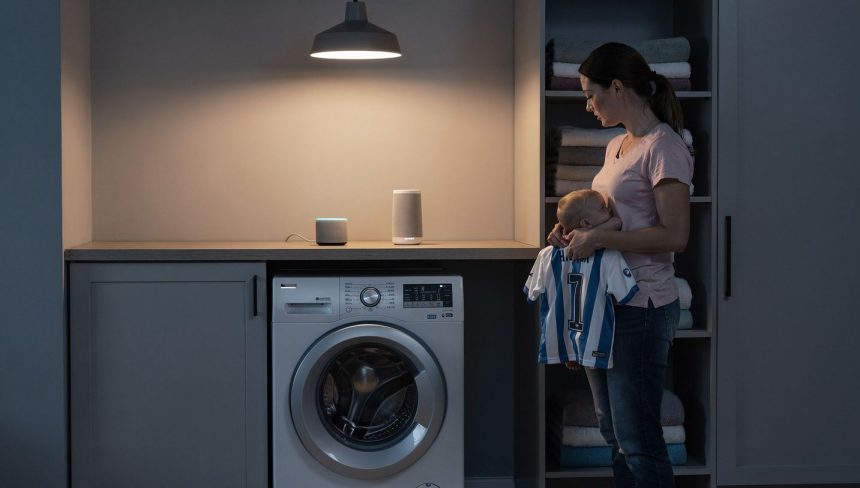
You’re standing in front of your washing machine at 6 a.m., holding a muddy soccer jersey, and you don’t want to ruin it. So you ask Alexa: “My kid’s soccer jersey could use a deep clean, but the tag says cold wash only.” The assistant understands the contradiction. It navigates your Whirlpool washer’s cycle menu, weighs the competing demands, and selects the right setting without you touching a button.
This isn’t science fiction. It’s the new Alexa Plus, and it represents a fundamental shift in how Amazon’s assistant talks to your home. The update, powered by Amazon’s new AI developer tools, lets Alexa Plus connect to smart devices from Bosch, Delta, Ecovacs, iRobot, Yale Home, Whirlpool, Tapo, Eufy, and others — nine major brands in a single ecosystem. For the first time, the assistant can handle requests that require reasoning about competing constraints, device-specific options, and real-world messiness. The convenience is real. So are the implications for how much Amazon now knows about how you live.
- Nine Brands, One Listener: Alexa Plus now integrates with nine major smart home manufacturers simultaneously, giving Amazon’s AI reasoning-level access to washing machines, smart locks, robot vacuums, and thermostats in millions of homes.
- Beyond Commands: The update moves Alexa from keyword matching to contextual reasoning — processing goals, constraints, and device capabilities in a single request, generating richer behavioral data with every interaction.
- The Training Pipeline: Every request Alexa Plus processes — including the constraints and preferences you mention — flows back to Amazon’s servers and feeds the AI training cycle that makes the next version of the assistant more capable and more data-dependent.
The stakes are personal and immediate. Amazon has spent the past decade building an infrastructure for understanding domestic life. The Alexa Plus update doesn’t just extend that infrastructure — it deepens it in ways that deserve careful attention from anyone with a smart home device on their kitchen counter.
For context on how platform ecosystems accumulate data authority over time, the invisible architecture of data flows follows a consistent pattern: infrastructure that appears neutral gradually becomes the layer through which all decisions pass.
How Does Alexa Plus Actually Reason About Your Home?
Until now, smart home assistants have worked like vending machines: you press the button, the machine dispenses the result. Ask Alexa to turn on the lights, and it turns on the lights. Ask it to start the washing machine, and it starts the washing machine. But real life doesn’t work that way. Real requests are tangled. They involve trade-offs, context, and knowledge that lives outside the device itself. A parent doesn’t just want the washer to run; they want it to run in a way that protects their kid’s favorite shirt. A person doesn’t just want the robot vacuum to clean; they want it to avoid the area where the dog is sleeping.
Alexa Plus now bridges that gap. The AI update allows the assistant to understand the full request — the goal, the constraint, the device’s capabilities — and then automatically route the instruction to the correct device with the correct settings. Amazon’s developer blog describes this as powered by a new AI developer tool, though the source does not specify the tool’s name or technical architecture.
The underlying capability draws on advances in contextual language understanding that researchers have been tracking for several years. Research published in IEEE Access on on-device intent reasoning for smart home agents demonstrates how systems combining flexible natural language understanding with knowledge-graph-driven contextual reasoning can resolve ambiguous or competing instructions — precisely the kind of multi-constraint problem that the washing machine scenario represents. This is not simple voice recognition. It is semantic inference applied to domestic decision-making.
• Natural language processing research reviewed in PMC identifies contextual understanding — the ability to interpret linguistic expressions in light of surrounding conditions — as the defining frontier separating current AI assistants from earlier rule-based systems.
• IEEE Access findings on smart home agent reasoning show that ontology-guided systems can navigate competing device constraints in real time, enabling the kind of multi-variable decision-making Alexa Plus now performs across nine manufacturer ecosystems.
• The practical implication: the more devices a reasoning system can access, the more behavioral inference it can perform — and the more granular the data profile it builds about the household it serves.
What Data Does Alexa Plus Actually Need to Make These Decisions?
The mechanics matter because they reveal what data Alexa Plus now needs to access and understand. To make these decisions, the assistant must know the capabilities of each connected device — what cycles a Whirlpool washer offers, what settings a Tapo smart plug supports, what rooms an Ecovacs vacuum can navigate. It must also understand the context of your home: which devices are where, which family members are present, what your past preferences have been. The more devices Alexa Plus can connect to, the more granular a picture it builds of how you live.
Amazon has not published detailed privacy documentation for the Alexa Plus update, and the source does not specify what data the assistant collects or retains from these new integrations. But the precedent is clear. Every request that Alexa Plus processes — every time you ask it to find the right washing cycle, every time it decides whether to run the vacuum — generates data about your habits, your preferences, your constraints, and your home’s configuration. That data flows to Amazon’s servers, where it trains the next version of the AI.
The company’s business model depends on this feedback loop. Alexa Plus is not a product you buy; it’s a service you subscribe to. The subscription model works only if Amazon can continuously improve the assistant’s accuracy and usefulness. That improvement requires data. And the more devices Alexa Plus connects to, the richer that data becomes.
• Nine major smart home brands now integrated into a single Alexa Plus reasoning layer — covering washing machines, robot vacuums, smart locks, thermostats, and smart plugs across hundreds of millions of devices.
• Whirlpool alone ships appliances to millions of U.S. households annually; Yale Home smart locks secure front doors across residential and commercial properties in dozens of countries.
• Amazon has not disclosed what data retention policies apply to the contextual reasoning logs generated by Alexa Plus’s new multi-device integrations.
Is This Amazon’s Largest Domestic Data Expansion Yet?
This is not a new pattern in Amazon’s playbook. The company has spent the past decade building what amounts to an infrastructure for understanding how people live. Alexa devices sit in bedrooms, kitchens, and living rooms. Ring doorbells watch front porches. Sidewalk sensors monitor neighborhoods. Each device collects data. Each data point feeds back into Amazon’s machine learning systems. Each improvement to the AI makes the devices more useful and more data-hungry.
The Ring doorbell program offers a useful precedent. As documented in analysis of how Ring doorbells built surveillance networks, Amazon’s home security devices gradually became nodes in a broader data-sharing infrastructure — one that extended well beyond what most users understood when they installed the hardware. The Alexa Plus expansion follows a structurally similar logic: a convenience feature that simultaneously expands the scope of behavioral observation.
The Alexa Plus update accelerates this cycle. By connecting to nine major smart home brands at once, Amazon is essentially asking millions of users to grant the assistant visibility into how they use their washing machines, their locks, their vacuums, their thermostats. The requests themselves — “my kid’s soccer jersey could use a deep clean” — become training data for the next generation of AI. The patterns emerge: parents with young children tend to request gentle cycles; households with pets request vacuum schedules that avoid sleeping areas; people in cold climates adjust thermostat settings in predictable ways.
The parallel to Cambridge Analytica’s methods is structural rather than conspiratorial. CA’s core insight was that behavioral data collected at scale — even data that seemed mundane or disconnected — could be aggregated into psychographic profiles precise enough to predict and influence decisions. Amazon is not running a political operation. But the underlying data logic is identical: granular behavioral signals, collected across millions of households, aggregated into models that understand preference, constraint, and habit better than the individuals themselves can articulate. The difference is that Amazon’s inference engine sits inside your home and controls your appliances.
This dynamic connects to a broader question about smart devices and the end of privacy — whether the cumulative effect of connected home technology represents a qualitative shift in what domestic life means as a private space.
What the Alexa Plus Expansion Means for the Smart Home Industry
None of this is illegal. Amazon’s terms of service permit the company to collect and use this data. The update is, by all accounts, a genuine improvement to the assistant’s capabilities. A parent who can ask Alexa to find the right washing cycle without consulting the manual has gained something real and useful.
But the transformation is worth naming clearly. Alexa Plus is no longer just an assistant that responds to commands. It’s becoming a reasoning system that understands your home, your habits, and your constraints well enough to make decisions on your behalf. The more devices it connects to, the more complete that understanding becomes. And the more complete that understanding, the more valuable you become as a data source for Amazon’s AI training pipeline. The comparison to operating systems as AI training pipelines is instructive: when the interface layer becomes the AI layer, the distinction between using a tool and being observed by one begins to collapse.
• The shift from command-response to contextual reasoning represents a categorical change in what voice assistants collect: not just what you ask, but the constraints, preferences, and household context embedded in how you ask it.
• Multi-device integration compounds this effect — a single request that spans a washer, a vacuum, and a smart lock generates a behavioral data point that no single-device system could produce.
• The absence of published privacy documentation for Alexa Plus’s new reasoning logs means users currently have no clear basis for understanding what is retained, for how long, or how it is used in AI model training.
The update is available now through the Alexa Plus subscription service. Amazon has not announced plans to expand the integrations beyond the nine brands currently supported, though the developer blog suggests that the AI framework is designed to scale. Whether other smart home manufacturers will choose to integrate with Alexa Plus remains an open question — one that will likely depend on whether they trust Amazon with deeper visibility into how their customers use their devices. For the millions of households already inside Amazon’s ecosystem, that question has already been answered by the devices sitting on their counters and the subscriptions they renewed without reading the terms.