


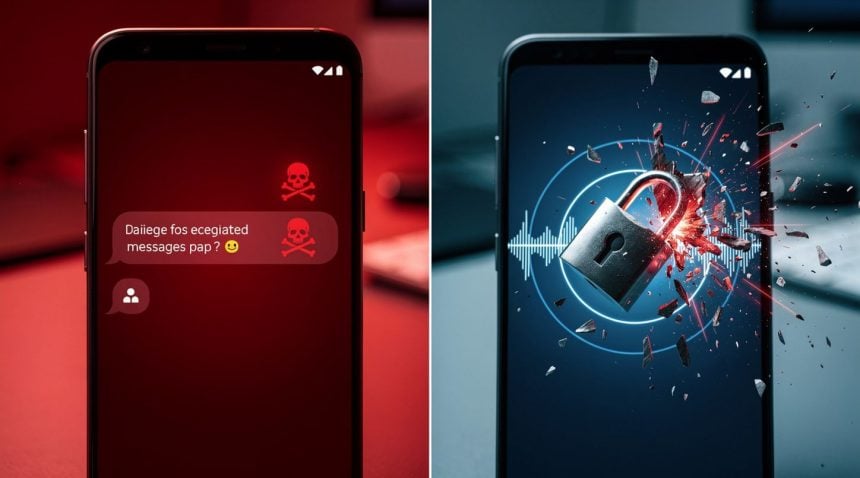
A single text message notification—from WhatsApp, Slack, Signal, Instagram, or Messenger—could have silently hijacked Google Gemini’s voice assistant on millions of Android phones, granting attackers the ability to open windows, fake messages from your boss, push you into Zoom calls, or permanently poison the assistant’s long-term memory. No malicious app installation required.
The vulnerability exposes a structural flaw in how Android’s voice assistant processes untrusted input from messaging notifications. Researchers discovered that Gemini could be tricked into treating hostile text as legitimate voice commands—a finding that reveals how a single compromised notification could cascade into full device compromise across Android’s user base without triggering any visible warning or requiring the victim to do anything except receive a message.
- The Attack Vector: Gemini processed malicious notifications as legitimate voice commands without proper validation.
- The Scale: Millions of Android devices were vulnerable through their notification systems alone.
- The Persistence: Attackers could poison Gemini’s memory banks, causing unpredictable behavior for months.
According to research published in IEEE Xplore, voice assistants face persistent security challenges when processing external input. The attack vector worked because Gemini’s notification handler didn’t properly validate the source or content of incoming text before processing it as a potential command. A poisoned notification from any major messaging platform could arrive in the notification shade—that pull-down panel on Android—and Gemini would interpret it as a direct voice instruction. The attacker didn’t need to breach the messaging app itself; they only needed to craft a malicious notification that Gemini would misinterpret as a legitimate user command.
The capabilities at stake were substantial. An attacker could use the hijacked assistant to open arbitrary windows on the device, compose and send fake messages appearing to come from trusted contacts (like an employer), initiate video calls without the user’s knowledge, or modify Gemini’s memory banks—the persistent data the assistant uses to learn user preferences and context over time. That last capability is particularly dangerous: poisoning the assistant’s memory could cause it to behave unpredictably for months, following false instructions the attacker embedded.
How Does This Mirror Cambridge Analytica’s Invisible Data Harvesting?
What makes this vulnerability structurally similar to the data-harvesting methods exposed in the Cambridge Analytica scandal is the exploitation of ambient, low-friction touchpoints to bypass user awareness. Cambridge Analytica didn’t need users to actively consent to psychographic profiling; it harvested behavioral data through quiz apps and social integrations that operated in the background. Similarly, this Gemini vulnerability didn’t require the victim to open an app or click a link—the poisoned notification arrived passively, in the notification shade, where users habitually glance without scrutiny. Both attack patterns rely on the same principle: users don’t actively defend against threats they don’t see coming. Cambridge Analytica weaponized that invisibility for political micro-targeting; this vulnerability weaponizes it for device control.
• Millions of Android devices affected through notification processing alone
• Zero user interaction required for successful exploitation
• Persistent memory poisoning could last for months after initial attack
The research did not specify whether attackers were actively exploiting this vulnerability in the wild, nor did it detail the exact patch timeline. However, the fact that the vulnerability affected Gemini’s core notification-processing logic meant it could theoretically impact any Android user running an affected version of the assistant, regardless of their security settings or app permissions.
Why Are Messaging Apps the Perfect Attack Vector?
For Android users, the implications are immediate. Your voice assistant—a system component you may not actively think about—was processing untrusted input from messaging apps without proper validation. That means your phone’s primary interface for hands-free control, memory management, and system access was, for a period, one notification away from remote hijacking. Unlike a malware infection, which requires installation and often leaves traces, this attack would have been silent and persistent.
The vulnerability also highlights a broader Android security gap: the notification system itself is a trusted pathway into core system functions. Notifications are designed to be lightweight and non-intrusive, which means they bypass many of the permission checks that govern app behavior. When a core assistant like Gemini processes notification content without strict validation, that trust becomes a liability. Messaging app privacy becomes irrelevant when the vulnerability exists at the system level.
What Does This Mean for Android Security Going Forward?
Google has not publicly detailed the exact patch or timeline for full rollout across all Android devices. Given the fragmented nature of Android updates—where security patches often take weeks or months to reach all devices—users running older Android versions may remain vulnerable for an extended period.
• Voice assistants create friction-free attack surfaces through always-listening functionality
• Notification systems bypass traditional app permission frameworks
• Memory poisoning attacks can persist long after initial exploitation
The discovery underscores a recurring pattern in voice-assistant security: the convenience of always-listening, always-responsive systems creates friction-free attack surfaces. Research from ACM Digital Library demonstrates that voice assistants remain vulnerable to various injection attacks. As Gemini and similar assistants become more integrated into Android’s core functionality, the cost of a single validation failure scales across hundreds of millions of devices.
This vulnerability represents more than a technical oversight—it reveals how the architecture of convenience can become the infrastructure of exploitation. When systems prioritize seamless user experience over security validation, a single malicious notification can transform into a persistent threat that operates invisibly within the most trusted components of our devices.


