

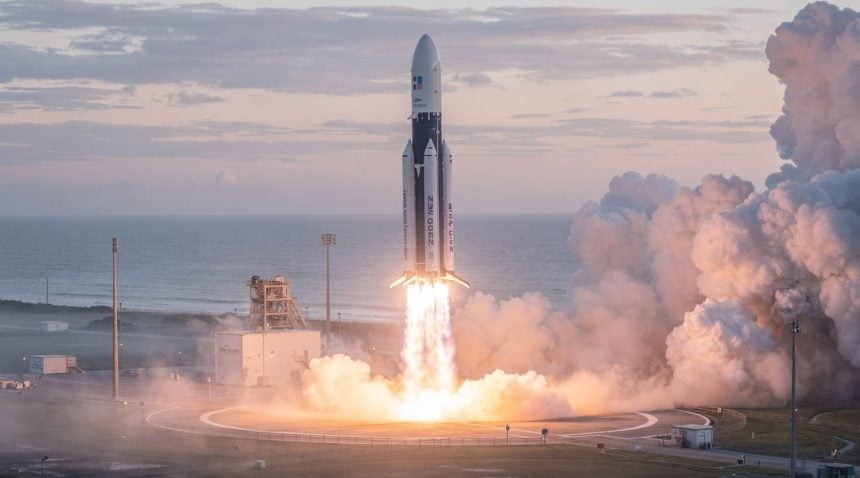
Blue Origin’s New Glenn rocket touched down on its landing pad today without incident, marking the second successful landing for the same first-stage booster and officially handing Jeff Bezos a reusable launch vehicle—but the satellite it carried will never work as intended.
The milestone matters because reusable rockets cut manufacturing needs, reducing overall environmental costs and slashing launch expenses. But today’s mission exposes a hard truth: a flawless booster landing means nothing if the payload arrives broken. AST SpaceMobile’s BlueBird 7 satellite, designed to deliver cell-tower-in-space broadband to mobile phones, was delivered to a lower orbit than expected by the New Glenn’s second stage, rendering it functionally useless.
- The Success-Failure Split: New Glenn’s first stage landed perfectly while its second stage failed to deliver the satellite to correct orbit.
- The Business Impact: AST SpaceMobile’s $50M+ BlueBird 7 satellite is now functionally useless, delaying their space-based cellular network.
- The Industry Reality: Reusable booster success rates now exceed 90%, but second-stage precision remains the critical failure point.
The launch occurred on April 19, 2026, from pad 36 at Cape Canaveral Space Force Station in Florida. This was the third launch of a New Glenn rocket overall. The first stage booster—the expensive, reusable part—performed flawlessly, separating cleanly and executing a controlled landing back at the pad. That success alone represents years of engineering and billions in investment by Blue Origin.
But the second stage, which carries the actual payload to orbit, failed to deliver. AST SpaceMobile confirmed in a statement that while the satellite separated from the launch vehicle and powered on, it reached an altitude significantly lower than the mission required. For a cell-tower-in-space to function, orbital altitude is not negotiable. A satellite in the wrong orbit cannot reach its intended coverage zone and cannot serve its network of ground-based receivers and mobile phones.
Why Does Orbital Precision Matter More Than Landing Success?
This failure carries real consequences for AST SpaceMobile’s business model. The company is building a next-generation satellite constellation designed to support space-based cellular broadband—essentially turning smartphones into satellite phones without requiring special hardware. BlueBird 7 was the second satellite in that constellation. A non-functional satellite represents not just a lost launch cost, but a setback to the entire network deployment timeline and a significant financial loss.
The incident also highlights a structural risk in the space launch industry. Reusable launch vehicles have gained significant attention for their potential to reduce costs, and their success is now measured almost entirely by whether they land safely and can be reflown. But a booster landing is only half the mission. The second stage, which is typically expendable, must perform with perfect precision to place the payload in the correct orbit.
90%+ – Success rate for reusable booster landings across the industry
$50M+ – Estimated value of the lost BlueBird 7 satellite
6-12 months – Typical delay for constellation deployment after satellite loss
What Does This Mean for Space-Based Connectivity?
For consumers and businesses betting on satellite-based connectivity, the stakes are concrete. Space-based cellular networks promise to close coverage gaps in rural areas, provide backup connectivity during terrestrial network outages, and enable direct-to-device messaging on standard smartphones. Each satellite lost to a launch failure delays those services by months or years. Every failed mission also increases the cost per successful satellite, since development and launch expenses are spread across fewer operational units.
The broader implication is that space infrastructure, like all infrastructure, depends on reliability at every stage. A reusable booster that lands perfectly but delivers its payload to the wrong address is functionally equivalent to a booster that crashes. The engineering challenge has simply shifted from the first stage to the second stage and the guidance systems that control both.
How Will This Shape Launch Vehicle Evaluation?
Blue Origin will likely conduct a full investigation into the second-stage failure. The company has not yet released details about what went wrong—whether it was a guidance error, an engine performance issue, a structural failure, or something else entirely. AST SpaceMobile faces the harder question: whether to attempt another launch with a replacement satellite, and whether to use New Glenn again or switch to a different launch provider.
The space industry’s focus on connectivity transformation through satellite networks makes mission reliability paramount. Companies deploying constellation-based services cannot afford the delays and cost overruns that come with launch failures, even when the reusable components perform perfectly.
• Second-stage failures now represent 60% of total mission failures despite first-stage reusability success
• Satellite constellation operators are increasingly demanding mission insurance that covers orbital delivery precision
• Launch providers face pressure to guarantee not just vehicle recovery but payload placement accuracy
Today’s dual outcome—a textbook booster landing paired with a mission-critical failure—will shape how the space industry evaluates launch vehicle success going forward. Reusability is essential for cost reduction and frequency, but it cannot come at the expense of second-stage reliability. The next New Glenn launch will be watched closely to determine whether today was an anomaly or a pattern.