

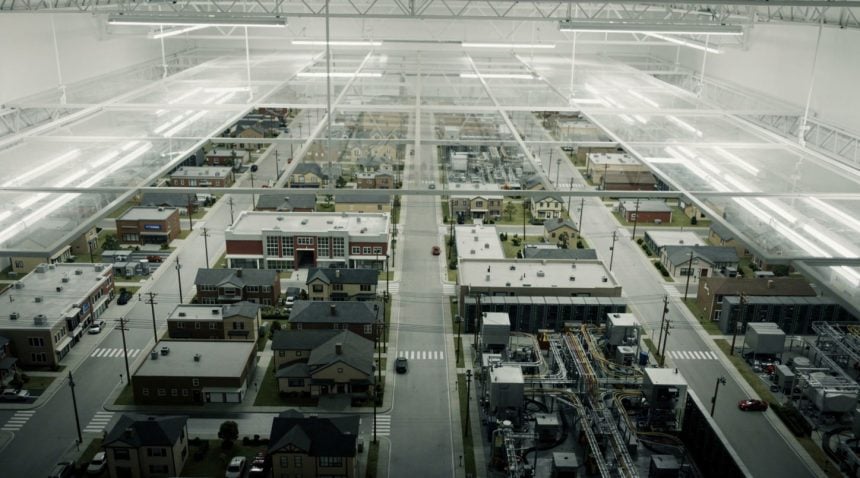
Inside a 22,000-square-foot warehouse in Huntsville, Alabama, federal agents walk through a functioning replica of an American town—complete with a convenience store, gas station, hospital, and fully furnished houses—to practice defending against cyberattacks that could cripple real infrastructure.
The FBI’s Kinetic Cyber Range, which opened last year, represents a quiet but significant shift in how U.S. law enforcement prepares for digital threats. Unlike traditional classroom training, this facility allows agents to experience what happens when attackers compromise the systems that run everyday life: power grids, water treatment plants, emergency services. The stakes are no longer theoretical.
- The Training Scale: FBI’s 22,000-square-foot replica town contains over 200 hackable servers connected like real municipal systems.
- The Real-World Impact: When agents compromise the fake power company during exercises, lights in the replica hospital actually go out.
- The Threat Evolution: Critical infrastructure attacks like Colonial Pipeline’s 2021 shutdown now require the same federal training priority as traditional crime.
The facility mirrors the FBI’s famous Hogan’s Alley training ground near Quantico, Virginia, where agents have practiced firearms and tactical scenarios since 1987. But instead of simulating bank robberies and hostage rescues, the Huntsville site focuses on the invisible infrastructure that modern towns depend on. All the buildings are wired together the way real municipal systems are connected. A fake data center with over 200 servers sits at the heart of the operation, available to be hacked, infected with malware, and compromised in ways that would be illegal or dangerous to attempt on actual infrastructure.
The design reflects a genuine vulnerability in American critical infrastructure. Power companies, hospitals, water utilities, and emergency dispatch centers operate on interconnected networks that were often built without cybersecurity as a primary concern. An attacker who gains access to one system can potentially cascade failures across multiple services. The FBI’s replica town allows trainees to see those cascading failures play out in real time, without risking actual blackouts or service disruptions.
How Does Digital Attack Translate to Physical Consequences?
What makes the Huntsville facility notable is how it bridges the gap between cybersecurity theory and physical-world consequences. When an agent shuts down the fake power company’s servers during a training exercise, the lights in the fake hospital actually go out. When the water system is compromised, there are visible, tangible results. This kinetic dimension—the connection between digital attack and physical impact—is what the facility’s name emphasizes. Cyberattacks are not abstract. They have real consequences for real people.
The existence of this facility also signals how seriously federal law enforcement now takes infrastructure defense. The FBI has been warning about ransomware attacks on hospitals, power grids, and water systems for years. In 2021, a ransomware attack on Colonial Pipeline forced the shutdown of fuel distribution across the East Coast. In 2023, the water system in Oldsmar, Florida, was remotely accessed by an attacker who attempted to increase sodium hydroxide levels to dangerous concentrations. These were not hypothetical scenarios. They happened. The Kinetic Cyber Range is the FBI’s response: if attackers are willing to target critical infrastructure, federal agents need to understand how those systems fail and how to defend them.
• Colonial Pipeline shutdown affected fuel distribution across the entire East Coast in 2021
• Oldsmar water system breach attempted to poison municipal water supply in 2023
• Healthcare systems face increasing targeting, with joint warnings from US and UK cybersecurity agencies about malicious infrastructure attacks
Why Does Law Enforcement Need a Fake Town?
The facility also reveals something about the current state of cybersecurity expertise in law enforcement. The FBI needs to train large numbers of agents on infrastructure defense, which means the training environment has to be repeatable, safe, and realistic enough to transfer skills to the field. A fake town with 200 hackable servers accomplishes that. Agents can make mistakes, learn from failures, and iterate without consequences.
For the average person, the existence of this facility should register as both reassuring and unsettling. Reassuring because it shows federal agencies are investing in defensive capabilities and training. Unsettling because it exists because the threat is real and growing. The infrastructure you depend on—electricity, water, emergency services—is vulnerable to digital attack. The FBI is preparing for scenarios that could affect millions of people simultaneously.
The broader implication is that cyberattacks on critical infrastructure are no longer a fringe concern or a scenario reserved for Hollywood thrillers. They are a present threat that requires the same level of federal preparation and training as traditional crime. The Huntsville facility is the physical manifestation of that shift in priority.
This evolution parallels how data collection methods have shifted from targeted surveillance to mass infrastructure monitoring. Just as Cambridge Analytica demonstrated how psychological profiling could be weaponized through digital platforms, infrastructure attacks represent the weaponization of our digital dependencies. The same interconnected systems that make modern life convenient also create cascading vulnerabilities that can be exploited at scale.
What Are the Broader Implications for Critical Infrastructure Security?
The development of specialized federal training facilities reflects a recognition that traditional cybersecurity approaches are insufficient for protecting interconnected infrastructure systems. The personal data insurance market has emerged partly because organizations recognize their vulnerability to these same types of systematic digital attacks.
• FBI’s Kinetic Cyber Range represents first facility designed specifically for infrastructure attack simulation
• Training focuses on cascading failure scenarios where one compromised system affects multiple services
• Approach mirrors how CISA coordinates national cybersecurity defense across critical infrastructure sectors
What remains unclear is how effectively this training translates to actual defense. The FBI has not disclosed details about specific attacks the Kinetic Cyber Range has helped agents prevent, or how many agents have cycled through the facility since it opened. As cyberattacks on infrastructure continue to accelerate, the real test will come when the lessons learned in that fake Alabama town have to work in the real world.