
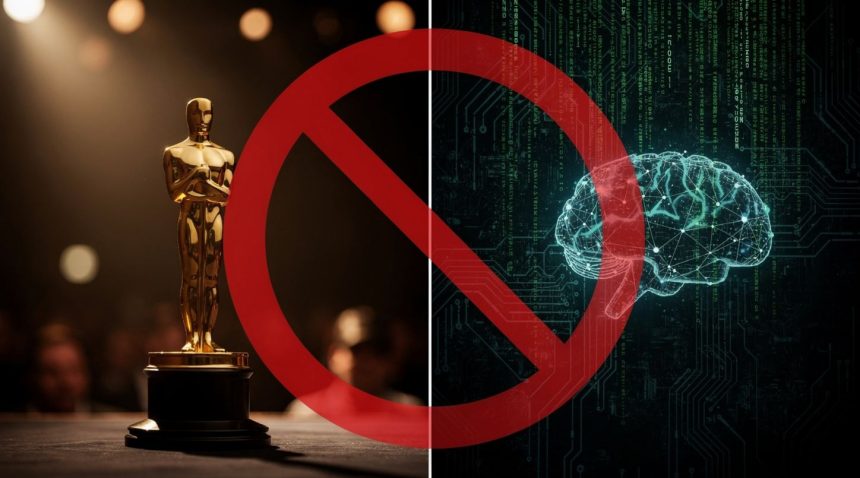
The Academy of Motion Picture Arts and Sciences has drawn a formal line: artificial intelligence-generated performances and screenplays are now ineligible for Oscar consideration. The rule, confirmed this month, marks the first explicit boundary the Academy has set around AI in filmmaking. Yet behind the scenes, studio executives and producers are already asking how to work around it.
The stakes matter because the Oscars remain Hollywood’s most visible legitimacy machine. A Best Picture win or acting nomination can transform careers, greenlight sequels, and signal to the industry what kind of filmmaking gets celebrated. By barring AI performances and AI-written scripts, the Academy is saying: these are not the work we honor. But the rule’s narrow scope—targeting only fully AI-generated performances and screenplays—may leave room for the very thing studios are most interested in: AI as a tool within human-led production.
- The Narrow Ban: Only fully AI-generated performances and screenplays are prohibited, leaving AI-assisted production eligible for awards.
- The Transparency Gap: Oscar-eligible films could be 70% AI-generated with 30% human revision, with no disclosure requirement for audiences.
- The Studio Advantage: The rule provides public relations cover while allowing continued AI integration in workflows the Academy doesn’t explicitly address.
The Academy’s eligibility requirements now explicitly state that performances generated by artificial intelligence cannot qualify for acting awards. Screenplays written entirely by AI systems are similarly excluded from consideration. These are bright-line rules. A film cannot win Best Picture if its lead performance is synthetic, nor can it compete if the screenplay was generated by an AI without human authorship. The move follows years of industry tension over how—or whether—to integrate generative systems into the filmmaking process.
What Does the Academy’s AI Ban Actually Prohibit?
What the rule does not prohibit is far more revealing. Studios can still use AI to assist human screenwriters, generate early drafts that writers then rewrite, or create visual effects and backgrounds. They can use AI to enhance or modify human performances in post-production. They can deploy AI for editing, color grading, or sound design. The Academy’s ban targets only the final product: a performance or script that is entirely machine-generated. The tool itself remains legal and encouraged in Hollywood.
This distinction matters because it mirrors a pattern already visible in other creative industries. When music labels faced pressure over AI-generated songs, they didn’t stop using generative systems—they reframed them as production tools rather than artists. When publishing houses debated AI-written books, the conversation shifted to disclosure and human editorial involvement rather than outright prohibition. The same logic is likely to apply in film: studios will continue experimenting with AI, but will ensure human names appear in the credits.
• Current rules require “entirely” AI-generated content for disqualification
• No percentage threshold defined for human vs. AI contribution
• Zero disclosure requirements for AI assistance in eligible categories
How Will Audiences Know What They’re Watching?
For viewers, this creates a transparency problem. An Oscar-eligible screenplay might have been 70 percent written by an AI system and 30 percent rewritten by a human screenwriter. A performance might have been synthetically generated and then touched up by a human editor. Under the Academy’s current rules, both would qualify. The audience watching the film would have no way to know how much of what they’re seeing came from a machine versus a person. The rule protects the category’s integrity only if you believe the category is defined by the final output, not the process that created it.
Research institutions are grappling with similar challenges around AI disclosure. Columbia University’s AI policy emphasizes that creators remain responsible for accuracy regardless of AI assistance, but the entertainment industry operates under different accountability standards than academic research.
The Academy’s decision also sidesteps a harder question: what counts as an AI performance? If a studio uses AI to recreate a deceased actor’s likeness and movements, but a human actor provides the voice, is that an AI performance or a human one? If a director uses AI to generate a character’s facial expressions while a human actor provides the body and voice, where does the line fall? The rule as stated targets performances that are entirely generated by artificial intelligence, but Hollywood’s actual use of these systems is likely to be far messier and more hybrid.
Why Studios See This as a Win-Win
For the studios, the ban is a public relations victory with minimal operational cost. They can tell shareholders, writers, and actors that they respect the Academy’s boundaries while continuing to integrate AI into their workflows in ways the rule doesn’t explicitly address. The rule gives the appearance of guardrails without requiring significant changes to how films are actually made.
This approach parallels broader industry trends in synthetic media development, where the focus has shifted from prohibition to integration with human oversight. The entertainment industry’s adoption of AI tools follows similar patterns seen in data manipulation across digital platforms—the technology advances while regulatory frameworks struggle to keep pace.
• Studios can maintain AI development investments while claiming Academy compliance
• Human oversight requirements create new job categories rather than eliminating existing ones
• The rule structure incentivizes hybrid approaches over fully automated production
What Happens When the Rules Get Tested?
The real test will come in the years ahead, as more films are submitted for consideration and the Academy must decide whether a particular screenplay or performance crosses the line from “AI-assisted” to “AI-generated.” That’s when the rule’s ambiguities will become apparent, and when studios’ lawyers will find the gaps. Research on generative AI governance suggests that policy implementation often reveals unforeseen complexities that weren’t apparent during rule creation.
The Academy has banned AI performances and screenplays from the Oscars. What it hasn’t done is ban AI from Hollywood—or even from the films that win. As the technology evolves and becomes more sophisticated, the line between human and machine creativity will only become more difficult to draw. The question isn’t whether AI will influence Oscar-winning films—it’s whether audiences will ever know how much.