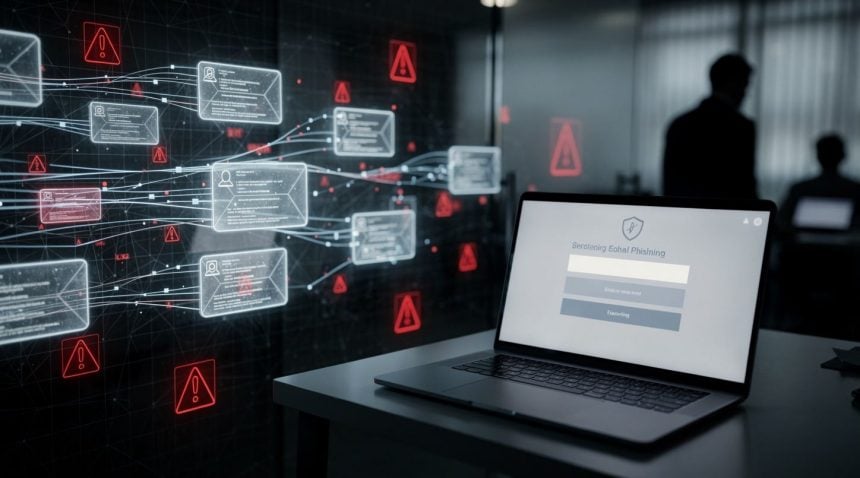
A phishing kit called Bluekit has emerged with a dangerous new feature: an AI assistant that can generate customized attack campaigns in minutes, not hours.
The toolkit represents a significant shift in how cybercriminals operate. By automating the labor-intensive work of crafting convincing phishing emails, AI-powered kits lower the barrier to entry for attackers with minimal technical skill. What once required expertise in social engineering and email spoofing can now be delegated to machine learning—making fraud campaigns faster, cheaper, and harder to detect at scale.
- The Automation Scale: Bluekit’s AI can generate dozens of distinct phishing campaigns simultaneously, compressing hours of manual work into minutes.
- The Template Arsenal: Over 40 pre-built templates target popular services, allowing rapid customization for specific victims and organizations.
- The Defense Gap: Traditional email filters and user training were designed for slower, manual campaigns and may struggle against AI-generated variations.
Bluekit includes more than 40 pre-built templates designed to impersonate popular services. These templates serve as starting points for attackers to customize campaigns targeting specific victims. The AI component generates drafts of phishing messages, allowing criminals to rapidly produce variations of the same attack and test which versions fool the most recipients.
How Does AI Lower the Barrier for Cybercriminals?
The kit’s design reflects a troubling trend: the democratization of cybercrime through automation. Phishing has always been a numbers game—send enough emails, and some percentage will click malicious links or enter credentials. But manual campaigns are labor-intensive. An attacker must research targets, craft believable pretexts, and monitor results. Bluekit’s AI assistant compresses that workflow, enabling a single operator to launch dozens of distinct campaigns simultaneously.
Research on AI-powered phishing published between 2023 and 2025 documents how large language models are increasingly being weaponized for attack generation. This academic analysis confirms what security practitioners are observing in the wild: AI is fundamentally changing the economics of cybercrime.
• 40+ service templates covering high-value credential theft targets
• Minutes required to generate customized campaigns vs. hours for manual creation
• Single operators can now manage dozens of simultaneous attack vectors
Security researchers tracking the service have documented its capabilities, though the full scope of its deployment remains unclear. What is known is that the kit is being actively marketed and used. The presence of 40 templates covering major platforms suggests the operators have invested significant effort in covering high-value targets—services where credential theft yields immediate financial or identity-theft payoffs.
Why Are Traditional Defenses Struggling?
The timing of Bluekit’s emergence matters. Generative AI tools have become widely accessible, and threat actors have been experimenting with language models to improve phishing effectiveness for months. Bluekit appears to be a purpose-built solution that integrates AI directly into the attack workflow, rather than requiring operators to use separate tools. This integration makes the attack chain more efficient and harder to disrupt.
For organizations, the implications are stark. Traditional phishing defenses—email filters, user training, link analysis—were designed for a slower threat landscape where attackers had to manually craft campaigns. An AI-assisted kit that can generate 40 variations of a phishing email, each tailored to a different department or company, may evade some detection methods. The sheer volume of customized attacks also overwhelms human analysts who might otherwise spot patterns.
Organizations should also consider how previous data breaches provide raw material for AI-powered personalization. Information harvested from past incidents becomes training data for more convincing attacks.
What Makes AI-Generated Phishing More Dangerous?
Individual users face a more insidious problem: personalization at scale. Phishing emails have always been more effective when they reference specific details about the target. Bluekit’s AI can incorporate information harvested from social media, company websites, or previous data breaches to make emails feel authentic. A message that appears to come from your bank, references your recent transactions, and uses language that matches your company’s internal style is far more likely to succeed than a generic “verify your password” spam email.
• Studies on generative AI applications demonstrate how the technology creates a double-edged sword in cybersecurity
• AI-generated phishing content shows improved linguistic sophistication and contextual relevance
• Automated attack generation significantly reduces the time and skill requirements for launching campaigns
The economic incentive driving Bluekit’s development is straightforward. Phishing remains one of the highest-ROI attack methods for criminals. A single successful credential theft can unlock access to corporate networks, financial accounts, or email systems. If AI can increase the success rate or volume of attacks, the return on investment justifies the development cost. Bluekit’s operators are betting that enough targets will fall for automated campaigns to make the service profitable.
How Should Organizations Adapt Their Defenses?
Security vendors and email providers will likely begin adapting defenses to detect AI-generated phishing emails. However, this creates a cat-and-mouse dynamic: as detection improves, attackers will refine their AI prompts or switch to different models. The fundamental problem—that AI can generate convincing text at scale—remains unsolved.
Cybersecurity research on AI applications suggests that artificial intelligence serves as both a defensive and offensive tool, helping security teams automate responses while simultaneously empowering attackers with new capabilities.
The emergence of Bluekit signals that AI-assisted cybercrime is no longer theoretical. It is operational, available for purchase, and actively being deployed. Organizations should assume that phishing campaigns they receive may have been generated or optimized by machine learning, and that traditional defenses may be insufficient. Employee training programs need to account for the fact that phishing emails will be more personalized and contextually appropriate than ever before.
Implementing robust password management systems becomes even more critical when facing AI-powered credential theft attempts. Multi-factor authentication and zero-trust architectures provide additional layers of protection against successful phishing attacks.
As AI tools become cheaper and easier to use, the next wave of phishing kits will likely be even more sophisticated. The question is not whether criminals will continue integrating AI into their attack infrastructure—they already have. The question is how quickly defenders can adapt.