

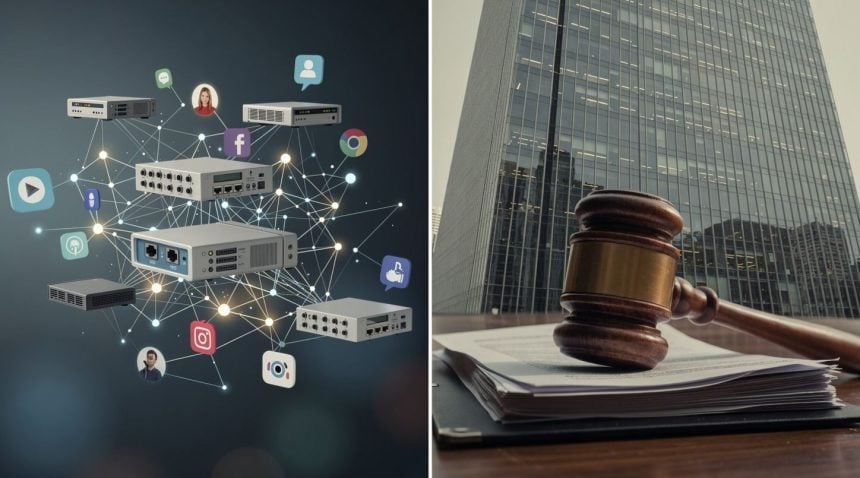
A coalition of small independent servers hosting decentralized social networks could be wiped out overnight by a single policy change that sounds like it targets Big Tech but would actually save it.
The threat is Section 230 repeal. Lawmakers frustrated with Meta, Google, and other tech giants are increasingly eyeing the 1996 law as a nuclear option—but killing it would eliminate the legal shield that allows thousands of small hosts to run Mastodon instances, Bluesky personal data servers, and other decentralized platforms without facing catastrophic liability. The paradox is stark: the companies Big Tech critics want to dethrone depend entirely on Section 230 to exist. Remove it, and only the largest, most lawyered-up corporations can survive the legal onslaught.
- The Legal Shield: Section 230 protects thousands of small decentralized hosts from liability for user-generated content they cannot pre-screen.
- The Survival Gap: Big Tech companies can absorb multimillion-dollar lawsuits while volunteer-run servers cannot afford basic legal defense.
- The Consolidation Effect: Repealing Section 230 would eliminate the legal foundation that enables Mastodon, Bluesky, and other decentralized alternatives to exist.
Section 230’s core protection is deceptively simple. The law states that “no provider or user of an interactive computer service shall be treated as the publisher or speaker of any information provided by another information content provider.” Passed in 1996 to preserve emerging online communities, this bipartisan measure recognizes that intermediaries—services delivering messages between users—cannot reasonably be held liable for every message they transmit. When harmful speech occurs, the speaker bears responsibility, not the platform.
For decades, this framework enabled the internet’s diversity. But it also enabled consolidation. Today, a handful of multi-billion-dollar companies control the social media landscape, trapping users in what the Electronic Frontier Foundation calls “walled gardens” where Google and Meta surveil, censor, and betray user interests for profit. Understanding personal data marketplaces reveals how these platforms monetize user information.
How Does the Open Social Web Challenge Big Tech?
The Open Social Web represents a genuine alternative. Built on protocols like ActivityPub (powering Mastodon) and AT Protocol (powering Bluesky), these decentralized systems distribute hosting across thousands of independent operators. Users own their connections. No single company controls your audience. Communities can self-organize and experiment with moderation approaches tailored to their values—from heavily curated to completely open.
This infrastructure works only because Section 230 exists. Without it, every small host faces existential legal risk. A defamatory post on a Mastodon instance could expose that instance operator to a lawsuit. A user sharing another person’s message could face liability. Even the infrastructure layer—ISPs, content delivery networks, domain registrars—would face potential liability for content flowing through their systems.
• Big Tech companies maintain legal departments with hundreds of attorneys
• Small decentralized hosts typically operate with zero legal budget
• A single defamation lawsuit can cost $50,000-$500,000 to defend regardless of merit
Why Would Section 230 Repeal Benefit Big Tech?
The math is brutal: Big Tech companies can absorb multimillion-dollar lawsuits. A volunteer running a Mastodon server cannot. The result of repealing Section 230 would be predictable: small hosts shut down one by one, unable to afford legal defense. Decentralized platforms collapse. Users have nowhere to go except the surviving giants—Meta, Google, and whoever else can afford an army of lawyers.
Section 230 also protects users themselves. When you share, boost, or quote another person’s message on the open social web, you’re not liable for their speech. Repeal that protection, and one misclick could expose you to a defamation lawsuit. The law extends to the entire infrastructure stack: ISPs, mesh networks, experimental decentralized systems still being built.
Research published in Daedalus warns that Section 230 repeal would serve as “a wakeup call for the entire social media ecosystem,” fundamentally reshaping how platforms operate. However, the analysis reveals this would disproportionately impact smaller platforms that lack resources for extensive legal compliance.
What Does Section 230 Actually Protect?
Critically, Section 230 was never a license to host anything. It does not protect companies that create illegal content themselves. It does not shield intellectual property violations. What it does protect is the legal space for moderation experimentation—the ability for small platforms to decide their own content policies without facing ruinous litigation for hosting user speech.
The irony cuts deep. Critics of Big Tech monopolies often frame Section 230 as the enemy, imagining that weakening it will force accountability on Meta and Google. But those companies have the resources to adapt. They’ll hire more lawyers, settle more suits, and emerge stronger. The platforms that cannot survive a post-230 world are the ones actually challenging their dominance.
• Section 230 enables content moderation by protecting platforms from liability for both hosting and removing user content
• Without this protection, platforms face legal risk whether they moderate aggressively or permissively
• Small platforms lack the legal infrastructure to navigate complex content liability without clear safe harbors
Lawmakers considering Section 230 changes face a choice they may not fully grasp: protect the legal conditions for a decentralized internet, or hand Big Tech a gift wrapped in the language of accountability. The Electronic Frontier Foundation is urging careful consideration of these impacts, warning that decentralized projects are uniquely vulnerable to liability changes. The broader context of tech giants’ influence shows how regulatory changes often benefit established players.
Could Decentralized Platforms Survive Without Section 230?
The open social web embodies what Section 230 was designed to protect: diverse, distributed communities organizing themselves online without a central authority controlling speech. It is, by most measures, the best realistic chance at building a democratic internet where users and communities hold power instead of billionaires and advertisers.
Legal scholarship from Texas A&M emphasizes that Section 230 remains “valuable” for enabling content moderation across diverse platforms, though many legislators continue pushing for amendments or repeal. The research highlights how alternative approaches to platform liability could fundamentally alter the internet’s structure.
However, concerns about decentralized platforms extend beyond legal liability. Analysis of decentralized protocol ethics reveals that some federated systems may replicate data extraction practices while avoiding traditional oversight mechanisms.
That future depends on a law from 1996 surviving into 2026. The question now is whether lawmakers understand what they would actually destroy.