
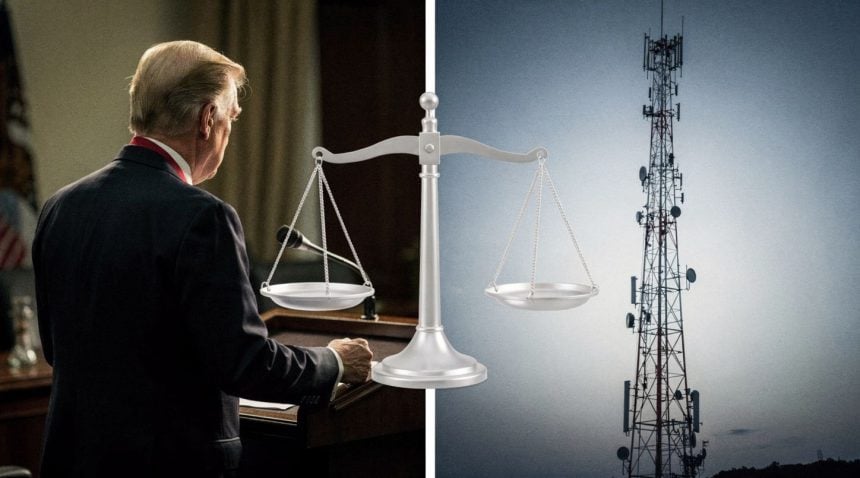
The Federal Communications Commission under the Trump administration has threatened to revoke ABC’s broadcast license, escalating a high-stakes confrontation between the government and one of America’s largest media companies. But Disney, which owns ABC, may have a powerful legal shield: a 1996 change to US law that has made broadcast license renewals effectively automatic.
The threat marks a dramatic moment in the ongoing tension between the current administration and mainstream media outlets. Yet the mechanics of broadcast licensing—and a three-decade-old statute—could render the FCC’s threat largely symbolic unless Disney chooses not to fight.
- The Legal Standard: The Telecommunications Act of 1996 made broadcast license renewals “all but automatic” by requiring the FCC to prove harm rather than broadcasters to prove worthiness.
- The Burden Shift: Under current law, the FCC must demonstrate that renewal is not in the public interest—a standard that has rarely been invoked successfully in recent decades.
- The Real Question: Disney’s decision to fight legally may matter more than the FCC’s formal authority, which faces substantial statutory constraints.
Under current law, broadcast license renewals are described as “all but automatic.” This protection stems from the Telecommunications Act of 1996, which fundamentally restructured how the FCC evaluates whether to renew a broadcaster’s license. The shift was designed to reduce regulatory burden and provide stability to the broadcast industry.
How Does the 1996 Law Actually Protect Broadcasters?
The practical effect is significant: for a broadcaster to lose its license, the FCC must demonstrate that renewal is not in the public interest. This is a high bar. The burden falls on the agency to prove harm, not on the broadcaster to prove worthiness. This framework stands in sharp contrast to earlier regulatory eras, when license renewals were treated as genuine moments of regulatory scrutiny and could be denied or conditioned on specific commitments.
• Pre-1996: Broadcasters required detailed showings of public service and community responsiveness
• Post-1996: License renewals became routine administrative approvals
• Current standard: FCC must prove renewal would not serve public interest
ABC’s parent company Disney has not yet publicly committed to a legal fight, and that hesitation may be the real story here. The question is not whether Disney can win in a legal challenge—the 1996 law appears to favor the broadcaster—but whether Disney will choose to engage in a prolonged regulatory and public battle with a sitting administration.
What Are the Broader Stakes for Media Independence?
The FCC’s threat arrives amid broader political friction between the Trump administration and ABC News, which has covered the administration critically. The license threat is one of several pressure points the administration has applied to media outlets it views as hostile. However, the FCC’s formal authority to revoke a broadcast license is constrained by statute and decades of precedent.
For viewers and the broader media ecosystem, the stakes are substantial. A successful license revocation would set a precedent that sitting administrations can use broadcast licensing as a tool to punish editorial coverage they dislike. Conversely, if Disney successfully defends ABC’s license, it would reinforce the legal protections that have insulated broadcasters from political retaliation through the licensing process.
Why Did Congress Make License Renewals Automatic?
The 1996 law was itself a product of deregulation momentum in the 1990s. Congress and the FCC at that time believed that the broadcast industry had matured sufficiently to operate with lighter regulatory oversight. License renewals, which once required detailed showings of public service and community responsiveness, became routine administrative approvals. The shift reflected a broader philosophy that market forces, not government gatekeeping, should determine which voices reach the public.
• The 1996 framework strongly favors broadcasters in license disputes
• Courts have consistently upheld the “public interest” standard as a high bar for revocation
• Successful license revocations for content-related reasons are extremely rare in the modern era
That philosophy is now being tested. If the FCC attempts to revoke ABC’s license, Disney would likely challenge the action in federal court. Legal experts quoted in reporting on this matter have indicated that the 1996 framework strongly favors the broadcaster in such disputes. The FCC would need to demonstrate that renewing ABC’s license would not serve the public interest—a standard that has rarely been invoked successfully in recent decades.
What Happens Next in This Legal Standoff?
The timing matters. ABC’s license renewal is not imminent; broadcasters typically have several years between renewals. This gives Disney time to assess its options and decide whether to mount a legal defense, seek a negotiated resolution, or attempt to de-escalate the political conflict through other means.
For ordinary viewers, the immediate impact is unclear. ABC continues to broadcast. The threat to its license is real in political terms but faces substantial legal headwinds. However, the episode underscores how broadcast licensing—a mechanism designed to serve the public interest—can become a flashpoint in partisan conflict.
The resolution will depend partly on Disney’s willingness to fight and partly on whether courts uphold the protections embedded in the 1996 law. If Disney declines to challenge the FCC, the legal question may never be resolved. If Disney fights, the outcome could reshape how administrations use licensing authority over broadcasters.
The next formal step will likely come when ABC’s license renewal is formally due. Until then, the threat remains more political than legal—but the 1996 law suggests that legal reality would favor the broadcaster if the dispute reaches court.