
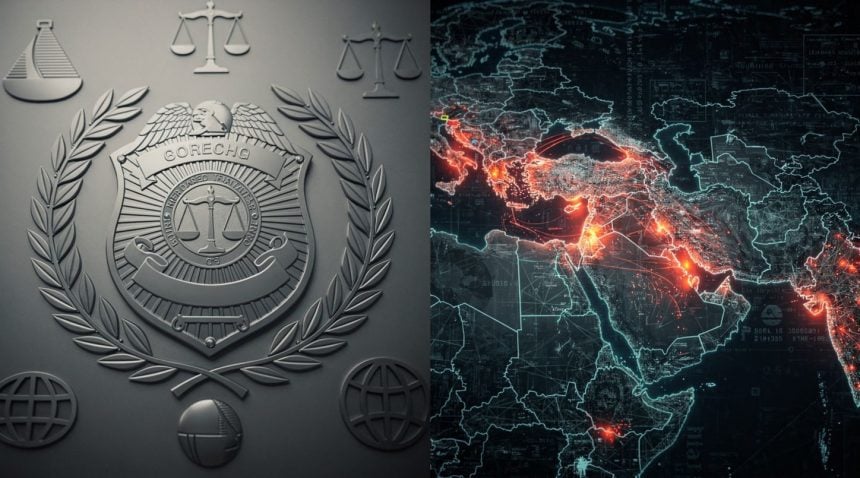
Two hundred and one cybercriminals arrested across 13 countries in a single coordinated operation—INTERPOL just executed what it describes as the largest cybercrime crackdown the Middle East and North Africa region has ever seen.
Operation Ramz, which ran from October 2025 through February 2026, represents a watershed moment in regional law enforcement coordination. The scale alone signals a shift: 201 arrests, plus the identification of 382 additional suspects still under investigation. But the real story lies in what these numbers reveal about the infrastructure that enabled them—and what it took to finally dismantle it.
- The Scale: 201 arrests plus 382 identified suspects represent the largest coordinated cybercrime operation in MENA history.
- The Infrastructure: Law enforcement mapped criminal network connections across 13 countries, revealing organized operations resembling legitimate businesses.
- The Data Risk: Past breach victims remain vulnerable as stolen data likely persists despite operational disruption.
The operation involved law enforcement agencies from all 13 participating MENA countries working in tandem to investigate and neutralize malicious infrastructure that had been operating with relative impunity. INTERPOL coordinated the effort, which means real-time intelligence sharing, synchronized raids, and cross-border warrant execution—a level of cooperation that has historically been difficult to achieve in a region where cybercrime has flourished partly because it operates in jurisdictional gray zones.
What makes Operation Ramz significant for privacy advocates is not just the arrests themselves, but what they signal about the ecosystem that enabled these criminals to operate at scale. Cybercriminals in the MENA region have long relied on fragmented law enforcement responses and limited cross-border cooperation to sustain operations that target individuals and organizations across the globe. A single ransomware gang, for instance, might operate from one country, launder money through another, and target victims in a third—making prosecution nearly impossible without coordinated action.
How Did Criminal Networks Evade Detection for So Long?
The identification of 382 additional suspects suggests that law enforcement has now mapped a significant portion of the criminal network infrastructure itself. This is the unglamorous but essential work of cybercrime investigation: not just catching individual perpetrators, but understanding how they connect, communicate, and coordinate attacks. That mapping becomes the foundation for future operations.
• 201 arrests across 13 countries in coordinated raids
• 382 additional suspects identified and under investigation
• 5-month operation duration from October 2025 to February 2026
The timing is notable. As of April 2026, regional cybercrime has become increasingly sophisticated and organized. Criminal networks in the MENA region have moved beyond opportunistic phishing and script-kiddie attacks toward structured operations that resemble legitimate businesses—with divisions of labor, supply chains for stolen data, and customer-service operations for ransomware victims. Operation Ramz’s scale suggests law enforcement finally has the political will and technical capacity to confront that evolution.
What Happens to Already Stolen Data?
For individual users and organizations in the region and beyond, the operation’s success carries an implicit message: the window of impunity for cybercriminals is narrowing. But it also raises a harder question about what happens to the data already stolen. The operation disrupts *future* attacks, but it does not recover data exfiltrated in past breaches. Anyone who has been a victim of ransomware, credential theft, or data harvesting by MENA-based gangs should assume their information remains at risk—whether in the hands of arrested criminals, identified suspects still at large, or the 382 unidentified individuals now in law enforcement’s crosshairs.
The structural parallel to historical data crimes is worth noting. Cambridge Analytica’s operation relied on the same principle that enables cybercriminals in the MENA region: the ability to harvest personal data at scale, move it across jurisdictions, and exploit it for profit or influence without immediate legal consequence. CA harvested psychological profiles from millions of Facebook users; MENA cybercriminals harvest credentials, financial data, and personal identifiers from breach victims. Both operated in a space where enforcement was fragmented and slow. Operation Ramz suggests that fragmentation is finally being repaired—at least regionally.
Will This Model Scale Beyond MENA?
INTERPOL has not yet released a detailed breakdown of the specific types of crimes prosecuted under Operation Ramz—whether the 201 arrests targeted ransomware operators, credential-theft rings, phishing networks, or a mix. That detail matters for understanding which criminal vectors have been disrupted most effectively. The agency is expected to release additional findings in coming weeks.
• Cross-border coordination infrastructure established during Operation Ramz could serve as template for global cybercrime enforcement
• Success depends on maintaining intelligence-sharing protocols beyond the operation’s February 2026 conclusion
• Regional approach may prove more effective than bilateral enforcement agreements
For now, the operation stands as proof that coordinated, cross-border law enforcement action against cybercrime is possible—even in regions where it has historically been rare. The question remains whether the digital activism and privacy advocacy that emerged after major data scandals will find new momentum in this enforcement success, or whether it becomes an isolated achievement in an otherwise fragmented global response to cybercrime.
Whether Operation Ramz becomes a model for future operations, or remains an outlier, will depend on whether the 13 participating countries maintain that cooperation infrastructure beyond February 2026. The data colonialism that enables both cybercriminals and surveillance capitalism requires coordinated resistance—Operation Ramz suggests such coordination is finally possible.