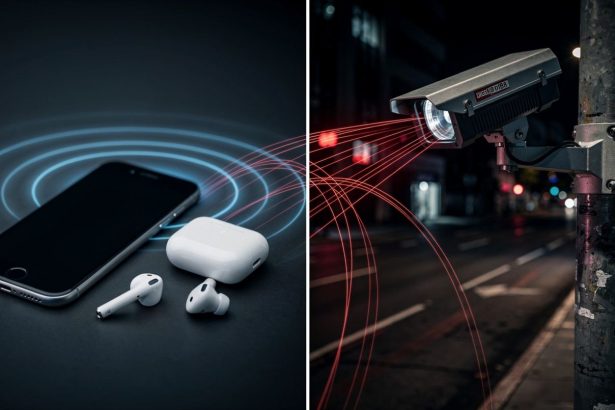

A Massachusetts defense attorney opens discovery documents in a felony case and finds a gap: the police report mentions a suspect identified through facial recognition, but the underlying database search, the accuracy rate, the images compared—all redacted or missing entirely.
- What Surveillance Technologies Is the Toolkit Targeting?
- How Does the Toolkit Force Disclosure?
- Why Are Prosecutors Resisting—and What Does That Resistance Reveal?
- What the Toolkit Demands—and What Silence Reveals
- How Did Surveillance Technology Reach This Scale Without Oversight?
- What Happens Next—and What It Means for Criminal Justice
This scenario is about to change. The ACLU has just released a comprehensive legal toolkit designed to force police departments and prosecutors to disclose the surveillance technologies they use to build criminal cases, from facial recognition systems to Stingrays (cell-site simulators that intercept phone signals) to AI-generated police reports. The toolkit, launched in Massachusetts, arms defense lawyers with specific interrogatories, motions, and legal strategies to pry open what has been one of law enforcement’s most opaque operational domains for decades.
- The Disclosure Gap: Police departments routinely withhold facial recognition search parameters, confidence scores, and Stingray deployment records from defense attorneys—evidence that directly affects the validity of criminal charges.
- The Scale of Deployment: The FBI’s facial recognition database contains over 640 million images, while vendors like Clearview AI scraped billions of photos from social media platforms without user consent.
- The Bias Problem: Research consistently documents that law enforcement facial recognition technology produces biased results across demographic groups, raising serious due process concerns in criminal proceedings.
- The Legal Mechanism: The ACLU toolkit uses existing Sixth Amendment protections and discovery rules to force transparency that no statewide legislation currently mandates in Massachusetts.
The stakes are immediate and personal: if you have been arrested or charged with a crime, the evidence against you may have been gathered using surveillance technology you have no way to know about, let alone challenge. Prosecutors and police have systematically withheld information about these tools from defense teams and judges. Now, for the first time, there is a structured legal mechanism to demand transparency.
What Surveillance Technologies Is the Toolkit Targeting?
The toolkit targets three categories of surveillance technology that police have historically concealed from discovery: facial recognition systems, cell-site simulators (Stingrays), and AI-generated or AI-assisted police reports. Each category represents a different threat to due process. Facial recognition databases—fed by driver’s license photos, mugshots, and increasingly social media images—can misidentify suspects, particularly people of color. Stingrays capture the location and communications of anyone in a geographic area, not just the target. AI-written reports can embed algorithmic biases into the official record without any human review or accountability.
The accuracy problem with facial recognition is not theoretical. A review of current research published in PMC confirms that law enforcement facial recognition technology is demonstrably biased along demographic lines, with error rates varying significantly depending on the subject’s race, age, and sex. This finding is reinforced by a landmark NIST study evaluating how accurately face recognition software identifies people of varied backgrounds, which found substantial performance disparities across demographic groups. When a system used to establish probable cause performs unevenly depending on who is being identified, the constitutional implications are direct and serious.
• PMC-published research documents that law enforcement facial recognition technology produces biased outcomes, with accuracy varying significantly across racial and demographic groups.
• The NIST Face Recognition Vendor Test (FRVT), Part 3 measured demographic effects across a wide range of commercial algorithms, finding that error rates for certain demographic groups were orders of magnitude higher than for others.
• Despite this documented unreliability, most police departments do not publicly disclose the false-positive rates of the facial recognition systems they deploy—an absence of data that is itself evidence of an accountability failure.
How Does the Toolkit Force Disclosure?
What makes the ACLU toolkit novel is its specificity. Rather than asking prosecutors to “disclose all surveillance,” which invites vague or evasive responses, the toolkit provides attorneys with precise discovery demands. Defense lawyers can now ask: What facial recognition database was searched? How many images were compared? What was the confidence score? Was the match used as probable cause or merely as a lead? For Stingrays: What location data was collected? How long was the device deployed? Were warrants obtained? For AI reports: Which sections were written or assisted by AI? What training data was used? Was the report reviewed by a human officer before filing?
The Massachusetts launch is significant because the state has no statewide transparency law governing police use of facial recognition or cell-site simulators. Police departments in Boston, Worcester, and other cities have used these tools with minimal public disclosure. The ACLU’s toolkit essentially creates a workaround—using existing discovery rules and constitutional protections to force the same transparency that legislation would mandate.
Why Are Prosecutors Resisting—and What Does That Resistance Reveal?
Prosecutors are already responding with resistance. The toolkit has circulated among defense bar associations and public defender offices in Massachusetts, and prosecutors’ offices have begun filing motions to limit discovery on surveillance technologies, arguing that disclosure would compromise investigative techniques or reveal proprietary information.
This defensive posture mirrors a pattern that defined the Cambridge Analytica scandal: when powerful institutions face demands for transparency about how they collect and use personal data, they invoke secrecy claims rather than submit to scrutiny. Cambridge Analytica harvested behavioral data at scale—Facebook likes, consumer purchases, location patterns—to build psychological profiles and micro-target individuals with personalized messaging designed to manipulate their decisions. Police facial recognition systems operate on a structurally similar principle: they harvest biometric data at scale to identify and locate individuals, often without consent or knowledge. Both systems relied on the assumption that secrecy was necessary to maintain effectiveness. Both were used disproportionately against vulnerable populations. And both resisted transparency until external pressure forced disclosure.
The parallel extends further. Just as Cambridge Analytica’s operations remained invisible to the public until journalists and regulators forced disclosure, the legacy of that scandal demonstrated that opacity in data-driven systems is not a neutral technical condition—it is a choice that benefits those wielding the systems. The ACLU toolkit applies that same lesson to criminal justice: demanding that the mechanics of surveillance be visible, auditable, and challengeable.
• The Sixth Amendment’s guarantee of effective assistance of counsel has long been interpreted to require access to exculpatory evidence—but courts are only beginning to grapple with whether that right extends to the algorithmic parameters of surveillance tools used to generate probable cause.
• When a facial recognition system produces a match with a low confidence score, and that score is never disclosed to the defense, the defendant cannot effectively challenge the reliability of the identification—a structural due process problem that the ACLU toolkit is designed to address.
• The toolkit’s approach of using existing discovery rules rather than waiting for new legislation reflects a strategic judgment: legislative reform is slow, but constitutional rights are immediate.
What the Toolkit Demands—and What Silence Reveals
The toolkit includes sample discovery requests that defense attorneys can adapt to their jurisdictions. One request asks for the total number of facial recognition searches conducted by a police department in a given year, the number of matches generated, and the number of arrests resulting from those matches. Another asks for the false-positive rate—how often the system identifies the wrong person. These numbers do not exist in most police departments’ public records, which itself is revealing. If police cannot or will not disclose how often their surveillance tools misidentify suspects, that absence of data is evidence of a problem.
The ACLU has also provided attorneys with legal arguments for why these disclosures are constitutionally required. The Sixth Amendment guarantees the right to effective assistance of counsel, which includes access to exculpatory evidence and information necessary to challenge the government’s case. If a suspect was identified through facial recognition, the defense has a constitutional right to know the system’s accuracy, the confidence score, and whether alternative suspects were ruled out. If a Stingray was used, the defense has a right to know whether it was deployed with a warrant and what other communications it intercepted.
How Did Surveillance Technology Reach This Scale Without Oversight?
Facial recognition technology has proliferated in police departments over the past five years, often without public debate or legislative approval. The FBI’s facial recognition database contains over 640 million images. State and local police departments have contracted with vendors like Clearview AI, which scraped billions of photos from social media platforms without consent. Meanwhile, Stingrays have been used by law enforcement for over a decade, often without warrants, to locate suspects and witnesses. The ACLU toolkit arrives as these technologies are reaching a critical mass of deployment—the moment when their cumulative impact on civil liberties becomes undeniable.
The absence of legislative guardrails is not accidental. As documented in analyses of behavioral microtargeting and the weaponization of personal data, institutions that benefit from data opacity have consistently lobbied against transparency requirements, framing disclosure as a threat to operational security rather than a democratic accountability obligation. The same dynamic has played out in law enforcement: vendors have argued that revealing algorithmic details would allow criminals to evade detection, while civil liberties organizations have countered that secrecy prevents defendants from exercising their constitutional rights.
• The FBI’s facial recognition database contains over 640 million images, drawn from driver’s licenses, passports, mugshots, and other government records.
• Clearview AI’s database, built by scraping social media platforms without consent, reportedly contains billions of images—making it one of the largest biometric databases in existence.
• Most U.S. states have no legislation specifically governing police use of facial recognition, leaving discovery rules as the primary legal mechanism for defendants to challenge its use.
What Happens Next—and What It Means for Criminal Justice
For someone arrested or charged with a crime, the practical effect is this: your defense attorney can now demand to know exactly which surveillance technologies were used to identify you, how accurate those technologies are, and whether police followed legal procedures in deploying them. If prosecutors refuse to disclose, your attorney can file a motion to compel discovery, potentially suppressing evidence obtained through undisclosed surveillance. If the evidence is suppressed, the prosecution’s case weakens or collapses.
The toolkit is not a silver bullet. Prosecutors can still invoke state secrets or proprietary information claims. Judges may rule against disclosure in individual cases. But the ACLU has created a template that defense attorneys across the country can adapt and use. Other states are watching Massachusetts. If the toolkit succeeds in forcing transparency there, similar efforts will likely spread to other jurisdictions.
The question now is whether prosecutors will resist disclosure or begin voluntarily disclosing surveillance technologies used in their cases. Some prosecutors’ offices have already signaled they will cooperate. Others are digging in. The outcome will depend on whether judges view surveillance transparency as a constitutional imperative or as an acceptable cost of law enforcement secrecy. That answer will shape criminal justice for years to come.