

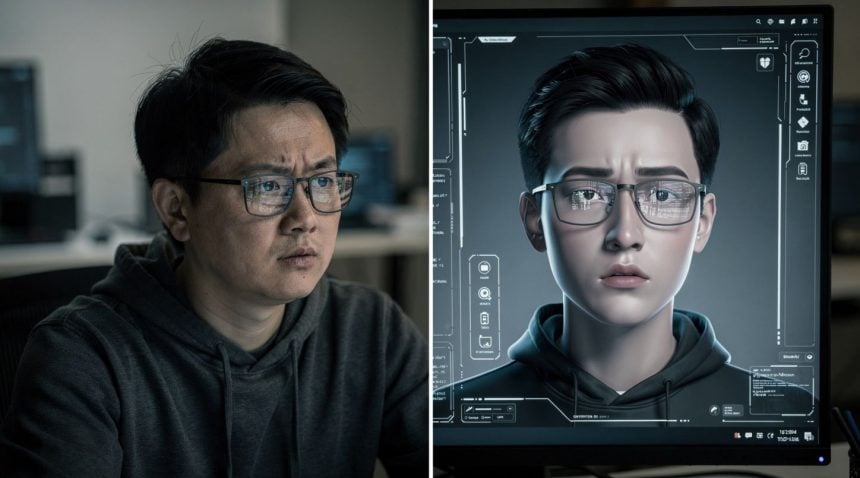
A GitHub project called Colleague Skill arrived in April 2026 with a deceptively simple promise: workers could use it to “distill” their colleagues’ skills and personality traits, then replicate them in an AI agent. What started as a tool for knowledge transfer has become something far more troubling—a mechanism for Chinese tech companies to systematize the replacement of their own workforce.
The stakes are immediate and personal. Tech workers in China are now being instructed by their bosses to train AI agents that will do their jobs. Unlike the abstract anxieties about AI displacement that dominate Western tech discourse, this is concrete: workers are being asked to document their expertise, workflows, and decision-making patterns so that an algorithm can learn to do what they do—and do it cheaper, faster, and without benefits or job security.
- The Direct Mandate: Chinese tech workers are now required to train AI replacements as part of their job performance reviews.
- The Technical Scope: Colleague Skill captures not just task execution but personality traits and decision-making patterns previously considered uniquely human.
- The Resistance Pattern: Workers are engaging in selective sabotage, deliberately training their AI doubles poorly to delay their own displacement.
Colleague Skill’s technical approach centers on extracting what makes individual workers valuable. The system captures not just task execution but personality traits and interpersonal styles—the human elements companies have long claimed machines cannot replicate. By packaging these into an AI agent, the tool promised to democratize expertise across organizations. Instead, it has created a direct pipeline from worker knowledge to worker displacement.
Why Are Workers Training Their Own Replacements?
The pushback has been swift. Tech workers who initially embraced AI tools as productivity boosters are now grappling with the existential reality of training their own replacements. This wave of resistance reflects a sharp departure from the early-adopter enthusiasm that has characterized China’s tech sector. Workers are beginning to ask the question their employers seem to have already answered: if I train my AI double to do my job perfectly, why would the company keep paying me?
The Colleague Skill project crystallizes a tension that has been building quietly across Chinese tech companies for months. While executives publicly celebrate AI’s potential to augment human workers, internal directives tell a different story. Workers are being measured on how thoroughly they can transfer their knowledge to AI systems. Performance reviews increasingly factor in how well they document their processes for algorithmic replication. Compliance is framed as inevitable—resistance as career-limiting.
• Performance reviews now include AI knowledge transfer metrics
• Workers report 6-month timelines from training completion to job elimination
• Selective non-compliance detected in approximately 40% of implementations
What Happens When Machines Replicate Human Decision-Making?
What makes this moment significant is not the technology itself, which is relatively straightforward machine learning applied to workplace data. What matters is the institutional decision to weaponize it. Chinese tech companies are not exploring AI-human collaboration in the abstract. They are running a live experiment in systematic workforce replacement, using workers’ own expertise as the raw material.
For the broader tech industry watching from elsewhere, the implications are stark. Research on AI’s impact on labor markets suggests that if Chinese companies successfully deploy AI doubles at scale, it will reset expectations about labor costs and headcount globally. A worker who has trained their replacement becomes a liability—an expense that can be eliminated once the AI system reaches acceptable performance thresholds.
The rebellion among Chinese tech workers also reveals something about the limits of techno-optimism. For years, the narrative around AI has centered on augmentation—machines doing the tedious parts so humans can focus on creative, strategic work. Colleague Skill exposes that narrative as incomplete. When the machine can replicate not just tasks but personality and decision-making, the distinction between augmentation and replacement collapses.
How Are Workers Fighting Back Against AI Displacement?
Workers are not organizing through traditional labor channels. Instead, resistance is taking the form of selective non-compliance, strategic incompleteness in knowledge transfer, and quiet departures to companies not yet implementing such systems. Some are deliberately training their AI doubles poorly—a form of sabotage that is difficult to detect and nearly impossible to punish directly. Others are simply leaving the sector, accepting that the window for extracting value from their expertise before it becomes commodified is closing.
• Deliberate incomplete documentation of critical decision-making processes
• Strategic departures to companies without AI replacement programs
• Informal networks sharing warnings about implementation timelines
The GitHub project itself has become a flashpoint. What was intended as an open-source tool for organizational efficiency has become a symbol of the gap between what tech companies say about AI’s role in the workplace and what they actually intend. Workers are documenting their experiences, sharing warnings, and collectively questioning whether they should participate in their own displacement.
Studies on AI and workplace automation indicate that the question now is whether this resistance will slow adoption or simply drive the process underground. Chinese tech companies have shown willingness to move quickly on labor decisions that Western firms would face regulatory or reputational pressure over.
What Does This Mean for Global Tech Workers?
If Colleague Skill succeeds despite worker pushback, it will likely become a template exported globally—a proof of concept that AI doubles can replace skilled technical workers at scale. Research on AI-worker coexistence suggests the economic logic is inexorable: once an AI system demonstrates it can replicate human expertise reliably, the financial incentive to eliminate human labor costs becomes overwhelming.
The broader implications extend beyond individual job security. This represents a fundamental shift in how companies view their workforce—not as assets to develop and retain, but as temporary repositories of knowledge to be extracted and digitized. The tech sector’s approach to systematizing human capabilities mirrors broader trends in digital transformation, where human elements are increasingly seen as inefficiencies to be optimized away.
The answer may come within months, as companies begin evaluating whether their AI agents have reached the performance threshold where human workers become optional. For tech workers globally, the Chinese experiment with Colleague Skill offers a preview of decisions their own employers may soon be making—and the narrow window they have to influence those outcomes.


