
Educational institutions across the United States are quietly deploying artificial intelligence surveillance systems that monitor student behavior, emotions, and academic performance in real-time. Parents remain largely unaware that their children’s every move, facial expression, and digital interaction may be tracked, analyzed, and stored by algorithms designed to predict everything from academic failure to potential violence.
- How Do Schools Monitor Students Without Parents Knowing?
- Why Can’t Parents Stop School Surveillance?
- What Happens to Student Data Beyond School Hours?
- How Do Companies Profit from Student Surveillance?
- Are States Fighting Back Against School Surveillance?
- What Parents Can Demand
- The Surveillance Generation
Key Findings:
- The Monitoring Scale: AI surveillance systems now track millions of students daily across facial expressions, keystrokes, and emotional states.
- The Legal Gap: FERPA’s “school official” exception allows districts to deploy comprehensive monitoring without parental consent or notification.
- The Data Reach: School-issued devices monitor students 24/7, including personal conversations and family interactions at home.
How Do Schools Monitor Students Without Parents Knowing?
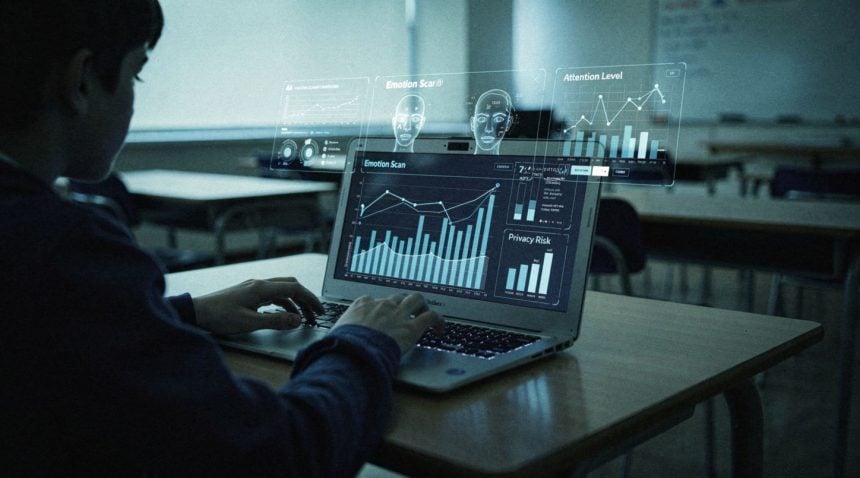
School districts nationwide have embraced AI-powered monitoring systems that extend far beyond traditional security cameras. These platforms analyze student facial expressions to detect “concerning” emotions, track eye movements during online tests to identify potential cheating, and monitor keystrokes and screen activity on school-issued devices to flag “inappropriate” behavior.
The technology operates through multiple layers. Classroom cameras equipped with emotion recognition software claim to identify students showing signs of depression, anxiety, or aggression. Learning management systems track how long students spend on assignments, their click patterns, and even how they hold their devices. Some districts have implemented AI chatbots that engage students in conversations designed to surface mental health concerns or disciplinary issues.
GoGuardian, Gaggle, and Bark for Schools represent the dominant players in this expanding market. These companies process data from millions of students daily, creating detailed behavioral profiles that follow children throughout their academic careers.
Why Can’t Parents Stop School Surveillance?
The Family Educational Rights and Privacy Act (FERPA) governs student privacy, but the 1974 law predates modern AI surveillance by decades. FERPA allows schools to share student data with third-party vendors under the “school official” exception, effectively granting surveillance companies access to intimate details about children’s lives without explicit parental consent.
This regulatory gap creates a troubling dynamic. While parents must provide written permission for their child to go on a field trip, schools can deploy sophisticated AI systems to monitor their child’s emotional state and behavior without any notification requirement.
• Field trip permission: Required written parental consent
• AI emotional monitoring: No notification required
• Biometric data collection: Varies by state, most allow without consent
The data collected often includes biometric information, detailed behavioral assessments, and psychological profiles that could impact a student’s future educational and employment opportunities.
Many districts justify these systems as necessary for student safety and academic improvement. However, internal communications and vendor marketing materials reveal a different priority: liability reduction. Schools fear litigation from parents if they fail to identify potential threats or academic struggles early.
What Happens to Student Data Beyond School Hours?
AI surveillance in schools creates ripple effects that extend far beyond the classroom. Many monitoring systems track students’ activity on school-issued devices 24/7, including weekends and holidays. This means children’s personal conversations, family discussions captured by device microphones, and private browsing behavior become part of their permanent educational record.
The psychological impact remains largely unstudied, but early evidence suggests concerning patterns. Students report self-censoring in online discussions, avoiding certain topics in essays, and feeling constantly watched. Teachers describe a shift in classroom dynamics as students become aware that algorithms are evaluating their every expression and interaction.
Some systems explicitly monitor for keywords related to LGBTQ+ identity, political views, or family financial struggles. Students exploring their identity or seeking support for personal challenges may find themselves flagged by algorithms trained on datasets that reflect societal biases about “normal” childhood behavior.
How Do Companies Profit from Student Surveillance?
The student surveillance industry operates on a data aggregation model that extends far beyond individual school contracts. Companies build comprehensive profiles across multiple districts, creating detailed behavioral baselines that inform their algorithms. This data becomes increasingly valuable as students progress through their academic careers.
Proctorio and similar companies have expanded from simple test monitoring to comprehensive behavioral analysis platforms. Their business models depend on continuous data collection and refinement of predictive algorithms. Each student interaction teaches the system to better identify patterns associated with cheating, mental health crises, or disciplinary problems.
The financial incentives create pressure for feature expansion. Companies regularly introduce new monitoring capabilities, from gait analysis to voice stress detection, often without additional privacy reviews or parental notification. Research on AI security deployment highlights how systems can be rapidly expanded without adequate consideration of privacy implications.
• Many AI applications in educational settings lack comprehensive security evaluations
• The rapid expansion of monitoring capabilities often outpaces privacy safeguards
Are States Fighting Back Against School Surveillance?
Several states have begun crafting legislation to address AI surveillance in schools. Illinois and Washington have introduced bills requiring explicit parental consent for biometric data collection, while California is considering broader restrictions on behavioral monitoring systems.
However, the education technology lobby has successfully weakened many proposed regulations by arguing that student safety requires comprehensive monitoring. Industry groups frame privacy restrictions as obstacles to preventing school violence and identifying struggling students.
Parent advocacy groups are pushing back with increasing sophistication. Organizations like Parent Coalition for Student Privacy have documented cases where AI systems incorrectly flagged students, leading to inappropriate interventions and lasting psychological harm. The expansion of surveillance systems in educational settings mirrors broader digital monitoring trends worldwide.
What Parents Can Demand
The current landscape leaves parents with limited but important options. They can request detailed information about which surveillance systems their district uses, what data is collected, and how long it’s retained. Many districts have not clearly communicated these policies, making information requests essential.
Parents should specifically ask about data sharing agreements with third-party vendors, whether their child’s information is used to train AI algorithms, and what happens to collected data when students transfer schools or graduate.
Some districts allow parents to opt their children out of certain monitoring systems, though schools may not clearly communicate this option. Parents can also request access to their child’s digital profile to understand what information has been collected and flagged.
The Surveillance Generation
The students currently experiencing AI monitoring in schools will graduate into a world where algorithmic surveillance is normalized. Their academic records will contain detailed behavioral and psychological assessments that may influence college admissions, employment opportunities, and access to services.
This generation has never experienced educational privacy as previous generations understood it. Their normal includes having algorithms evaluate their emotions, predict their behavior, and flag their thoughts for adult review. The long-term societal implications of this shift remain largely unexplored, as surveillance infrastructure expands across multiple aspects of daily life.
The expansion of AI surveillance in schools represents more than a technology upgrade—it’s a fundamental redefinition of the relationship between institutions and individuals. Parents who remain unaware of these systems cannot advocate for their children’s privacy rights or help them navigate an increasingly monitored world.
The choices made today about student surveillance will shape not only individual privacy rights but also societal expectations about algorithmic monitoring throughout these students’ lives.