
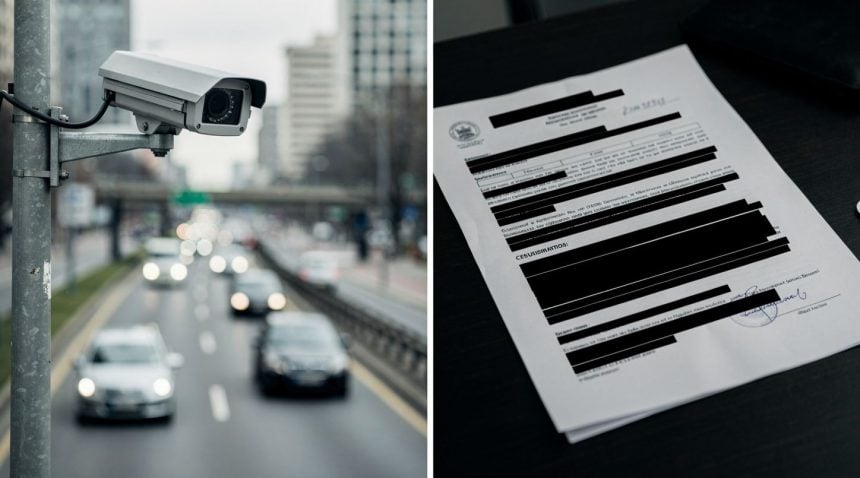
Seven states have quietly enacted or are advancing laws that would seal police license plate reader data from public view, blocking the very transparency mechanisms that have exposed racist policing, abortion tracking, and systematic surveillance abuses.
The Electronic Frontier Foundation warns that these legislative moves represent a dangerous national trend. While lawmakers frame the restrictions as privacy protections, they would eliminate the public’s ability to monitor how law enforcement deploys one of the most revealing surveillance technologies available: automated license plate readers (ALPRs) that capture and retain detailed records of where vehicles—and by extension, their occupants—travel.
- The Legislative Sweep: Seven states have enacted or are advancing laws to exempt ALPR data from public records, with Arizona’s version making public access a potential felony.
- The Surveillance Scale: ALPR systems create detailed movement portraits from thousands of scans, revealing associations, routines, and private activities.
- The Accountability Gap: Public records requests have already exposed racist targeting, protest surveillance, and abortion tracking through ALPR data analysis.
Washington state enacted such a law earlier this year, exempting ALPR data from its public records statute. The move directly overrides a Washington court ruling from last year that found images captured by license plate readers are public records, including photos of individuals’ own vehicles. Georgia, Maryland, and Oklahoma have already passed similar exemptions. Connecticut’s SB 4 and Arizona’s SB 1111 are pending bills that would expand these blackouts, with Arizona’s version potentially making it a felony for a member of the public to access or disseminate ALPR data obtained through a public records request.
Illinois passed HB 3339 a year ago, blocking public records requests for ALPR data collected by the Illinois State Police. The language mirrors what Connecticut now proposes—excluding not just raw ALPR data but also any information “created through an analysis” of that data, a sweeping restriction that would hide statistical reports, error rates, and data-sharing audits.
How Have Public Records Exposed Police Surveillance Abuses?
The stakes are concrete. The Electronic Frontier Foundation has used public records requests to uncover how police deploy these systems. Through ALPR disclosures, the organization identified racist surveillance targeting Romani people, documented how law enforcement used the technology to track protesters and activists, and exposed a case where a Texas sheriff used license plate data to track a person who sought an abortion. Municipalities nationwide have cited these documented abuses when terminating ALPR contracts with vendors like Flock Safety, using the transparency record as leverage to exercise what advocates call “procurement power”—the ability to simply say no to surveillance infrastructure.
• Oakland ALPR analysis revealed systematic patrol pattern biases in minority neighborhoods
• Multiple municipalities terminated surveillance contracts after public disclosure of abuse patterns
• Texas case documented abortion-related tracking through license plate data cross-referencing
ALPR data is uniquely revealing because it maps movement patterns over time. A single license plate scan reveals nothing; thousands of scans create a detailed portrait of where someone goes, what they do, and who they associate with. This is why the Electronic Frontier Foundation opposes widespread ALPR deployment by police in the first place. The organization acknowledges the tension: raw ALPR data should not be freely disclosed to employers, political opponents, or surveillance-oriented corporations that would monetize it or weaponize it for targeted advertising.
What Would Balanced Transparency Look Like?
But the proposed state laws create a false choice between total secrecy and total transparency. The Electronic Frontier Foundation proposes a middle path: public records laws should contain privacy exemptions that require case-by-case balancing of transparency benefits against privacy costs. Many states already have such provisions for other sensitive government records. Agencies could redact personally identifiable information while disclosing aggregate data—the number of scans conducted, error rates, data-sharing patterns between departments—that has genuine public accountability value.
Under this approach, individuals could access records of their own vehicle’s movements, while broader searches would be restricted. Aggregate ALPR statistics showing how many scans occur in which neighborhoods, and how many result in actual crime-related matches, would remain public. Audit logs of police searches could reveal an officer’s investigative purpose without exposing whether a specific license plate was searched. Images of government vehicles engaged in routine business—garbage trucks, for example—could be disclosed without revealing social workers’ visits to vulnerable clients.
Why Are States Choosing Complete Opacity?
The seven states moving toward blanket exemptions are instead choosing opacity. Washington’s law permits “bona fide research” access, but journalists and activists analyzing aggregate data to identify policy flaws may not qualify. Georgia made it a misdemeanor to request ALPR data for any purpose other than law enforcement. These provisions don’t just protect privacy; they eliminate accountability.
Communities have leveraged ALPR transparency to block new deployments, refuse contract renewals, and terminate existing surveillance agreements. Without access to the evidentiary record—the data-sharing reports, hit ratios, and documented abuses—cities lose the factual foundation needed to exercise procurement power. Journalists lose the ability to investigate. Advocates lose the leverage to push back.
• EFF and ACLU litigation has established precedent for ALPR data disclosure in multiple jurisdictions
• Case-by-case balancing allows individual privacy protection while preserving oversight mechanisms
• Aggregate reporting requirements could maintain transparency without exposing personal movement data
The Electronic Frontier Foundation urges legislators to reject wholesale exemptions and instead adopt balancing standards that protect individual privacy while preserving public oversight. The alternative is a surveillance infrastructure that operates entirely in the dark, accountable to no one but the agencies deploying it. As more states consider similar legislation, the question is whether transparency or secrecy will govern how police use technology that reveals the most intimate details of American movement and association.