

A school district in Georgia with 6,000 students ran 375 license plate reader searches in 15 months—more than half of all its ALPR queries—to verify whether families actually lived in the district.
The Electronic Frontier Foundation’s analysis of millions of Flock Safety automated license plate reader (ALPR) searches reveals a pattern that should alarm anyone who believes location data deserves protection: police agencies are using these cameras to track families for school residency checks, employment background investigations, and noise complaints—all without warrant requirements.
- The Scale: A single Georgia school district ran 375 residency verification searches, with each query accessing up to 5,800 camera networks nationwide.
- Mission Creep: 26 police agencies used nationwide ALPR networks to investigate noise complaints, searching across more than 6,500 cameras for loud music or house parties.
- Legal Void: No federal law requires warrants for ALPR database searches, allowing police to track location data for administrative tasks that would never meet probable cause standards.
Buford City Schools in Georgia illustrates the scale. Between January 2025 and March 2026, school police logged more than 375 searches explicitly marked “RV” (residency verification) or school residency verification as the reason. In the first three months of 2026 alone, three-quarters of all ALPR searches by the district were residency-related. A school district spokesperson defended the practice to Appen Media, stating: “Because Buford City Schools is a highly sought-after district, we experience ongoing challenges with residency fraud. Flock Safety is one of the tools we use to verify residency and protect the integrity of the Buford City School System for families who live within the district.”
What Does a Single License Plate Search Actually Reveal?
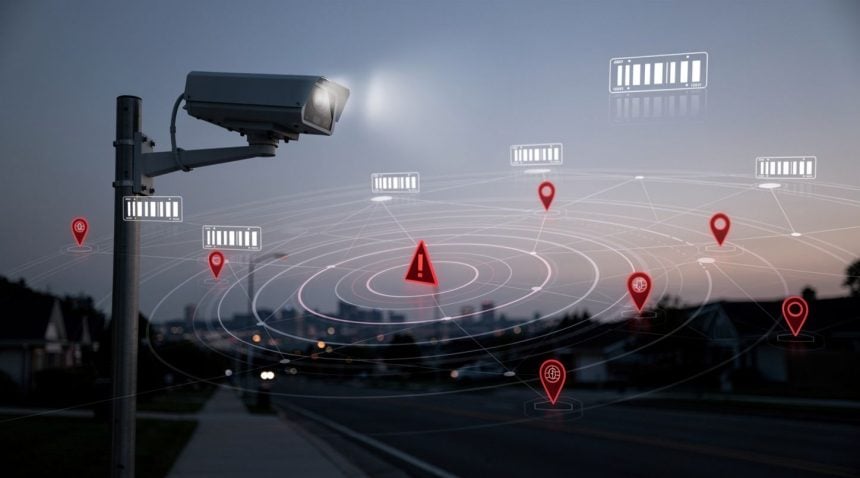
What that statement omits is what a single license plate search actually reveals. When officers ran these residency checks, some queries spanned more than 5,800 different camera networks nationwide. Each search can expose when a family visits a doctor, attends worship, travels at night, or goes on vacation. The school district’s stated purpose—confirming a child’s address—requires none of that data.
Buford wasn’t alone. Delhi Township Police Department in Ohio ran 35 residency-related searches across five schools in spring 2025. Cortland Police Department and Lincoln Police Department also conducted residency verification queries. After EFF inquired about Delhi Township’s searches, the agency said it would implement changes to how these queries are documented “to increase accountability and help avoid any confusion moving forward”—an implicit acknowledgment that the practice warranted scrutiny.
How Far Has Mission Creep Extended Beyond School Enrollment?
The mission creep extends far beyond school enrollment. EFF identified law enforcement agencies using Flock’s nationwide network for employment background checks. Jefferson County Sheriff’s Office in Missouri ran six employment-related searches across 2,853 networks. Little Elm Police Department in Texas ran 10 such searches across 6,306 networks. Texas City Police Department, Ridgeland Police Department in Mississippi, and Zion Police Department in Illinois all documented employment background queries. When EFF asked Davidson Police Department in North Carolina about an “Employment Background” search, the chief called it a “poor choice of words,” but the pattern remains: location surveillance is being weaponized for routine administrative tasks.
• 26 agencies used ALPR networks to investigate noise complaints
• Some searches spanned more than 6,500 camera networks nationwide
• Employment background checks accessed up to 6,306 networks per query
Perhaps most striking: 26 agencies used the Flock network to investigate noise complaints. Some searched across more than 6,500 camera networks—a nationwide manhunt for a loud muffler or a house party. Officers documented reasons ranging from “music” to “loud exhausts” to “house parties.” The rhetorical distance between “solving crimes of violence” (the pitch Flock and police chiefs use publicly) and tracking someone’s vehicle because neighbors complained about bass is the distance between stated purpose and actual practice.
Why Does This Pattern Echo Cambridge Analytica’s Tactics?
This pattern mirrors a structural tactic from the Cambridge Analytica era: data harvesting at scale justified by narrow stated purposes, then repurposed for uses the original subjects never anticipated. Cambridge Analytica built psychographic profiles by collecting Facebook data under the guise of academic research, then weaponized those profiles for political micro-targeting. Here, police collect location data under the promise of solving serious crimes, then deploy it for residency fraud checks and noise complaints. The mechanism differs—ALPR instead of social data—but the logic is identical: collect everything, justify narrowly, use broadly.
The absence of warrant requirements is the enabling condition. Law enforcement agencies can search Flock’s database on their own authority, without asking a judge whether probable cause exists. For serious crimes, police must present evidence to a judge before accessing location data from cell providers or other sources. But ALPR databases operate in a legal void. As EFF notes, this absence of judicial oversight has “fostered a culture of unrestricted access to sensitive location data, allowing agencies to leverage that data beyond the scope of specific criminal investigations.”
What Does Unrestricted Camera Access Look Like in Practice?
Ridgeland Police Department in Mississippi operates more than 50 cameras—one for every 500 residents—and maintains access to tens of thousands more nationwide. The then-police chief told local press the cameras would help solve “theft to crimes of violence.” He did not mention that officers would later use them to investigate loud music. When that rhetorical gap between promise and practice is exposed, the response is typically defensive silence: Ridgeland Police Department did not respond to EFF’s requests for comment.
The legal framework that should constrain this surveillance simply does not exist. No federal law requires a warrant to search ALPR databases. Most states have no warrant requirement either. The result is that your vehicle’s location—where you worship, where you seek medical care, where you travel at night—can be tracked and logged by police for reasons that would never survive judicial scrutiny if you were applying for a job or enrolling your child in school.
• No federal warrant requirement exists for ALPR database searches
• Most states lack warrant requirements for location tracking via license plates
• Police can access nationwide camera networks without judicial oversight for administrative tasks
This surveillance expansion parallels how fitness tracker data has been repurposed for criminal investigations—technologies marketed for health and safety become tools for comprehensive monitoring. The difference is scale: while fitness trackers monitor individuals, ALPR networks can track entire populations across thousands of camera locations.
Will Any Legislature Act Before This Becomes Normalized?
EFF’s investigation is ongoing. The question now is whether any state or federal legislature will act before location surveillance becomes so routine, so normalized, that the idea of police needing a warrant to track your movements seems quaint. The trajectory from surveillance capitalism to surveillance policing follows the same path: collect first, regulate never, normalize completely.
According to research published in SAGE Journals, the challenge lies in balancing security benefits with privacy protections—but current ALPR deployment suggests that balance has already tipped decisively toward surveillance. When school districts can track families nationwide to verify addresses, and police can investigate noise complaints across 6,500 camera networks, the concept of proportional response has been abandoned entirely.