

Anduril just doubled its valuation. Mach Industries quadrupled theirs. The U.S. government is proposing a 40% increase in defense spending. And a flood of startups is racing to capture a piece of what looks like an unlimited government windfall—but according to the venture investor who wrote Anduril’s first check, 90% of them won’t make it.
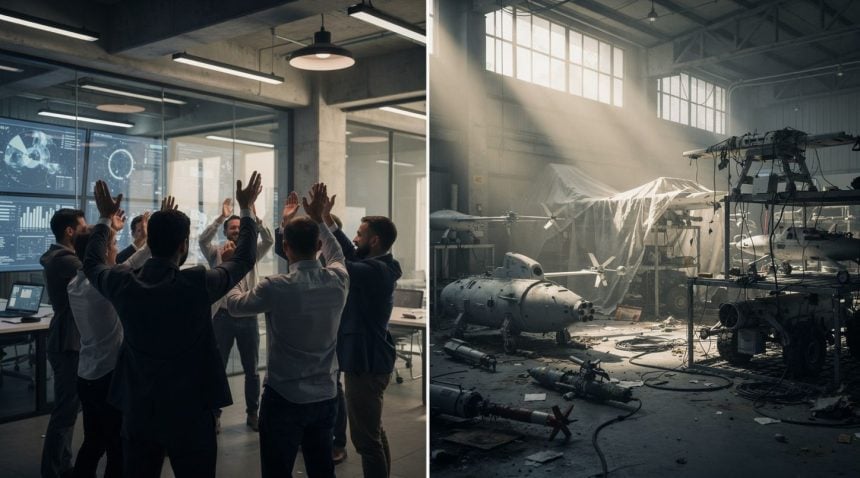
Ross Fubini, the VC who backed Anduril from the beginning, has a blunt diagnosis for the defense tech boom: most startups are walking into what he calls the “Valley of Death”—the gap between winning a prototype contract and actually shipping production hardware to the Pentagon. That chasm has killed defense companies before. It will kill most of them again.
- The Survival Rate: 90% of defense tech startups will fail to bridge the gap between prototype contracts and production orders.
- The Capital Reality: Defense production requires different manufacturing expertise, supply chains, and regulatory compliance than prototype development.
- The Market Paradox: A $40 billion defense budget increase creates unlimited opportunity appearance but brutally narrow actual capture paths.
The timing matters. Defense tech is experiencing genuine momentum. Anduril, the autonomous defense platform founded by Palmer Luckey, has seen its valuation double in recent years. Mach Industries, which builds hypersonic missiles, has quadrupled its valuation. These aren’t paper gains in a speculative market; they reflect real Pentagon interest and real government contracts flowing into the sector. The proposed 40% increase in the defense budget signals that Washington is serious about accelerating military-industrial innovation.
That signal has triggered exactly what you’d expect: a surge of new entrants. Founders with AI expertise, robotics backgrounds, and drone experience are spinning up defense startups at a pace not seen since the post-9/11 boom. Venture capital is following the money. The narrative is intoxicating: the government needs cutting-edge technology, startups can build it faster than legacy contractors, and the addressable market is enormous.
What Makes the Valley of Death So Deadly?
But Fubini’s warning cuts through the hype. The Valley of Death isn’t metaphorical—it’s a structural feature of defense procurement that has destroyed well-funded, well-intentioned companies. A startup can win a Small Business Innovation Research (SBIR) contract or a prototype development deal. Those contracts validate the technology and generate revenue. But they don’t automatically lead to production orders. The leap from “we proved the concept works” to “we’re now manufacturing 10,000 units a year for the Pentagon” requires different capital, different supply chains, different manufacturing expertise, and different regulatory compliance than a prototype phase demands.
• 90% – Estimated failure rate for defense tech startups attempting the prototype-to-production transition
• 40% – Proposed increase in U.S. defense spending driving startup interest
• 18-24 months – Critical window revealing which startups can survive the transition
Most venture-backed startups are built for speed and iteration. Defense production is built for reliability, redundancy, and accountability. A software startup can push a buggy update and patch it overnight. A defense contractor that ships faulty hardware has violated federal contracts, exposed soldiers to risk, and destroyed its reputation permanently. The operational cultures are nearly incompatible. Startups that don’t understand this dynamic—or that believe their technology advantage alone will carry them through—tend to hit the Valley of Death hard.
Why Do Venture Capitalists Keep Funding Doomed Defense Startups?
Fubini’s assessment isn’t pessimism; it’s pattern recognition. He’s seen the defense market long enough to know which startups have the capital reserves, the manufacturing partnerships, the regulatory patience, and the organizational discipline to survive the transition from prototype to production. Research from MIT’s Defense Innovation Report confirms that venture capital often plays an outsized role in defense technology development, but the transition from funding to sustainable production remains the critical bottleneck.
Most don’t make it through. They run out of money waiting for the next contract. They can’t scale manufacturing without massive capex they can’t raise. They lose key engineers to better-funded competitors. They discover that a government contract that looked lucrative on paper generates razor-thin margins once you account for compliance, security audits, and supply chain redundancy.
• Companies like SpaceX have demonstrated successful transitions from startup to major defense contractor
• Pentagon contracts now represent billions in validated revenue streams
• The model requires massive capital reserves and manufacturing infrastructure most startups lack
Which Defense Startups Will Actually Survive?
The irony is sharp: a $40 billion defense budget increase creates the appearance of unlimited opportunity, but the actual path to capturing that money is brutally narrow. The startups that will survive are likely the ones that have already proven they can navigate the Valley of Death—companies like Anduril, which has moved beyond prototype phase and is now shipping systems. New entrants will face a much steeper climb, even with strong technology and strong funding.
Analysis of venture capital patterns in dual-use hardware reveals that defense funding in technology and innovation has become increasingly fragmented, making the path from prototype to production even more challenging for new entrants.
For founders and investors chasing defense contracts right now, Fubini’s warning is a reality check. Winning a government contract is not the same as building a sustainable defense company. The Valley of Death separates the two, and it’s wider and deeper than most startup metrics account for. The next 18 to 24 months will reveal which of the current wave of defense startups actually have the infrastructure, capital, and organizational maturity to cross it.