
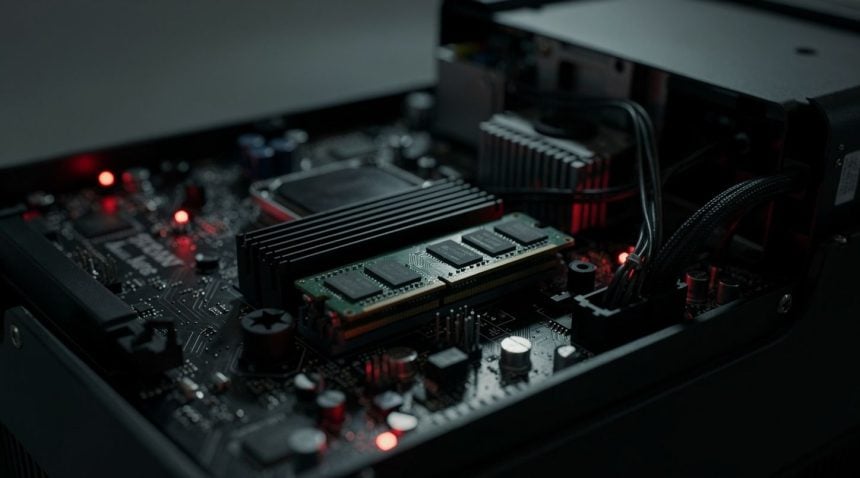
Valve’s Steam Machine will cost you $1,349 for the 2TB model—a price tag that reveals something darker than typical hardware economics: the company has lost negotiating power over the components that define the device.
The pricing crisis exposes a structural vulnerability in gaming hardware manufacturing. Valve is not subsidizing the Steam Machine, a departure from its original strategy. Instead, the company is passing the full cost of components directly to consumers, a shift driven by what Valve engineers described in a Gamers Nexus interview as take-it-or-leave-it pricing from memory suppliers. With Samsung, Micron, and SK Hynix controlling the RAM supply in 2026, Valve has no leverage to negotiate better terms.
- No Negotiation Possible: Valve engineers confirmed that RAM suppliers in 2026 set prices unilaterally, leaving hardware manufacturers with no leverage to secure volume discounts or alternative terms.
- Price Jump Is Structural: The 2TB Steam Machine costs $1,349 — a figure that reflects non-negotiable component costs, not corporate margin expansion, with controllers sold separately at additional cost.
- Subsidy Strategy Collapsed: Valve’s original plan to subsidize hardware for market share became financially untenable once Samsung, Micron, and SK Hynix locked in pricing that left no room for absorption.
The 512GB configuration starts at $1,049, but the 2TB version jumps to $1,349. Neither price includes bundled controllers, which add further cost. These figures represent a dramatic departure from Valve’s initial pricing plans. The company has already indicated that the component crisis forced it to reconsider what it originally intended to charge consumers, meaning the sticker shock reflects real constraints, not corporate margin expansion. This situation is not unique to Valve — as Nothing CEO Carl Pei has warned, RAM now accounts for roughly 50 percent of an entire device’s cost across the industry.
The RAM shortage is not incidental to the Steam Machine story — it is the story. Valve engineers explained to Gamers Nexus that sourcing memory in 2026 operates under conditions where suppliers set prices and manufacturers accept them or walk away. There is no negotiation, no volume discount leverage, no alternative vendor to pit against Samsung or Micron. The few companies that control DRAM production have consolidated supply to the point where a hardware maker like Valve, despite its market position, cannot force better terms.
• Three suppliers — Samsung, Micron, and SK Hynix — control the overwhelming majority of global DRAM production, creating a near-monopoly pricing environment
• Steam Machine 2TB model: $1,349, up significantly from Valve’s originally planned price point before component costs locked in
• Controllers are sold separately, adding further cost burden to a device already priced at the high end of the gaming hardware market
Why Does RAM Concentration Make Every Hardware Maker Powerless?
This dynamic has real consequences for the Steam Machine’s market viability. A gaming PC or console at $1,349 competes directly with high-end laptops and existing console ecosystems. Valve’s device must justify that price through performance, exclusive software, or form factor — but the price itself is not a choice. It is an extraction. Every dollar above what Valve would have charged under normal supply conditions flows directly to memory manufacturers.
The broader implication cuts deeper than one product launch. If Valve — a company with decades of industry relationships, billions in revenue, and direct control over a major gaming platform — cannot negotiate RAM pricing, what leverage does any hardware manufacturer have? The answer is: very little. Analysis published in IEEE Xplore on the economics of semiconductor manufacturing identifies cost of ownership and supply concentration as central structural pressures that downstream manufacturers cannot easily offset, regardless of their scale or market position. This is the infrastructure of 2026 hardware economics: a small number of suppliers controlling essential components, setting prices unilaterally, and forcing manufacturers to choose between accepting the terms or canceling products.
Apple has reached the same wall. Tim Cook has publicly called the RAM cost crisis “unsustainable”, signaling that price hikes are coming across Apple’s entire product lineup — a remarkable admission from a company that has historically absorbed supply shocks through its scale and supplier relationships. When both Valve and Apple are publicly acknowledging the same constraint, the problem is systemic, not company-specific.
What Valve’s Transparency Reveals About the Supply Chain
Valve’s transparency about the crisis, shared through engineers speaking to Gamers Nexus, is unusual. Most companies absorb supply shocks silently or blame them on abstract “market conditions.” Valve named the problem directly: Samsung, Micron, and SK Hynix control the supply, and they are exercising that control. The company also made clear that its initial pricing strategy — subsidizing hardware to build market share — became impossible once component costs locked in at non-negotiable levels.
• Semiconductor supply concentration creates what economists describe as oligopolistic pricing power — where a small number of producers can set prices above competitive equilibrium without losing customers, because buyers have no viable alternatives
• For hardware manufacturers, this means bill-of-materials costs become unpredictable and non-negotiable, making long-term product roadmap planning structurally difficult
• The practical result is that innovation in hardware design — better performance, new form factors, lower price points — becomes constrained not by engineering limits but by supplier pricing decisions
The Steam Machine’s $1,349 price tag is not a failure of Valve’s planning. It is evidence of a market failure: the concentration of DRAM production in three vendors, each with the ability to set prices without competitive pressure. Valve can design better hardware, optimize software integration, or build a superior gaming experience — but none of that matters if the bill of materials is determined by suppliers operating in a near-monopoly condition. The same dynamic is reshaping chip design more broadly, as companies like Anker explore custom AI processor architectures partly to reduce dependence on commodity components controlled by concentrated suppliers.
Is the RAM Pricing Crisis Temporary or the New Baseline?
For consumers, the immediate impact is straightforward: gaming hardware costs more in 2026 than it would under competitive supply conditions. For manufacturers, the impact is existential. Companies that depend on commodity components — RAM, storage, processors — cannot plan product roadmaps, set pricing, or commit to market entry when suppliers control all the terms.
Valve’s decision to not subsidize the Steam Machine reflects a pragmatic acceptance of this reality. Subsidizing hardware only makes sense if you can absorb the loss through software revenue or market expansion. But if component costs are non-negotiable and rising, subsidies become a sinkhole. The company chose to pass costs to consumers instead, a choice that may limit adoption but protects the business model.
• Semiconductor manufacturing economics are shaped by steep experience curves and high capital barriers to entry, meaning new competitors cannot quickly enter DRAM production to relieve pricing pressure
• IEEE analysis of semiconductor manufacturing economics highlights that cost structures in chip production create durable competitive moats for established producers, reinforcing long-term pricing power
• Industry analysts broadly expect DRAM supply concentration to persist through the mid-2020s, suggesting the current pricing environment is structural rather than a temporary disruption
The question now is whether this supply crisis is temporary or structural. If Samsung and Micron maintain pricing power through 2027 and beyond, the Steam Machine’s $1,349 entry point may become the baseline for all premium gaming hardware. If supply normalizes, Valve could eventually lower prices — but the damage to market perception may already be done. The Steam Machine will be remembered not for its innovation but for the moment when RAM suppliers made it unaffordable.