

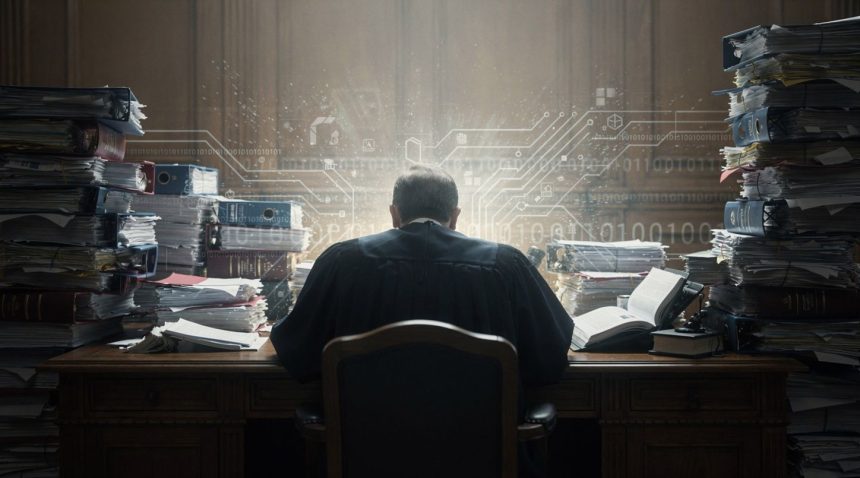
Judge Maritza Braswell sits in her Colorado federal chambers most days sorting through stacks of documents she knows were written by artificial intelligence, not human lawyers.
The flood of AI-generated lawsuits has become so severe that federal courts are now forced to develop entirely new strategies just to identify which briefs came from language models and which came from actual attorneys. This is no longer a theoretical concern about AI in the legal system—it is a real operational crisis unfolding in courtrooms right now, with judges like Braswell on the front lines trying to manage the fallout.
- The Detection Crisis: Federal courts have no standardized method to identify AI-written legal documents before they enter the official record.
- The Error Rate: Research shows AI legal tools hallucinate nonexistent case law in approximately 1 out of 6 queries, creating false precedents in court filings.
- The Disclosure Gap: No federal filing requirement forces lawyers to reveal whether they used language models to draft briefs or motions.
Braswell, a federal magistrate judge, has become one of the most visible figures documenting this problem. Most days in her chambers, she sifts through stacks of documents that bear the unmistakable hallmarks of AI composition: verbose phrasing, citation patterns that don’t quite track, logical structures that feel generated rather than reasoned. Lawyers are increasingly using large language models to draft and file briefs, motions, and complaints—sometimes without adequate human review, sometimes deliberately, sometimes out of genuine cost-cutting pressure.
The core issue is speed and scale. A language model can generate a legal brief in minutes. A human lawyer takes hours or days. For attorneys operating under tight deadlines or thin margins, the temptation to use AI as a drafting shortcut is enormous. But when those AI-written documents hit the court docket, they create a cascading problem: judges must now spend extra time identifying AI composition, flagging errors that the AI introduced, and managing the credibility gap between what the filing claims and what the law actually says.
How Are Courts Detecting AI-Generated Legal Documents?
Braswell’s experience reflects a broader pattern emerging across the federal judiciary. Courts have no standardized way to detect AI-written legal documents. There is no official filing requirement that forces lawyers to disclose whether they used language models. There is no penalty structure yet in place for filing AI-generated briefs without disclosure. The result is a system operating in a gray zone where AI-assisted legal writing is becoming normalized faster than the courts can develop governance frameworks to manage it.
The implications for litigants are significant. If a lawyer files an AI-generated brief that contains factual errors, misrepresentations of precedent, or logical fallacies that a human lawyer would have caught, the opposing party and the judge both suffer. The opposing party must now spend extra time identifying and refuting errors that should never have made it into a formal filing. The judge must spend extra time reading briefs that may contain plausible-sounding but legally incorrect arguments—exactly the kind of thing language models are prone to generate when they prioritize fluency over accuracy.
• Stanford research demonstrates that AI legal tools produce hallucinated case citations in approximately 17% of queries
• Multiple high-profile cases have documented lawyers submitting court filings citing nonexistent case law generated by AI systems
• Legal AI tools show significant reliability gaps when benchmarked against established legal databases and precedent verification
What makes Braswell’s position particularly important is that she is not simply complaining about the problem in private—she is publicly documenting how courts are coping with it. This visibility matters because it signals to the legal profession that federal judges are paying attention and that the use of AI in legal writing is no longer invisible or consequence-free. It also creates pressure on bar associations, law schools, and legal ethics bodies to develop clearer standards around AI disclosure and AI-assisted drafting.
Why Are Judges Struggling to Manage AI-Written Briefs?
The Colorado federal courts are not alone in this crisis. Courts across the country are reporting similar experiences. But Braswell’s willingness to name the problem directly—and to describe the specific operational burden it places on judges—makes the Colorado situation a test case for how the broader judiciary will respond.
The question facing courts now is whether they will develop proactive rules requiring disclosure of AI use in legal filings, or whether they will continue to manage the problem reactively, one brief at a time. Some courts are already experimenting with new filing procedures that ask lawyers to certify whether they used AI tools. Others are training their staff to spot the linguistic patterns that language models tend to produce. But there is no national standard yet, and no uniform penalty for violations.
The New York courts’ 2025 AI report acknowledges that evidence in cases may be “created or processed using artificial intelligence,” but stops short of mandating disclosure protocols. This patchwork approach leaves individual judges like Braswell to develop their own detection methods and response strategies.
What Happens When AI Errors Enter the Legal Record?
For anyone involved in litigation, the message is clear: the legal system is not yet equipped to handle the volume of AI-generated documents that lawyers are now filing. That gap between AI capability and judicial capacity is creating real friction in real courtrooms, and judges like Braswell are being forced to absorb the cost. How courts respond in the next year will determine whether AI becomes a tool that improves legal efficiency or a source of systemic error that undermines the integrity of the filing system itself.
The pattern emerging in federal courts mirrors broader concerns about AI-generated content across multiple sectors. When automated systems can produce convincing but factually incorrect information at scale, the burden shifts to human reviewers to catch errors that may not be immediately obvious. In the legal context, this creates a particularly dangerous dynamic where false precedents or misrepresented case law can influence judicial decisions before the errors are discovered.