

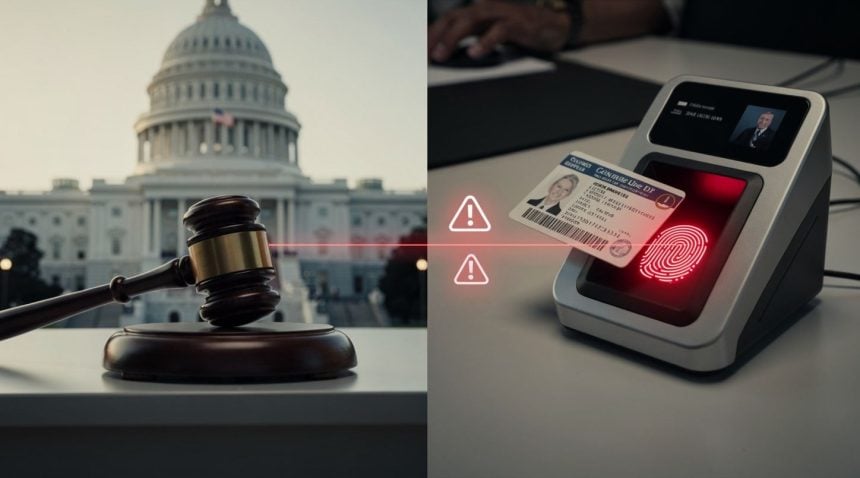
California lawmakers are fast-tracking a sweeping bill that would require every resident—regardless of age—to hand over government-issued ID or biometric information to private companies just to use social media. Assembly Bill 1709 has already cleared the Privacy and Judiciary Committees with near-unanimous support and could face a floor vote within the next week, according to the Electronic Frontier Foundation.
The stakes are immediate and concrete. Under A.B. 1709, all Californians would be forced to verify their identity before accessing social platforms. The bill would also ban anyone under 16 from using social media entirely. For millions of users, this means surrendering their most sensitive personal data to third-party verification vendors—data that would be stored in centralized systems that have become prime targets for hackers.
- The Verification Mandate: A.B. 1709 would force all California residents to provide government ID or biometric data to access social media platforms.
- The Privacy Risk: Age-verification systems have suffered repeated data breaches, exposing sensitive identity documents and biometric information.
- The Constitutional Challenge: The bill would eliminate anonymous speech online and disproportionately silence marginalized communities who face ID verification barriers.
The bill’s trajectory is striking. A.B. 1709 has already passed out of the Assembly Privacy and Judiciary Committees. Its next stop is the Assembly Appropriations Committee, followed by a floor vote. Privacy advocates are sounding alarms because the timeline is compressed, leaving little room for public input or legislative debate.
California is explicitly modeling this approach on Australia’s social media ban, which took effect in late 2024. But early results from Australia show the exact problems critics predicted: platforms overblocking users, massive spikes in VPN use and other workarounds, and smaller platforms shutting down entirely rather than attempt costly compliance. When California leads on tech policy, other states typically follow—meaning this bill could set a national precedent.
Why Are Age Verification Systems So Vulnerable to Hackers?
The privacy risks are well-documented. Age-verification services have suffered repeated breaches. In 2024, a hack of an age-verification company exposed sensitive user data. Similar incidents have compromised identity documents on platforms like Discord and dating apps. A.B. 1709 would force millions more Californians—including the youth the bill claims to protect—to feed their most sensitive data into this growing surveillance ecosystem.
• NIST research demonstrates that face recognition software shows significant accuracy disparities across racial and age groups
• Age estimation technology remains unreliable for determining access to age-restricted platforms
• Third-party verification creates centralized honeypots of biometric and government ID data
The bill creates what privacy advocates call “honeypots” of biometric and government ID information, concentrating exactly the kind of data that attracts identity thieves and permanent surveillance.
How Does A.B. 1709 Threaten Anonymous Speech?
The bill also raises serious constitutional questions. The First Amendment protects the right to speak and access information regardless of age. By imposing a blanket ban on social media access for under-16s and forcing all users to verify identity before speaking, A.B. 1709 would cut off lawful speech for millions of California teenagers. Age-verification technology is far from perfect, and the bill’s reliance on it would disproportionately silence marginalized communities—those whose IDs don’t match their presentation, transgender and gender non-conforming people, and people of color—who are most likely to be wrongfully denied access by discriminatory systems.
The anonymity issue cuts deeper. The right to anonymous speech has been a cornerstone of free expression since the nation’s founding and essential for online safety since the internet’s dawn. It allows creativity, innovation, and political thought to flourish, and is critical for those who risk retaliation for their speech or associations. A.B. 1709 threatens to destroy it by requiring users to surrender anonymity to access the modern public square.
What Do Young People Actually Want Instead of Bans?
Supporters frame the bill as protecting children, but the bill would actually sever vital lifelines for young people. Social media provides crucial spaces for identity exploration, civic engagement, and community building—particularly for LGBTQ+ and marginalized youth who may lack support in their physical environments. Research indicates that moderate internet use is a net positive for teen development, with negative outcomes usually stemming from either lack of access or excessive use.
• Moderate social media use supports teen identity development and community building
• Negative outcomes typically result from either complete isolation or excessive use, not moderate access
• LGBTQ+ and marginalized youth particularly benefit from online community spaces
By replacing access to political news and health resources with state-mandated isolation, A.B. 1709 ignores what young people themselves are asking for: digital literacy education, not censorship and control.
Young people have been vocal about their preferences. They even drafted their own digital literacy education bill, A.B. 2071, which is currently before the California legislature. That bill represents what youth actually want—knowledge and tools to explore online spaces safely—rather than government-imposed isolation.
How Does the Bill Actually Strengthen Big Tech?
The bill also strengthens Big Tech rather than challenging it. Steep fines and costly compliance regimes disproportionately harm smaller platforms. Where large corporations can afford to absorb legal risk and shell out for expensive verification systems, smaller forums and emerging platforms cannot. Platforms have already shut down or geoblocked entire states in response to age-gating laws. When small platforms shutter, their users and valuable data migrate straight back to the largest companies.
This dynamic mirrors broader trends in the attention economy, where regulatory compliance costs create barriers that favor established players over innovative competitors.
A.B. 1709 would also create a new “e-Safety Advisory Commission” to enforce the ban, adding bureaucratic overhead during California’s budget crisis. Congressional research has highlighted the complex feasibility challenges surrounding social media age verification legislation. Lawmakers supporting the bill have already acknowledged it is likely to be struck down in court for First Amendment and privacy violations—meaning taxpayers would fund millions in legal fees to defend an unconstitutional law.
The vote could happen within days. For Californians concerned about privacy, free speech, or the precedent this sets for the nation, the window to contact legislators is closing fast.