

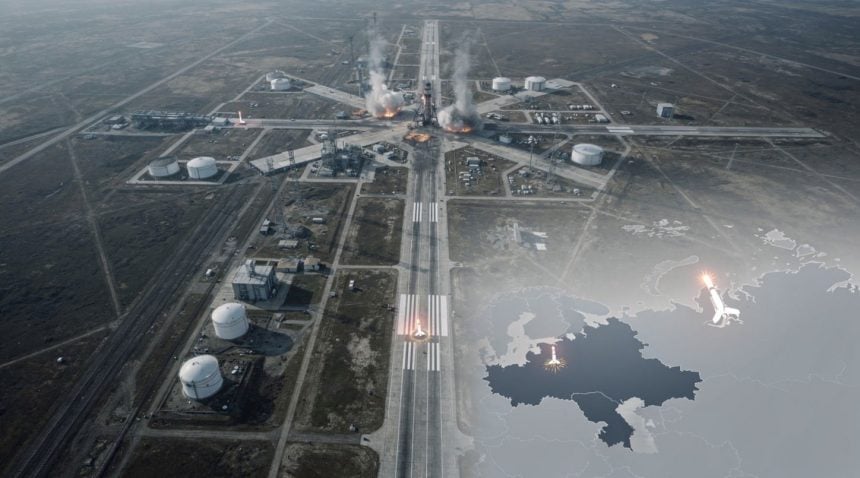
Russia’s space agency has stopped publishing its launch schedule—a dramatic reversal that exposes how a single Ukrainian military operation forced Moscow to treat routine spaceflight data as a national security secret.
The silence began after Ukraine targeted Baikonur Cosmodrome, Russia’s largest and most critical spaceport, in April 2026. The facility, located in Kazakhstan, handles the majority of Russian orbital launches and has been central to the country’s space program for decades. What was once public information—when rockets would lift off, what payloads they carried, which orbital slots they aimed for—has now vanished from official channels.
- The Information Blackout: Russia eliminated all public launch schedules after Ukrainian strikes demonstrated precision targeting capability at 2,000-kilometer range.
- The Strategic Shift: Moscow now treats space operations as active combat zones rather than routine infrastructure requiring transparency.
- The Intelligence Value: Launch schedules reveal satellite deployment timing, reconnaissance platform activation, and military asset distribution across orbital domains.
A Russian official acknowledged the severity of the threat in a statement about the incident: “We had serious inbound attempts to the cosmodrome that day.” The phrasing suggests multiple attack vectors, not a single strike, and indicates that Ukraine’s targeting capability has advanced enough to pose a credible threat to one of Russia’s most heavily defended installations.
The decision to classify launch schedules reflects a shift in how Russia now views space infrastructure. For most of the post-Soviet era, Baikonur’s launch calendar was published months in advance—a transparency born partly from commercial partnerships with Western space agencies and partly from the technical difficulty of keeping such information secret. This approach mirrors broader challenges in national security operations where transparency traditionally balanced operational needs with public accountability.
Why Does Launch Schedule Secrecy Matter for Intelligence?
This blackout matters for surveillance and intelligence purposes. Launch schedules reveal which satellites are being deployed, when reconnaissance platforms are becoming operational, and how Russia is distributing its orbital assets across military and civilian domains. By hiding this information, Russia denies Ukraine and Western intelligence agencies real-time confirmation of what’s going into orbit—making damage assessment harder and preventing adversaries from timing countermeasures to specific deployment windows.
• Launch schedules previously provided 3-6 months advance notice of satellite deployments
• Orbital insertion timing reveals reconnaissance coverage patterns and surveillance priorities
• Payload classifications indicate military versus civilian space asset distribution
The broader implication cuts deeper: if Russia believes its largest spaceport is vulnerable enough to warrant information lockdown, it signals that Ukraine’s precision strike capability has reached a threshold that forces Moscow to treat space operations as active combat zones rather than routine infrastructure. Research on critical infrastructure security demonstrates how targeting vulnerabilities force operational changes that extend far beyond physical damage.
What Does the Timing Reveal About Military Capabilities?
For observers tracking the conflict, the silence is itself intelligence. When a state stops publishing data it previously released freely, it’s announcing that the threat environment has changed. The fact that Russia chose secrecy over hardening suggests either that defensive measures are insufficient, or that the military calculus now favors operational security over the diplomatic and commercial benefits of transparency.
The timing matters. April 2026 marks an escalation in Ukraine’s ability to strike deep into Russian-controlled territory. The targeting of Baikonur—a facility 2,000 kilometers from the Ukrainian border—demonstrates that either Ukraine has extended the range of its precision weapons, or that Russian air defenses have gaps large enough for strikes to penetrate. This development reflects the broader transformation of conflict into what analysts describe as AI warfare where information control becomes as critical as physical destruction.
How Does Information Control Replace Physical Defense?
This creates a secondary effect on commercial and scientific operations. International space agencies and private companies that coordinate with Russian launches now operate on degraded information. Partners in joint missions lose the ability to plan around published schedules. The opacity also complicates arms control verification, since independent observers can no longer cross-reference official announcements with satellite imagery to confirm compliance with space treaties.
• Information blackouts signal threat assessment changes more clearly than defensive announcements
• Operational security now outweighs diplomatic transparency in Russian space policy calculations
• Commercial partnerships become secondary to military vulnerability concerns
The Ukrainian strikes on Baikonur represent a new frontier in how modern warfare treats space infrastructure. Rather than destroying launch facilities outright—a costly and difficult task—precision strikes can force an adversary to abandon the transparency that makes space operations efficient. Space cybersecurity research indicates that infrastructure vulnerabilities create cascading effects beyond immediate physical damage, forcing operational changes that persist long after initial threats.
Russia’s response shows that information control has become as valuable as physical hardening when facing a technologically advanced opponent. This shift represents a fundamental change in how nations approach the intersection of digital dominance and military infrastructure protection.
Is This the New Normal for Space Operations?
Whether this blackout is temporary or permanent remains unclear. Russia may resume publishing schedules once it believes the threat has diminished, or the secrecy could become the new normal for Russian space operations. What’s certain is that the era of open launch calendars for Russian space missions has ended, at least for now.
The precedent extends beyond Russia’s immediate response. Other nations with vulnerable space infrastructure may now reconsider their own transparency policies, weighing the operational benefits of public schedules against the intelligence value they provide to potential adversaries. The Ukrainian operation at Baikonur has effectively demonstrated that space infrastructure transparency can become a liability in modern conflict scenarios.